
A race condition vulnerability occurs when two or more processes or threads access shared resources simultaneously without proper synchronization, causing the program's behavior to depend on the order of execution. Such vulnerabilities can lead to data corruption, privilege escalation, inconsistent program states, and security breaches.
- Race conditions occur due to uncontrolled concurrent access to shared resources.
- They can affect files, memory, threads, processes, and operating system resources.
Example: The following program demonstrates a race condition caused by unsynchronized access to a shared variable.
#include <iostream>
#include <thread>
using namespace std;

int counter = 0;

void increment()
{
    for (int i = 0; i < 100000; i++)
        counter++;
}

int main()
{
    thread t1(increment);
    thread t2(increment);

    t1.join();
    t2.join();

    cout << "Counter = " << counter << endl;

    return 0;
}
Output
Counter = 129331
Explanation: Since both threads modify the same variable simultaneously without synchronization, the final result becomes unpredictable.
Understanding Race Conditions
A race condition occurs when multiple threads or processes access shared data concurrently and the program's result depends on the order of execution.
- Multiple threads or processes access the same shared resource simultaneously.
- At least one thread or process modifies the shared resource.
- Proper synchronization mechanisms are not used.
- Race conditions inside a critical section indicate that the critical section is not properly protected.
Real-Life Examples of Race Conditions
1. ATM Withdrawal: Suppose two users attempt to withdraw money simultaneously from the same bank account.
Available Balance = ₹500
User A withdraws ₹500
User B withdraws ₹500
Without proper synchronization, both transactions may succeed, resulting in an incorrect account balance.
2. Printer Queue: If multiple users submit print jobs simultaneously without coordination, pages from different documents may become mixed.
Race Condition Vulnerability in Application Programs
A race condition vulnerability occurs when two or more processes or threads access a shared resource simultaneously without proper synchronization, allowing an attacker to manipulate the timing of operations and cause unexpected behavior or security issues.
- It is classified as CWE-362 (Race Condition Vulnerability).
- It commonly occurs during a TOCTOU (Time-of-Check to Time-of-Use) window.
TOCTOU (Time-of-Check to Time-of-Use) Vulnerability
A TOCTOU vulnerability arises when a program checks the state of a resource and later uses that resource, assuming that its state has not changed. The vulnerability typically follows these steps:
- The application checks a resource (for example, file permissions).
- The operating system performs a context switch.
- Another process modifies the resource.
- The application resumes execution and uses the modified resource.
Flow of TOCTOU Vulnerability
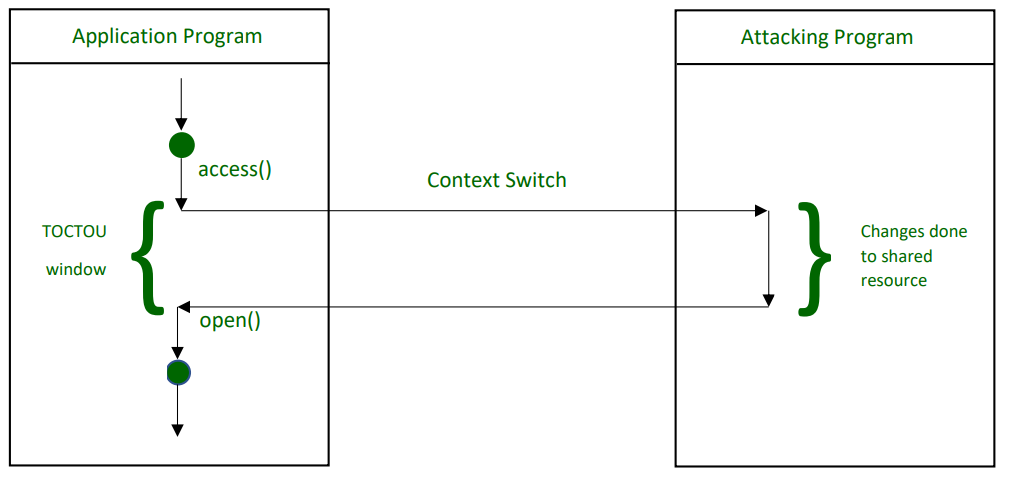
This timing gap allows an attacker to alter the resource after the check but before its actual use.
Limitations of Simple File Locking
Although file locking helps control concurrent access, it cannot completely eliminate TOCTOU vulnerabilities due to several practical limitations:
- Files cannot always be locked during the check-and-open phase.
- Advisory locks may be ignored by malicious processes.
- Locking mechanisms introduce performance overhead and may cause deadlocks.
- PID-based locking mechanisms can fail due to PID reuse.
Therefore, file locking alone is not sufficient to completely prevent TOCTOU-based race condition vulnerabilities.
Practical Solution: File Region Locking
A better approach is to lock only the required portion of a file instead of the entire file. In UNIX systems, this is commonly implemented using flock(). The flock() system call supports:
- LOCK_SH — Shared lock for reading.
- LOCK_EX — Exclusive lock for writing.
- LOCK_UN — Unlock the file.
Advantages of selective locking include:
- Multiple readers can access data simultaneously.
- Only one writer is allowed at a time.
- Read and write operations remain synchronized.
- Resource contention is reduced.
Consequences of Race Condition Vulnerabilities
Race condition vulnerabilities can cause incorrect behavior, system failures, and security issues.
- Data corruption and inconsistent program states due to concurrent modifications.
- Privilege escalation and unauthorized access through exploitation of timing windows.
- Application crashes, denial-of-service conditions, and resource exhaustion.
- Security breaches caused by manipulation of files, memory, or shared system resources.
Detecting Race Conditions
Race conditions can be identified using several techniques:
- Code reviews help identify unsafe access to shared resources and missing synchronization.
- Static analysis tools can detect potential concurrency and synchronization issues.
- Multithreaded testing helps expose timing-related bugs during concurrent execution.
- Logging and monitoring can reveal inconsistent execution patterns and resource access conflicts.
Race Condition vs Deadlock vs Thread Blocking
| Feature | Race Condition | Deadlock | Thread Blocking |
|---|---|---|---|
| Cause | Concurrent unsynchronized access | Circular waiting | Resource unavailable |
| Result | Incorrect output | Complete standstill | Temporary pause |
| Recoverable | Sometimes | Usually difficult | Yes |
| Primary issue | Timing dependency | Resource dependency | Resource availability |
