
Penetration testing or pen testing is a practice where a simulated cyber attack is conducted on your computer systems to find and fix any weak spots before real attackers can exploit them.
- It focuses on web application security by testing APIs and servers to identify vulnerabilities like code injection caused by unfiltered inputs.
- The results help adjust web application firewall (WAF) settings and fix any weaknesses found to boost overall security.
- Simulates real-world attacks to evaluate how well the system can defend against potential security threats and breaches.
Penetration Testing Stages
Penetration testing follows a structured process to identify vulnerabilities, validate security controls, and provide recommendations for improving security.
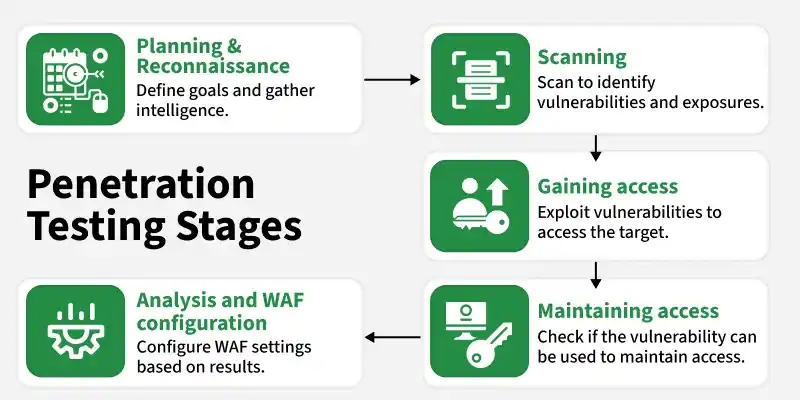
- Planning and Reconnaissance: In this stage, the scope and objectives of the test are defined. The tester collects information about the target system, such as domains, IPs, technologies, and possible entry points.
- Scanning: The target system is scanned to identify open ports, running services, and known vulnerabilities. This helps understand how the system behaves and where weaknesses may exist.
- Gaining Access: The tester attempts to exploit identified vulnerabilities to gain unauthorized access to the system. This shows how an attacker could reach sensitive data or critical functions.
- Maintaining Access: After gaining access, the tester checks whether access can be maintained over time. This helps assess the severity of the vulnerability and the risk of long-term compromise.
- Analysis and Reporting: All findings are documented in a report that includes vulnerabilities, their impact, supporting evidence, and recommended fixes. This helps the organization improve its security posture.
Penetration Testing Methods
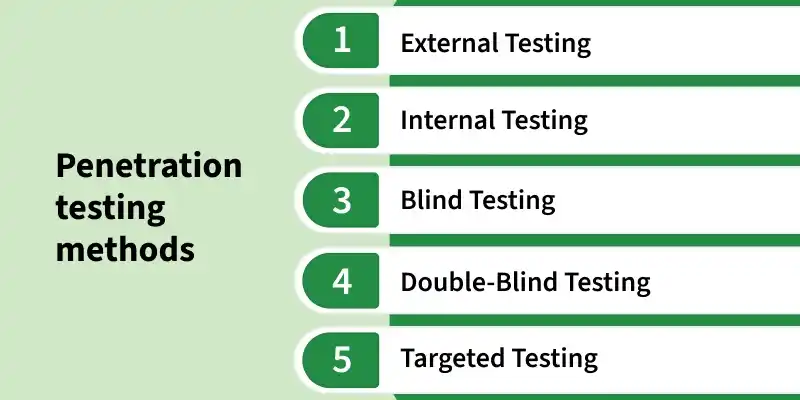
- External Testing: Targets internet-facing systems such as websites, servers, and DNS to find vulnerabilities that attackers could exploit from outside the organization.
- Internal Testing: Simulates attacks from within the organization’s network to test internal security controls and identify insider or compromised-account risks.
- Blind Testing: The tester has very limited information about the system, which helps simulate a realistic external attack and evaluate detection capabilities.
- Double-Blind Testing: Neither the tester nor the security team knows the full test details in advance, making it useful for assessing real-time response to unexpected attacks.
- Targeted Testing: The tester and security team work together during the assessment, allowing quick identification of vulnerabilities and better communication throughout the process.
Types of Penetration Testing
Here are the Types of Penetration Testing:
- Black Box Penetration Testing: In black box testing, the tester has no prior knowledge of the target system. It simulates a real-world external attack and helps identify vulnerabilities from an attacker’s perspective.
- Grey Box Penetration Testing: In grey box testing, the tester has partial knowledge of the system, such as limited access or network details. It allows more focused testing while combining both external and internal viewpoints.
- White Box Penetration Testing: In white box testing, the tester has complete knowledge of the system, including source code and architecture. It enables a deep security assessment and helps uncover hidden vulnerabilities and misconfigurations
Rules of the Penetration Testing Process
Penetration testing must be conducted safely, ethically, and within agreed boundaries to avoid legal, operational, or security issues.
- Obtain proper written authorization before starting the test
- Clearly define the scope, objectives, timeline, and allowed techniques
- Avoid disrupting systems or causing unnecessary downtime
- Maintain confidentiality of sensitive information discovered during testing
- Document findings responsibly and report vulnerabilities clearly
Penetration Testing Tools
Common tools used in penetration testing include:
- Nmap: It is a network exploration tool and security scanner. It can be used to identify hosts and services on a network, as well as security issues.
- Nessus: It is a vulnerability scanner. It can be used to find vulnerabilities in systems and applications.
- Wireshark: It is a packet analyzer. It can be used to capture and analyze network traffic.
- Burp Suite: It is a web application security testing tool. It can be used to find security issues in web applications.
Real-Life Example of Penetration Testing
Problem: An online shopping application has weak input validation, making it vulnerable to SQL injection and unauthorized access to customer data.
Solution: A penetration testing team identifies these security flaws, fixes the vulnerable inputs, improves authentication checks, and strengthens WAF rules to secure the application.
Common Vulnerabilities Found During Penetration Testing
Penetration testing often uncovers vulnerabilities that are also highlighted in the OWASP Top 10.
- SQL Injection: Attackers insert malicious SQL queries into input fields to access, modify, or delete database information.
- Cross-Site Scripting (XSS): Attackers inject malicious scripts into web pages, which execute in the browsers of other users.
- Broken Authentication: Weak authentication mechanisms may allow attackers to bypass login controls, steal credentials, or hijack user sessions.
- Security Misconfiguration: Improper system, server, or application settings can expose sensitive data and increase the risk of attack.
Tips to Follow and What to Avoid
Follow
- Test only with explicit permission and clearly defined Rules of Engagement
- Prefer a staging or controlled environment whenever possible
- Use both automated tools and manual testing for better coverage
- Prioritize high-impact vulnerabilities such as data exposure, privilege escalation, and remote code execution
- Document findings with evidence, impact, and remediation steps
Avoid
- Do not test production systems without prior approval
- Do not rely solely on automated tools, as they may miss business logic flaws
- Do not exceed the agreed testing scope
- Do not handle sensitive findings or captured data insecurely
- Do not make uncontrolled changes to the target environment
Advantages of the Penetration Testing
Penetration testing provides several benefits by helping organizations identify weaknesses and improve their overall security posture.
- Identifies vulnerabilities before attackers can exploit them
- Helps assess the real-world impact of security weaknesses
- Validates the effectiveness of existing security controls
- Supports risk prioritization and remediation planning
- Reduces the likelihood of data breaches and unauthorized access
- Improves overall security awareness and preparedness
Applications of Penetration Testing
Penetration testing is widely used across industries to strengthen system security, protect sensitive data, and prevent cyberattacks.
- Corporate networks are tested to identify weaknesses in firewalls, routers, and internal systems.
- Software development cycles use penetration testing to ensure new features do not introduce vulnerabilities.
- Cloud systems are tested to detect misconfigurations, weak access controls, and security gaps in virtual environments.
