I have shipped real services on all three this year. Here is what actually separates them once the marketing slides are put away.
Ask five Java developers which framework to pick in 2026 and you will get five confident, slightly different answers. That is not indecision, it is because the honest answer depends on what you are building. I have spent the last few months moving a handful of services between Spring Boot, Quarkus, and Micronaut, partly out of curiosity and partly because a client asked me to justify a stack choice with numbers instead of vibes. What follows is that justification, cleaned up and with the sales pitch removed.
Where each framework actually stands right now
Spring Boot 4.0 shipped in November 2025, and it is a genuine generational reset built on Spring Framework 7. It moves the whole ecosystem to a Jakarta EE 11 baseline, splits the old monolithic auto-configuration jars into smaller focused modules, and adds portfolio-wide null safety through JSpecify. Spring Boot 4.1 followed in June 2026 and, while smaller, it is the release worth landing on: it brings first-class gRPC support, lazy JDBC connections that only open when a transaction actually needs one, and a new SSRF protection bean for anything that fetches user-supplied URLs. If you are still on the 3.x line, that branch left open-source support at the end of June 2026, so the free security patches now only flow to 4.x.
Quarkus has kept moving on its own rhythm of frequent minor releases plus a long-term support line every six months, and by mid 2026 it sits well into its 3.3x series. Its whole design philosophy is doing work at build time instead of at startup: dependency injection wiring, configuration processing, and reflection metadata all get resolved before the application ever runs, which is exactly why it plays so well with GraalVM native images.
Micronaut 4 took the same build-time philosophy even further, using annotation processing at compile time so there is no reflection-based container spinning up behind the scenes. Worth knowing if you are choosing today: Micronaut 5 reached general availability in May 2026, so Micronaut 4 is no longer the newest line, even though it is still very much supported and what most production Micronaut apps are running right now.
The numbers that actually move the needle
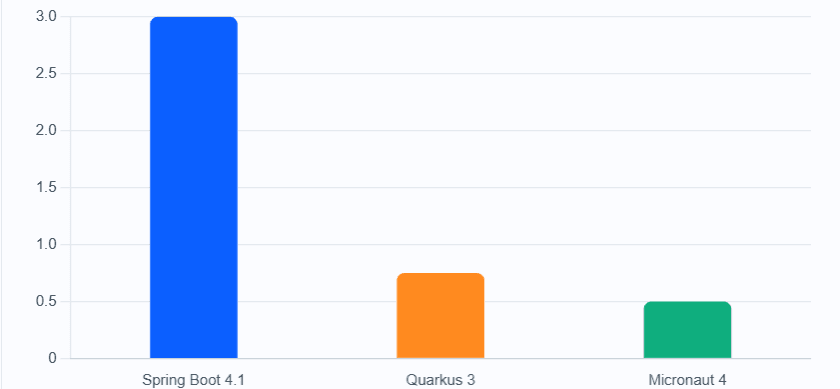
Startup time and memory footprint are where these frameworks genuinely diverge, and where I want to be careful, because published benchmarks on this topic disagree with each other more than you would expect. Test hardware, JDK version, and what counts as “hello world” all shift the outcome. Rather than pick the most dramatic number I found, I am showing typical ranges reported across multiple independent write-ups, so treat the bars below as a sense of scale rather than a lab certificate.
Typical JVM startup time (not native image)
Native image compilation is where the gap narrows the most, because build-time optimization is the whole point of Quarkus and Micronaut, while Spring Boot has been catching up to that world rather than starting there.
Native image startup time (milliseconds)
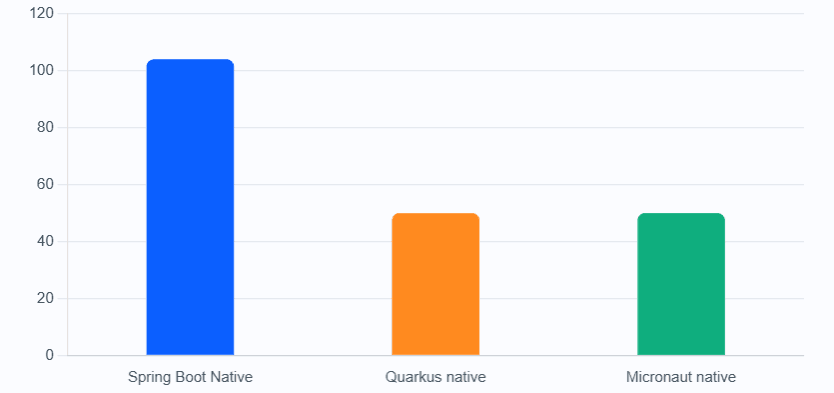
Memory tells a similar story and it matters more than startup time in most real deployments. If you are running twenty microservices on a shared cluster, the difference between a service that idles at 300 megabytes and one that idles at 80 adds up to actual node count, not just a benchmark bragging right. That said, if you are running three or four services with plenty of headroom, chasing that difference buys you very little in practice. Know which situation you are actually in before you let a memory chart decide your architecture.
Side by side, without the marketing language
| Spring Boot 4 | Quarkus 3 | Micronaut 4 | |
|---|---|---|---|
| Core philosophy | Convention over configuration, runtime flexibility | Build-time processing, container-first | Compile-time DI, minimal runtime overhead |
| Native image support | Yes, via GraalVM, added on top | Yes, native from day one | Yes, native from day one |
| Ecosystem size | Largest by a wide margin | Growing fast, strong Kubernetes tooling | Smaller, focused on microservices and serverless |
| Best fit | Long-running services, teams that want the biggest talent pool | Kubernetes-native workloads, containers with tight limits | Serverless functions, edge, memory-constrained environments |
A pattern worth noticing: almost every serious comparison I read this year lands on the same conclusion. Use Spring Boot unless you have a specific, measurable reason not to. The ecosystem and hiring pool advantages are real, and the performance gap has narrowed enough that it no longer decides the question on its own for most teams.
So which one should you actually pick
If your team already knows Spring and you are building a normal business application with a normal deployment footprint, Spring Boot 4.1 is the sane default. The gRPC and lazy connection additions alone make it a better citizen than the 3.x line was, and you get the biggest talent pool to hire from when the project grows.
If you are deploying to Kubernetes with tight resource requests and limits, or you are paying per invocation on something like AWS Lambda, Quarkus earns its reputation. The build-time optimization is not a party trick, it is the reason your pods start fast enough that autoscaling actually feels responsive instead of laggy.
Micronaut earns its place at the edges of the map, literally. Serverless functions, IoT gateways, anything where a few extra megabytes of baseline memory gets multiplied across thousands of instances. It is a smaller community than the other two, so weigh that against how specialized your deployment target really is.
If you are staying on Spring Boot, here is the migration reality
Deciding to stick with Spring Boot is the easy part. Actually moving from 3.x to 4.x is where teams underestimate the work, because this is not a routine minor bump. Spring Boot 4 sits on Spring Framework 7, which means the jump touches Hibernate, Jackson, and Tomcat versions underneath you, plus any internal library that leaned on Spring’s old internal APIs instead of its public ones. If your codebase or a dependency you rely on ever reached into package internals, expect to feel that during the upgrade.
The move to Jakarta EE 11 is the other big one. Anything still quietly holding onto a javax.* import somewhere, a forgotten servlet filter, an old validation annotation, will surface now rather than later. Spring Boot 4.0 also split its once-monolithic auto-configuration jars into smaller, more focused modules, which is good for your final artifact size but means a dependency tree audit is worth doing before you flip the switch, not after.
My honest advice here, having done this migration twice this year: skip 4.0 entirely if you are starting the move today. It loses open-source support in December 2026, so any team beginning fresh should land directly on 4.1 and save themselves a second migration a few months later. Read the official migration guide before you touch a single dependency line, run your full test suite against a feature branch first, and budget real calendar time for it. This is closer in spirit to the 2.x to 3.x jump than to an ordinary minor version bump.
What we have learned
Spring Boot 4.1, Quarkus 3, and Micronaut 4 have all closed the gap with each other more than the loudest benchmarks suggest, and the real decision usually comes down to where you deploy rather than which framework feels the fastest on a laptop. Spring Boot still wins on ecosystem and hiring, Quarkus wins when Kubernetes resource limits are a hard requirement, and Micronaut wins at the extreme end of memory-constrained, serverless, or edge deployments. Worth remembering too: Micronaut 5 already reached general availability in May 2026, so anyone evaluating fresh today should at least glance at where that line has moved.
Sources
- Spring.io, Spring Boot 4.0.0 available now
- InfoQ, Spring Boot 4.1 Adds gRPC Auto-Configuration, SSRF Mitigation
- Dan Vega, Spring Boot 4: Everything You Need to Know
- Katyella, Spring Boot vs Quarkus vs Micronaut in 2026: An Honest Comparison
- Java Code Geeks, Spring Boot vs Quarkus vs Micronaut: The Ultimate 2026 Showdown
- Micronaut Framework, Micronaut Framework 5.0.0 Released
- endoflife.date, Quarkus release and support schedule