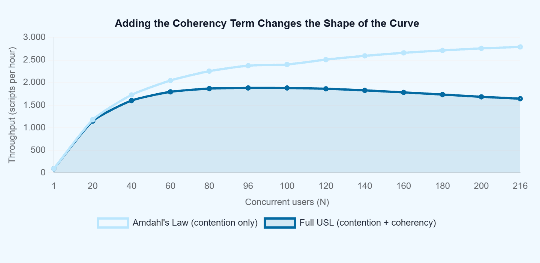
Neil Gunther’s Universal Scalability Law adds a second penalty term to Amdahl’s Law, and that one term explains a failure mode Amdahl’s original model cannot: throughput that goes down as you add more concurrency, not just up more slowly.
Amdahl’s Law tells you that speedup plateaus once the serial fraction of a workload takes over. It is a clean, useful ceiling, and a previous piece in this series walked through exactly how that ceiling is derived. What Amdahl’s Law does not explain is something every performance engineer has actually seen in production: a system that gets slower, not just flatter, once you push concurrency past a certain point. That behavior needs a second term, and Neil Gunther supplied it in what he named the Universal Scalability Law.
One Term Was Missing
Amdahl’s Law models a single cost: contention, the fraction of work that cannot run in parallel because it is waiting for a shared, serialized resource. As concurrency N grows, contention cost grows linearly with N, and throughput approaches a fixed ceiling. That is a reasonable model of a queue at a checkout counter. It is not a complete model of a distributed system where every worker occasionally needs to reach an agreement with every other worker.
Gunther’s insight was that many real systems pay a second, worse-scaling cost: coherency, the overhead of keeping shared, mutable state consistent across a growing number of participants. Cache coherency protocols, distributed locks, consensus rounds, and cross-node synchronization all share a property that plain contention does not: the amount of coordination work tends to grow with the number of pairs of workers that might need to agree, which grows proportionally to N squared. The Universal Scalability Law folds that quadratic term directly into Amdahl’s formula.
The Formula Itself
The Universal Scalability Law expresses relative capacity C at concurrency N as:
C(N) = N / (1 + σ(N − 1) + κN(N − 1))
Here σ is the contention coefficient, playing exactly the role Amdahl’s serial fraction plays. The new term, κ, is the coherency delay coefficient. Setting κ to zero collapses the formula back to Amdahl’s Law exactly, which is why Gunther’s model is usually described as a generalization rather than a replacement. With κ greater than zero, the denominator eventually grows faster than the numerator as N increases, which means C(N) does not just flatten, it turns over and declines. That decline is what practitioners call retrograde scalability, and it is the phenomenon Amdahl’s original model has no way to produce.
Because the quadratic term dominates for large N, the formula also predicts exactly where throughput peaks. Differentiating C(N) and solving for the maximum gives an optimal concurrency of N* equal to the square root of (1 minus σ) divided by κ. Past that point, adding more concurrency actively makes the system slower, not merely a less efficient use of extra resources.
A Real Benchmark, Not a Toy Example
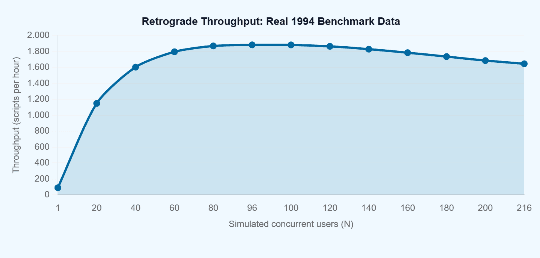
The clearest way to see this is with actual measured data rather than a hypothetical curve. The usl R package, built specifically to fit Gunther’s model to performance data, ships a demonstration dataset from a real 1994 benchmark: a 16-CPU Sun SPARCcenter 2000 running the SPEC SDM91 benchmark, measuring script executions per hour against simulated user load from 1 to 216.
Fitting the Universal Scalability Law to that dataset produces a contention coefficient of roughly 0.0277 and a coherency coefficient of roughly 0.0001. Small as that coherency number looks, it is enough to completely change the shape of the curve once load climbs into the high double digits.
| Metric | Value |
|---|---|
| Contention coefficient (σ) | 0.0277 |
| Coherency coefficient (κ) | 0.0001 |
| Peak throughput | ~1,884 scripts/hour at ~97 users |
| “Amdahl-only” ceiling if κ were 0 | ~3,246 scripts/hour, never reached |
| Throughput at maximum tested load (216 users) | ~1,646 scripts/hour, below the peak |
The last row is the part that matters operationally. Pushing this particular system from its optimal load of roughly 97 concurrent users out to 216 does not just fail to help, it actively costs throughput. An engineer relying only on Amdahl’s Law would expect the curve to keep climbing toward that 3,246 ceiling and would have no model-based reason to expect the drop that the real hardware actually produced.
What tends to show up as a large κ in practice:
- Cache coherency traffic across many CPU sockets or NUMA nodes
- Distributed locks or leader-election protocols that require broadcast-style coordination
- Consensus rounds, such as quorum reads and writes, that scale with cluster size
- Shared mutable state replicated across many application server instances
Why This Matters for Capacity Planning
Gunther’s own use for the law was capacity planning: given a handful of load test measurements, fit σ and κ, then use the fitted curve to answer “how many servers, threads, or users before adding more starts to hurt.” That is a fundamentally different question than the one Amdahl’s Law answers, which is closer to “how good can this ever get.” A team that only asks the Amdahl question can be blindsided by a system that has already passed its peak, because a plateau and a peak look identical from below and only differ once you have already gone past the top.
The practical guidance that follows is correspondingly different too. Under Amdahl’s Law, the only lever is reducing the serial fraction. Under the Universal Scalability Law, there are two independent levers, and they call for different fixes. A high σ points toward contention on a shared resource, addressed by sharding, queueing, or reducing lock scope. A high κ points toward coordination overhead that grows with cluster size, addressed by reducing cross-node chatter, batching synchronization, or partitioning state so fewer nodes need to agree on anything at all.
What We Have Learned
The Universal Scalability Law keeps everything useful about Amdahl’s Law and adds exactly the term Amdahl’s Law was missing: a quadratic coherency cost that models the price of keeping many concurrent workers in agreement. Because that cost grows faster than the linear speedup concurrency provides, real systems with non-trivial coordination overhead do not merely plateau, they can turn over and get measurably slower past an identifiable point, a point the formula lets you calculate rather than discover the hard way in production. The 1994 Sun SPARCcenter 2000 benchmark above is not a special case; it is an early, well-documented instance of a pattern that shows up constantly in distributed databases, multi-socket servers, and any system where more workers eventually means more talking to each other than working.