Every team has seen it. You draw a clean architecture on a whiteboard, and six months later the services line up with the org chart instead. This is not bad luck. It is one of the oldest observations in software engineering, and it has real evidence behind it.
What Conway Actually Said
In April 1968, Melvin Conway published How Do Committees Invent? in Datamation. His claim was simple: organizations that design systems end up producing designs that copy their own communication structures. Fred Brooks later popularized the idea under the name “Conway’s Law” in The Mythical Man-Month, according to a Thoughtworks podcast on the topic.
The reasoning is practical rather than mystical. Two components can only work together if their designers first agreed on an interface. Therefore, a working dependency is evidence that two groups talked. Conversely, groups that never talk rarely produce components that fit. The org chart quietly decides where the seams go.
How the Org Chart Turns Into Services
In a typical company, nobody decides to mirror the structure. It simply happens through small, sensible choices. A team owns a database, so its data stays private. A team has its own release train, so it ships its own deployable. Meanwhile, a hand-off between two teams becomes an API, because an API is the cheapest way to avoid a meeting.
| Org shape | Typical boundary | Typical symptom |
|---|---|---|
| Frontend, backend and database teams | Layers: UI, API, data | One feature touches three teams and three backlogs |
| Teams per business capability | Services per capability | Shared concepts such as “customer” get duplicated |
| Outsourced module | Hard, formal interface | Slow change, heavy contract documents |
| One overloaded “platform” team | One large shared core | Everyone waits on the same queue |
These rows are illustrative patterns from common experience, not results from the study discussed below.
What the Evidence Shows
Is this just folklore? Fortunately, researchers have tested it. Lyra Colfer and Carliss Baldwin reviewed 142 empirical studies of what they call the mirroring hypothesis, the general form of Conway’s idea. Their paper, The Mirroring Hypothesis: Theory, Evidence, and Exceptions, appeared in Industrial and Corporate Change in 2016.
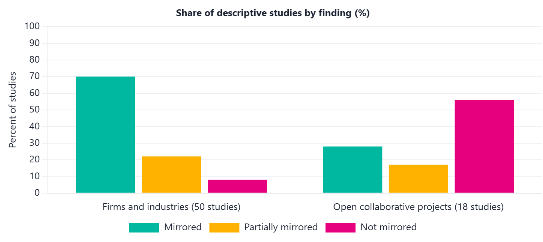
Inside firms, the law holds up well. About 70 percent of the descriptive studies on firms and industries showed clear mirroring, and only 8 percent showed none. However, open collaborative projects, mostly open-source software, told the opposite story. There, 56 percent of studies did not support mirroring.
| Setting (descriptive studies) | Fully mirrored | Studies |
|---|---|---|
| Industry structure | 7 of 7 | 7 |
| Within one firm | 12 of 16 (75%) | 16 |
| Buyer and supplier | 13 of 17 (76%) | 17 |
| Management of knowledge | 2 of 6 (33%) | 6 |
| Alliances and consortia | 1 of 4 (25%) | 4 |
| Open collaborative projects | 5 of 18 (28%) | 18 |
Data: Tables 4 and 6 of Colfer and Baldwin (2016). Small groups, so read the fractions with care.
Why Open Source Breaks the Pattern
The authors argue that digital tools changed the economics. Contributors can read the whole codebase, make small changes, and see what happens, so they coordinate through the artifact instead of through meetings. They call this stigmergic coordination. As a result, a project can stay modular without a team boundary behind every module.
Mirroring Is Not Always Good News
Next, consider whether mirroring actually pays off. The same review looked at 64 normative studies of firms, which ask how mirrored and unmirrored organizations performed.
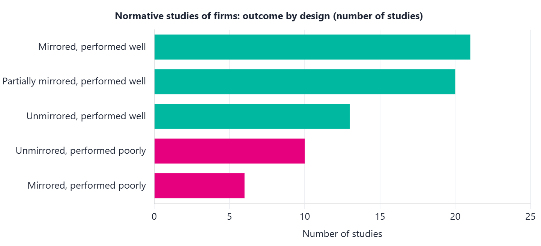
Two lessons stand out. First, the worst failures came from premature modularization. Companies split work into modules before they understood the hidden dependencies, so the organization no longer matched the real system. The authors describe Ford’s fast outsourcing of modules, which failed, against Hyundai’s slower approach, which appeared to be working. Second, strict mirroring can become a trap. Firms that organize tightly around today’s architecture may miss architectural change that arrives from outside. The authors recommend partial mirroring, where people know more than their narrow task requires.
Using the Law on Purpose
If the structure of your teams shapes your system, then you can design the teams deliberately. This is the Inverse Conway Maneuver. Thoughtworks put it in the Technology Radar in July 2014 at the Trial ring. The idea is to evolve the team structure so that it promotes the architecture you want. Jonny LeRoy and Matt Simons described it in 2010, according to t2informatik.
Still, it is not a magic wand. Mathias Verraes argues that a reorganization cannot repair a rigid, badly designed system. His suggestion is practical: reorganize when the system is new or flexible, and invest in design work when it is rigid.
Checklist: before you redraw the boxes
- Map where your services actually depend on each other, not where the diagram says.
- Compare that map with who talks to whom. The gaps show your friction.
- Give each team a whole business capability, including its data.
- Change the org structure only if the system is flexible enough to follow.
- Keep some cross-team knowledge, so teams can see change coming.
What We Have Learned
Conway’s Law says that a system copies the communication structure of the group that builds it, and the research largely agrees. In a review of 142 studies, about 70 percent of descriptive studies of firms and industries showed clear mirroring, while open-source projects often did not. Mirroring is efficient but can become a trap, and splitting work before you understand the dependencies caused the worst failures. Therefore, treat team design as architecture design: map real dependencies, align ownership with business capabilities, keep some shared knowledge, and do not expect a reorganization to fix a rigid system.