
Spacewar!
-
 Spacewar!
(2021 on
TRS-80 CoCo)
Description
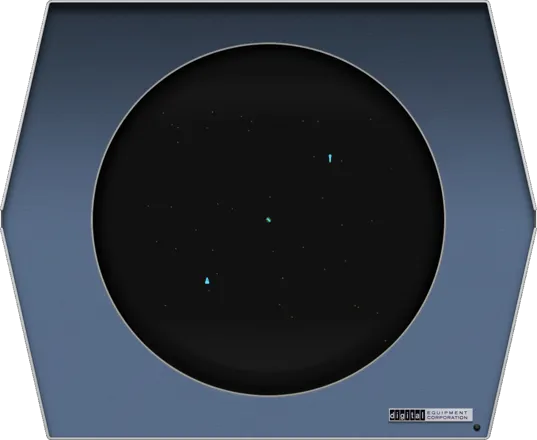
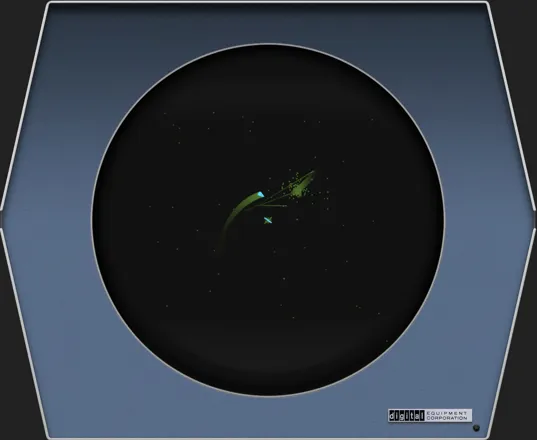
Spacewar! is a two-player space-combat game developed for the DEC PDP-1 computer. Each player controls one of two differently shaped spacecraft, known as the Needle and the Wedge, and attempts to destroy the opposing ship with torpedoes.
The ships can rotate in either direction, accelerate with their thrusters, fire torpedoes, and enter hyperspace. They retain their momentum when thrust is released, while a star at the center of the screen continuously pulls both ships toward it. Players can use the star’s gravity to curve their trajectories or accelerate around it, but colliding with the star destroys the ship. Ships and torpedoes that leave one edge of the screen reappear from the opposite side.
Each spacecraft has a limited supply of fuel and torpedoes. A ship may be destroyed by enemy fire, a collision with the opposing vessel, or contact with the central star. Hyperspace provides a possible escape by making the ship disappear and reappear at a random location, although repeated use carries an increasing risk of the ship being destroyed instead.
The game was initially controlled through switches on the PDP-1 console. Dedicated control boxes were later constructed to give each player easier access to rotation, thrust, firing, and hyperspace controls.
Early versions used a randomly generated field of background stars. This was later replaced by Peter Samson’s Expensive Planetarium, which displayed stars based on astronomical charts and represented their relative brightness.
Groups +
Screenshots
Credits (Mainframe version)
5 People
| Programmed by | |
| Additional programming by | |
| Collaborators |
Collaborations
People credited on this game were also credited on:
- Computer Space, a group of 3 people
- Galaxy Game, a group of 3 people
Other Games
In addition to this game, these people were also credited on other games:
- Steve Russell on 3 other games
- Martin Graetz on 2 other games
- Wayne Wiitanen on 2 other games
Reviews
Players
Average score: 3.1 out of 5 (based on 13 ratings with 1 reviews)
The first true computer game; evergreen
The Good
I'm currently on a journey of reading about and, wherever possible, playing through the early history of computer games. Spacewar! is the earliest title where I feel there's enough to write about. In my opinion, it's the earliest game that is fascinating not only because of its technical novelty, but also its merit as a creative work. It may be the first game that truly demonstrated how computer games opened up the door to a new form of entertainment, which can't be duplicated by any other medium.
The Bad
Frankly, I don't think there's anything that it'd be fair to dislike in the game. Could it be improved? Yes, of course – and it was, through different expanded versions on other CRT-equipped minicomputers. But given that it taxed the original platform to the very last cycle and word of memory, to result in an almost unfathomably advanced game for its time, this was pretty much as good as it would be possible to get.
The Bottom Line
Spacewar! was so far ahead of its time that in retrospect, it almost feels like an anachronism. Of course, the first thing to catch your eye is the fast, real-time on-screen action. Animated dots representing tennis balls had been seen before, but here, players get to see two detailed spaceships, flickering thrust flames, a blazing star, flying torpedoes, and an astronomically correct star field background. Input is translated quickly into fluent on-screen movement. What the hackers wrangled out of the DEC PDP-1, with memory for 4,000 words, in around 1,000 lines of code, is impressive in every way. Conceived from the beginning as a demonstration to tax the full technical capabilities of the DEC PDP-1, Spacewar! uses its entire available memory and pushes the limits of its computational performance to the point where it's just barely able to still update its point-addressable CRT monitor at a flicker-free rate.
But just as important is the fact that the game's designers placed as much importance on the demo offering a recognizable scenario, and being continually fascinating to its audience. Inspired by pulp science-fiction novels and cheaply produced, special-effects-focused action films from Japan, they designed and implemented the first real-time space combat game. I'd consider it the earliest game that creates a palpable sense of place, communicated visually rather than through words.
And in terms of game mechanics, they play-tested and tweaked the game's parameters until they reached a balance that would allow for thrilling duels, while also giving amateurs a chance at a few lucky shots. The balancing of the game is exceptional. In a way, it's probably the first game that even needed "balancing" in the modern game design sense, and it nails it. The gravitational field of the central star heightens the action by making it more difficult to use lazy strategies, while allowing experienced players to perform advanced maneuvers. The hyperspace feature offers an escape out of high-risk situations, but its usefulness is balanced out by its unreliability. With details like this, the game creates a motivating combination of reflex-based action gameplay and tactical possibilities.
All of these factors turn Spacewar! into a kind of game that probably couldn't have been more fascinating and compelling at its time. Because it's not only technically impressive, but also offers an elaborate scenario and game principle, it sticks out among the mass of experiments, demonstrations and spare-time projects of early computer game history. Its popularity in the 60s, and its later spread among the computer community, are undeniable proof of that, as is the fact of how much historical importance is still ascribed to it.
And: it's still a lot of fun to play today. Few games can claim that so unconditionally after more than half a century.
Mainframe · by Daniel Saner (3583) · 2021
Trivia
Awards
- The Strong National Museum of Play
- 2018 – Introduced into the World Video Game Hall of Fame
Analytics
Related Games
Released 1979 on TRS-80

Released 1976 on Altair 8800, Intel 8080, Zilog Z80
Released 1969 on Terminal

Released 1985 on DOS
Released 1980 on Mainframe

Released 2025 on Windows, Linux
Released 1979 on Dedicated console

Released 2002 on Windows
Related Sites +
-
Lyle Bickley explains the PDP-1 (and we play the original Spacewar!)
Video (starting at 13:17) demonstrating "Spacewar!" on original hardware. Note the phosphorescent afterglow as pixels move about on the radar screen ("P7 phosphor").
Identifiers +
Contribute
Are you familiar with this game? Help document and preserve this entry in video game history! If your contribution is approved, you will earn points and be credited as a contributor.
Contributors to this Entry
Game added by vedder.
Additional contributors: lilliputian, SoMuchChaotix.
Game added June 1, 2017. Last modified August 12, 2026.
