

Taiwanese prosecutors suspect that three people successfully smuggled at least one shipment of Nvidia Corp artificial intelligence (AI) chips to China after first exporting them to Japan, people familiar with the matter said.
The trio was detained last week by the Keelung District Prosecutors’ Office for allegedly falsifying documents related to exports of Super Micro Computer Inc servers containing advanced Nvidia chips, which the US has barred from sale to China without a license from Washington.
The move marked Taiwan’s first public crackdown on AI chip diversion after years of pressure from the US to take a more active role in curtailing China’s tech access.
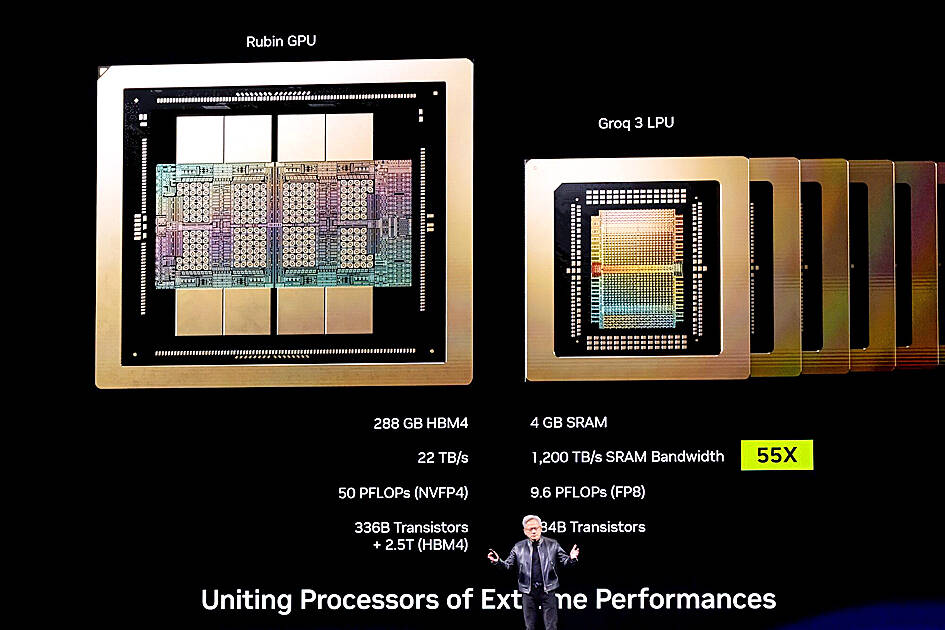
Photo: David Paul Morris, Bloomberg
When Taiwanese authorities apprehended the three defendants — who have now been officially detained — they also seized about 50 servers for which they accuse the trio of preparing fraudulent export documents.
However, at least one shipment had already gone through Taiwan customs, said people familiar with the matter, who requested anonymity as they were speaking about an ongoing criminal investigation.
That earlier shipment went to Japan before eventually making it to Hong Kong, a known waypoint for hardware that is ultimately shipped to China, the people said.
They declined to specify the amount of hardware that Taiwan authorities believe was successfully smuggled.
The defendants also allegedly planned to use Japan as an intermediary location for the batch of servers that Taiwan officials seized last week, the people said.
The probe might be the first known instance of prosecutors targeting an AI-chip smuggling route through Japan, a close ally of the US and cornerstone of US defense strategy in the Asia-Pacific. Other cases have focused on diversion via Southeast Asia, including the biggest such indictment in the US.
Japan is one of many locations in Asia where Chinese companies access US AI chips — by renting hardware that is owned by foreign firms and installed in overseas data centers. That setup is generally permitted under US export control rules, which were first imposed in 2022 over concerns that advanced AI could lend Beijing a military edge.
However, many in Washington have long been convinced that Chinese firms have also managed to procure smuggled hardware within their home country, and after years of relative quiet on the chip export control enforcement front, US prosecutors are now pursuing at least five criminal cases related to semiconductor diversion.
That is on top of chip export fraud cases in Taiwan and Singapore, which do not have their own semiconductor export controls and instead rely on local laws to address the issue.
Taiwan authorities have not accused Nvidia or Super Micro of any wrongdoing.
Nvidia did not respond to a request for comment for this story, while Super Micro declined to comment.
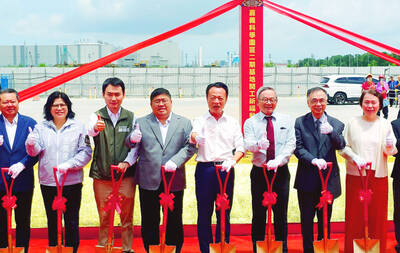
TECH CORRIDOR: The new Phase II site is expected to work with other facilities in the region and nation as TSMC looks to shape the future with its manufacturing Taiwan Semiconductor Manufacturing Co (TSMC, 台積電) would build three additional advanced packaging facilities in Phase II of the Chiayi Science Park (嘉義科學園區), National Science and Technology Council (NSTC) Minister Wu Cheng-wen (吳誠文) said yesterday. Speaking at the groundbreaking ceremony for the Phase II, Wu said the roughly 90-hectare site would be developed into an advanced packaging industry cluster led by TSMC. Two advanced packaging facilities at Phase I began mass production last month. Wu said that the Phase II development of the Chiayi Science Park would strengthen the resilience of the regional economy and help transform Chiayi County into a global production

Chinese authorities have held meetings with top tech firms over the past month about potentially restricting overseas access to China’s most advanced AI models, including those yet to be released, three people familiar with the discussions said. The talks follow a number of steps by Beijing to keep homegrown AI technology in the country and underscore how China, like the US, is now treating cutting-edge artificial intelligence as a critical national asset that needs controls. Companies present at the talks included tech giants Alibaba Group Holding Ltd (阿里巴巴) and ByteDance Ltd (字節跳動), as well as start-up Z.ai, formerly known as Zhipu AI
MOMENTUM: Second-quarter revenue reached NT$1.27 trillion as the June turnover surged, while TSMC’s 2nm process spending and US expansion remain focus points Taiwan Semiconductor Manufacturing Co (TSMC, 台積電) yesterday reported its highest quarterly sales amid strong global demand for artificial intelligence (AI) applications. The world’s largest contract chipmaker posted NT$1.27 trillion (US$39.5 billion) in consolidated revenue for the second quarter of this year, up 36 percent year-on-year and nearly 12 percent from a quarter earlier. The quarterly figure was bolstered by a very strong performance last month, when TSMC’s revenue was up 67.9 percent from a year earlier and rose 6.2 percent from a month earlier to NT$442.68 billion, a new monthly high, TSMC said in a statement. At its earnings conference in April, TSMC

People buy mangoes at a wholesale market in Tainan’s Yujing District yesterday after Typhoon Bavi moved away from Taiwan. With the Irwin mango harvest season nearing its end, reduced output and strong demand has led the average mango price to climb to NT$67.4 per kg from about NT$35 at the beginning of this month, the Tainan Agriculture Bureau said.


 RSS
RSS