


Summary
- Holiday PC shipments increased 10% to 76.4 million as buyers delve into their stock as memory price hikes continue.
- Memory shortages and tariffs will reportedly push makers to trim RAM specs and favor mid/high-end models in 2026.
- Fewer total units are expected in 2026, alongside higher average PC prices.
The PC market has been all doom and gloom lately, especially during CES 2026. Like always, new laptops and PCs were revealed at the annual conference, including Lenovo's wild gaming concept that features a rollable display, but a lot of manufacturers remained uncharacteristically quiet about pricing.
Given the memory shortage is affecting more than just DRAM prices now and the ongoing tariff situation in the US, laptop makers are not totally sure how much they'll need to charge for their latest models. That said, at least as far as this past holiday quarter is concerned, the PC market remains unaffected by the rampocalypse, with a recent International Data Corporation (IDC) study noting that shipments grew nearly 10% year-over-year to 76.4 million overall.
To some extent, this isn't surprising given Microsoft recently ended support for Windows 10, pushing forward a renewed upgrade cycle. On top of this, the IDC says that PC manufacturers are digging deep into their inventory to circumvent both tariffs and the ongoing worldwide memory shortage.
This upward trend isn't likely to continue into 2026
PC makers are expected to focus on mid-range and high-end devices this year
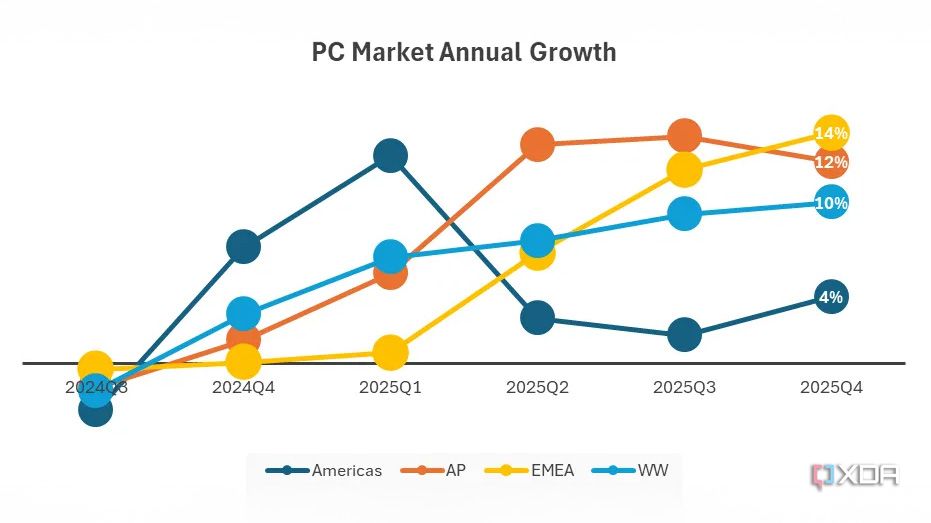 "While the holiday season typically drives stronger demand, the surge in late 2025 was further amplified by emerging memory shortages that led buyers and brands to secure inventory ahead of anticipated price increases in 2026," writes the International Data Corporation (IDC).
In the IDC's report, Jean Philippe Bouchard, the research vice-president with IDC’s Worldwide Mobile Device Trackers, outlines that the research firm expects the PC market to be very different in 12 months given "how quickly the memory situation is evolving."
"Beyond the obvious pressure on prices of systems, already announced by certain manufacturers, we might also see PC memory specifications be lowered on average to preserve memory inventory on hand. The year ahead is shaping up to be extremely volatile," writes Bouchard.
Total unit shipments will experience a downturn, but the overall market value will increase as supply chains adjust their pricing to net more revenue.
The report goes on to state that the IDC expects the average price of PCs to increase in 2026 as manufacturers shift to more mid-range and high-end devices to offset the higher cost of memory. Total unit shipments will experience a downturn, but the overall market value will increase as supply chains adjust their pricing to net more revenue.
A previous IDC report stated that the current state of the market "signals the end of an era of cheap, abundant memory and storage." Over the past several months, the price of DRAM has grown significantly, with the industry's biggest manufacturers, including Samsung, SK Hynix, Micron, and more, allocating the bulk of their resources to AI tech giants (Micron even left the consumer memory industry entirely).
While the impact of the RAM crisis hit the PC gaming space first, there are now ripple effects tied to other hardware components, including GPUs, with reports stating that Nvidia is lowering GPU production by up to 40% in 2026, and that even legacy components like HDDs are increasing in cost.
