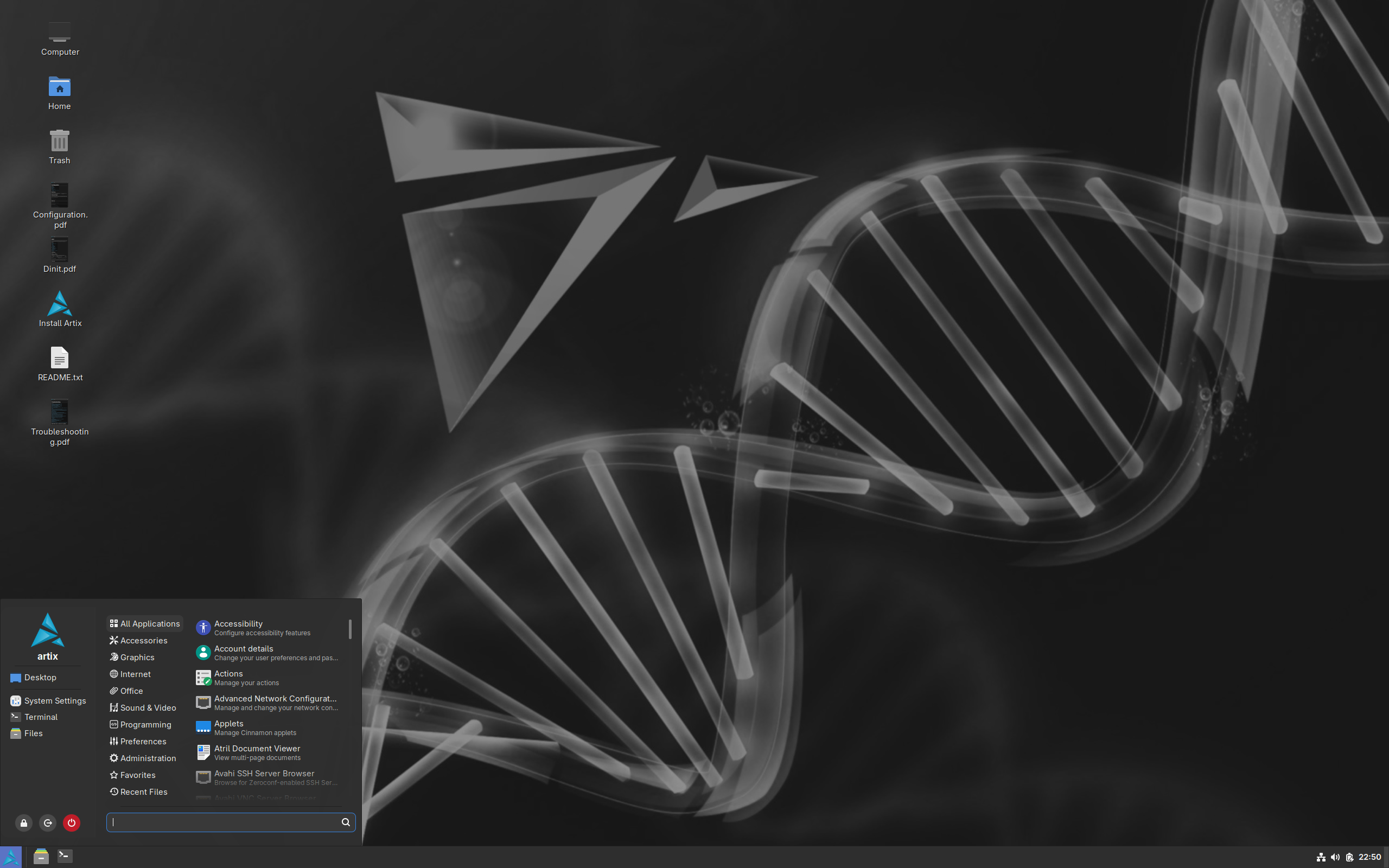
Artix Linux is a fork (or continuation as an autonomous project) of the Arch-OpenRC and Manjaro-OpenRC projects. Artix Linux offers a lightweight, rolling-release operating system featuring the OpenRC init software. (Alternative spins feature the runit and s6 init software.) Several editions of Artix Linux are available, featuring either a plain command line or one of several desktop environments.
To compare the software in this project to the software available in other distributions, please see our Compare Packages page.
Notes: In case where multiple versions of a package are shipped with a distribution, only the default version appears in the table. For indication about the GNOME version, please check the "nautilus" and "gnome-shell" packages. The Apache web server is listed as "httpd" and the Linux kernel is listed as "linux". The KDE desktop is represented by the "plasma-desktop" package and the Xfce desktop by the "xfdesktop" package.
Colour scheme:green text = latest stable version, red text = development or beta version. The function determining beta versions is not 100% reliable due to a wide variety of versioning schemes.
TUXEDO
TUXEDO Computers - Linux Hardware in a tailor made suite Choose from a wide range of laptops and PCs in various sizes and shapes at TUXEDOComputers.com. Every machine comes pre-installed and ready-to-run with Linux. Full 24 months of warranty and lifetime support included!
Learn more about our full service package and all benefits from buying at TUXEDO.
NovaCustom
NovaCustom PrivacyGuard Laptops - Escape from Big Tech
The NovaCustom PrivacyGuard Laptop is ideal for anyone who prioritizes privacy. Comes with Dasharo coreboot open source firmware and Zorin OS Pro, free from influence of Big Tech.
Star Labs
Star Labs - Laptops built for Linux.
View our range including the highly anticipated StarFighter. Available with coreboot open-source firmware and a choice of Ubuntu, elementary, Manjaro and more. Visit Star Labs for information, to buy and get support.
This is the Arch derivative that stands out the most. While most other Arch-based distros just slap up an installer and a fancy wallpaper, Artix is an actual fork officially supporting 4 init systems (openrc, dinit, runit and s6). This is no small feat, if you take into account the extent systemd has spread to the Linux userspace.
I'm daily driving the openrc init, which was the first one supported at Artix's inception and I haven't yet needed a daemon service that hasn't got official support. Boot times are really fast, already faster than systemd's, and I've got an additional PC with dinit which is absurdly faster than openrc. People coming from systemd are advised to choose dinit which has the same command syntax as systemd (systemctl -> dinitctl) and similar declarative service files. Both openrc and dinit support user services natively, while for runit and s6 Artix offers a 3rd-party solution.
For new installations my ISO of choice is the community QT edition, which offers pretty much anything an average computer user needs and perhaps remove a few apps I never personally use. The community editions have graphical package management front-ends, so users who don't like terminals won't have to use one. After installation it's even preconfigured with the plymouth splash screen and a very tasteful dark theme applied to both QT and GTK applications. The Arch repositories are enabled by default in this one, so you won't miss much but if you do, the AUR is there for you. I should mention that Artix has a repository for user-submitted service scripts (called AURIS, heh), where said scripts are tested and curated and eventually moved to the official repos. Artix offers several desktop editions in their download page, base editions for purists (yes, console only) and recently they introduced a gaming ISO, currently marked as alpha but I didn't notice any issues with it. Think community QT with Plasma, with the addition of several game launchers, gaming tools and utilities and numerous performance settings applied.
The community is very vibrant and helpful; this is an important factor to take into account when choosing a Linux distribution, especially non-corporate backed ones. I only needed help once and I had it within the day I posted my question on the forum. All in all, a great choice for a wide range of users, from relatively noobs to experts, but it should be noted that rolling-release distros are generally considered less user-friendly. However, I never felt intimidated by Artix and their wiki is an excellent complement to the Arch one, covering topics specific to Artix.
I wanted to try a nonsystemd based arch and see the differences.
-First Install on rather exotic 2-in-1 device with multigrub failed. Then one on an thinkpad barebone, complete disk erase- that went very smooth with ARCH/XFCE/Dinit, positively surprised, even Calamaris was used properly.
-First I am impressed, how many different init systems are supported, how many apps and systems where wired to this other init systems, impressive!
-A small set of software with UI preinstalled but too few about system parts for my taste, but that's typical for many ARCH distros. Installed then Pamac for a visual software package management.
-Some apps from the AUR repo will not work due their systemd relationship- so the Artix repo should have priority always, as it can cause funky errors.
-I found a small, but relevant set of apps on the artix repo, but was missing often the dependencies.
-I came in a bad moment a main maintainer just had left, and VM stuff failed with dependency problems. This can happen, and it then all relies how good a "community" can compensate. Didn't go well in my case. I got a couple of random ideas in the artix forum, but I finally found the root cause with some certainity. But then no one could tell me, where bugs are logged, and the repo from the former maintainer is a closed club, also no other options in the forum mentioned where/how bugs find their way to resolution. With this, it's not possible to maintain such a variety of init systems for very long, this distro has a real problem.
- I can recommend this distro only for real linux experts with deep CLI knowhow and absolute no need for help.
As a long-time Linux user, I love using Artix Linux because of the simple init structure. Now it isn't like the 90ies with SysV but in fact it's better—it gets out of your way. Besides that, it respects my freedom more than any other OS that would force me into Wayland. Now I do use Wayland but only because it's my choice to do so.
The only small downside is that if you browse the website, the cringey neckbeard energy is a litle much. But that said, they are my neckboards and I love their style.
Artix is a OS that protests systemd. It forked Arch Linux to run runit as init system. It was the rule to do 1 thing simple before systemd changed it. So Artix is following the original linux philosophy that systemd broke.
Here's why I keep coming back to Artix: you actually get to decide how your system runs. Most distros nowadays are pushing systemd as if there's no other way. It's convenient, sure, but it's also a one-size-fits-all approach that assumes you want their services running. Not me. Artix lets me use runit, s6, or whatever init system I feel like that week, and I don't have to jump through hoops to make it work. That's the kind of freedom I signed up for when I picked Linux in the first place.
Now, the init system is just the beginning. Artix doesn't care what desktop environment you use, what display server you prefer, or whether you're rolling your own setup or using a pre-built iso. If you want to experiment with different tools, you can. If you just want a solid system that gets out of your way, you can do that too. It doesn't lock you into a specific philosophy or force you to follow someone else's rules.
Yeah, it's not for everyone. If you want something that just works out of the box without any configuration, you might be better off with Ubuntu or Fedora. But if you want a system that actually respects your choices and lets you take control of what's running under the hood, Artix is hard to beat. It's not perfect, but it's honest. Distros that pretend to give you freedom while actually locking you into their ecosystem are all over the place these days.
Keep it up, boys and girls. I will keep using Artix for many more years.

 •
•  •
•  •
•  •
•  •
•  •
•  •
• 


 bc1qxes3k2wq3uqzr074tkwwjmwfe63z70gwzfu4lx
  lnurl1dp68gurn8ghj7ampd3kx2ar0veekzar0wd5xjtnrdakj7tnhv4kxctttdehhwm30d3h82unvwqhhxarpw3jkc7tzw4ex6cfexyfua2nr
  86fA3qPTeQtNb2k1vLwEQaAp3XxkvvvXt69gSG5LGunXXikK9koPWZaRQgfFPBPWhMgXjPjccy9LA9xRFchPWQAnPvxh5Le