
Vote for your favorite mineral in #MinCup26! - Cuprite vs. Halite
While externally similar shapes, these two minerals are very different inside.
Log InRegister
Quick Links : The Mindat ManualThe Rock H. Currier Digital LibraryMindat Newsletter [Free Download]
Home PageAbout MindatThe Mindat ManualHistory of MindatCopyright StatusWho We AreContact UsAdvertise on Mindat
Donate to MindatCorporate SponsorshipSponsor a PageSponsored PagesMindat AdvertisersAdvertise on Mindat
Learning CenterWhat is a mineral?The most common minerals on earthInformation for EducatorsMindat ArticlesThe ElementsThe Rock H. Currier Digital LibraryGeologic TimeExplore Fossils
Minerals by PropertiesMinerals by ChemistryMineral Visual ExplorerAdvanced Locality SearchRandom MineralRandom LocalitySearch by minIDLocalities Near MeSearch ArticlesSearch GlossaryMore Search Options
Search For:
Mineral Name:
Locality Name:
Keyword(s):
 
The Mindat ManualAdd a New PhotoRate PhotosLocality Edit ReportCoordinate Completion ReportAdd Glossary Item
Mining CompaniesStatisticsUsersMineral MuseumsClubs & OrganizationsMineral Shows & EventsThe Mindat DirectoryDevice SettingsThe Mineral QuizTime Machine
Photo SearchPhoto GalleriesSearch by ColorPhoto Colour ExplorerNew Photos TodayNew Photos YesterdayMembers' Photo GalleriesPast Photo of the Day GalleryPhotography

Zippeite Group from
Blue Lizard Mine, Red Canyon Mining District, San Juan County, Utah, USA

Locality type:Mine
Classification
Species:'Zippeite Group' (not an IMA approved species)
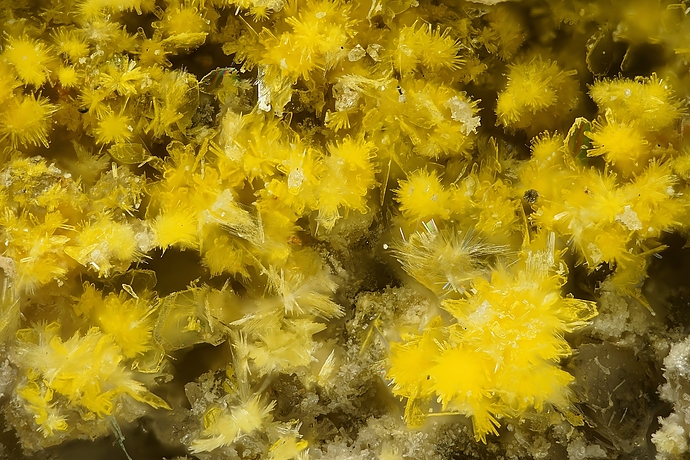
Comments:Zippeite itself is the K-dominant member of this group, while natrozippeite, is the Na-dominant member, and both of these are listed as occurring at the Blue Lizard Mine, along with ammoniozippeite, the NH4 analog. Because all of these various zippeite-group species have similar yellowish external appearance and often occur as fine-grained or clumped coatings on sandstone that often do not allow for evaluation of crystal structure, determining which one is present in any given sample can be challenging, and usually requires X-ray powder diffraction. As such, unless a suitable analysis has been undertaken, or good crystal structure is evident, it is more correct to list specimens in this set of species as belonging to the “Zippeite Group” since any other identification is basically a guess. It is worth noting that none of the photos of natrozippeite from the Blue Lizard mine posted on Mindat reference any form of analysis to verify the identification.

Members of the zippeite group occur in areas where uraninite and sulfide minerals are actively oxidizing, and as noted by Burns et al. (2003) may occur as mixed assemblages of related species containing mono- and divalent cations. As such, their accurate characterization in any particular sample can be difficult.
Confirmation
Validity:Believed Valid
Associated Minerals Based on Photo Data:
Chalcanthite1
Gypsum1
Data
Mineral Data:Click here to view Zippeite Group data
Locality Data:Click here to view Blue Lizard Mine, Red Canyon Mining District, San Juan County, Utah, USA
Data Identifiers
Mindat Occurrence Record ID:1513493
Long-form Identifier:1:3:1513493:0
GUID (UUID V4):0
References
 
and/or  
Mindat.orgÂŪ is an outreach project of the Hudson Institute of Mineralogy, a 501(c)(3) not-for-profit organization. MindatÂŪ and mindat.orgÂŪ are registered trademarks of the Hudson Institute of Mineralogy.
Copyright © mindat.org and the Hudson Institute of Mineralogy 1993-2026, except where stated. Most political location boundaries are ÂĐ OpenStreetMap contributors. Mindat.org relies on the contributions of thousands of members and supporters. Founded in 2000 by Jolyon Ralph and Ida Chau.
Content on this site may not be used to train, fine-tune, or otherwise develop artificial intelligence or machine learning models without prior written permission - see our Terms & Conditions.
To cite: Ralph, J., Von Bargen, D., Martynov, P., Zhang, J., Que, X., Prabhu, A., Morrison, S. M., Li, W., Chen, W., & Ma, X. (2025). Mindat.org: The open access mineralogy database to accelerate data-intensive geoscience research. American Mineralogist, 110(6), 833–844. doi:10.2138/am-2024-9486.
Privacy Policy - Terms & Conditions - Contact Us / DMCA issues - Report a bug/vulnerability Current server date and time: September 29, 2026 07:17:43
Go to top of page