About
Photos
Discussions
Search
Learn


╳Discussions
💬 Home🔎 Search🚩 Flagged📅 LatestGroups
EducationOpen discussion area.Fakes & FraudsOpen discussion area.Field CollectingOpen discussion area.FossilsOpen discussion area.Gems and GemologyOpen discussion area.GeneralOpen discussion area.How to ContributeOpen discussion area.Identity HelpOpen discussion area.Improving Mindat.orgOpen discussion area.LocalitiesOpen discussion area.Lost and Stolen SpecimensOpen discussion area.MeteoritesOpen discussion area.Mineral ExchangesOpen discussion area.Mineral PhotographyOpen discussion area.Mineral ShowsOpen discussion area.Mineralogical ClassificationOpen discussion area.Mineralogy CourseOpen discussion area.MineralsOpen discussion area.Minerals and MuseumsOpen discussion area.PhotosOpen discussion area.Techniques for CollectorsOpen discussion area.The Rock H. Currier Digital LibraryOpen discussion area.UV MineralsOpen discussion area.Recent Images in Discussions


General#MinCup26 - Round 3 Match 3 - Julienite vs. Halite

27th Sep 2026 00:22 UTCRyan Hamel Manager OP

Due to a Mindat user (who hasn't posted during #MinCup26) repeatedly violating trust by stuffing ballots, validated results for all remaining matches will be delayed due to audits. Please be patient with us, and thank you to the vast majority of you who make this fun!
---
It's a pair of dissolvable beauties as rare and complicated julienite is against ubiquitous and straightforward halite.
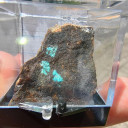
Julienite is a sodium and cobalt hydrous thiocyanate that forms blue needlelike crystals and crusts. The complex salt dissolves easily in water or alcohol, where its distinctive blue transforms into a rosy pink. When dragged across a ceramic plate, julienite leaves a streak of the same distinctive rich blue as its crystals.
It is the only known mineral to contain thiocyanate ions, which are similar to cyanite but with oxygen in place of sulfur. Historically, thiocyanate was named rhodanide (Greek for “rose”) in honour of the red it makes when combined with iron. While rare in geology, thiocyanate is common in biology and you have it in your blood.
It is found in only one region, the Katanga Copperbelt formed when an ancient seabed was metamorphosed during continental collisions that ultimately formed the Gondwana supercontinent. The julienite deposit is part of a white talc schist formed by metamorphism of dolomite within the Katanga Copperbelt, which is the second largest copper reserve in the world and also home to massive sulfide ore deposits with significant amounts of cobalt, silver, nickel, bismuth and arsenic.
Julienite is named to honour Henri Julien, a geology graduate student who died while in the region collecting material for his dissertation. It’s unconfirmed but plausible that during his fieldwork he met Pierre Vanden Brande, who was on an unrelated expedition that discovered julienite about 10 kilometers to the south and who later suggested the name. Henri Julien was the son of Pierre-Alphonse Julien, the first professor of geology and mineralogy at the University of Clermont-Ferrand, and was an aspiring geologist in poor health when he died at 33 years old.
Halite, otherwise known as rock salt, is sodium chloride and the titular mineral of the halite group of salts. It is the ultimate of lickable minerals, the proverbial rock salt left behind when sea water and brines evaporate. Soft as a human fingernail, it crystallizes as perfect cubes, and has perfect 90° cubical cleavage to also break into even more cubes. It's most easily identified by its salty taste.
Transparent when clear, halite can take on a rainbow of hues depending on trace impurities by other elements, inclusions, or lattice defects in its crystal structure. Warm pink, orange, and yellow salts come from small amounts of iron oxide or organic impurities like bacteria or algae, while more striking blue and purple come from sodium nanoparticles or irradiation causing lattice defects. Because halite forms by evaporation of a brine, it often traps small amounts of liquids within it. These water pockets can be protected by the crystals for long periods of time, preserving evidence of past environments and even life.
Large deposits are a tectonic force capable of changing entire landscapes as salt domes rise like blobs in a lava lamp. This process happens through diapirism, where halite's low density and malleability squeezes it up through brittle overlaying sediment.
Along with its use as table salt, halite is also used as a food preservative by brining, dry curing, or fermentation. As a preservative, salt draws water out of food through osmosis, dehydrating it. High salt levels are toxic to many microbes (excluding salt-loving extremophiles called halophiles).

27th Sep 2026 00:47 UTCRyan Hamel Manager OP

27th Sep 2026 15:25 UTCGiles Peatfield
27th Sep 2026 23:54 UTCRyan Hamel Manager OP
28th Sep 2026 15:28 UTCGiles Peatfield

28th Sep 2026 03:06 UTCKevin Conroy Manager
Ryan Hamel Manager OP ✉️
repeatedly violating trust by stuffing ballots,
28th Sep 2026 19:24 UTCItsuki Imaeda
Copyright © mindat.org and the Hudson Institute of Mineralogy 1993-2026, except where stated. Most political location boundaries are © OpenStreetMap contributors. Mindat.org relies on the contributions of thousands of members and supporters. Founded in 2000 by Jolyon Ralph and Ida Chau.
Content on this site may not be used to train, fine-tune, or otherwise develop artificial intelligence or machine learning models without prior written permission - see our Terms & Conditions.
To cite: Ralph, J., Von Bargen, D., Martynov, P., Zhang, J., Que, X., Prabhu, A., Morrison, S. M., Li, W., Chen, W., & Ma, X. (2025). Mindat.org: The open access mineralogy database to accelerate data-intensive geoscience research. American Mineralogist, 110(6), 833–844. doi:10.2138/am-2024-9486.
Privacy Policy - Terms & Conditions - Contact Us / DMCA issues - Report a bug/vulnerability Current server date and time: October 3, 2026 14:29:36
