
Beryllium-bearing Vesuvianite
A variety of Vesuvianite
This page is currently not sponsored. Click here to sponsor this page.

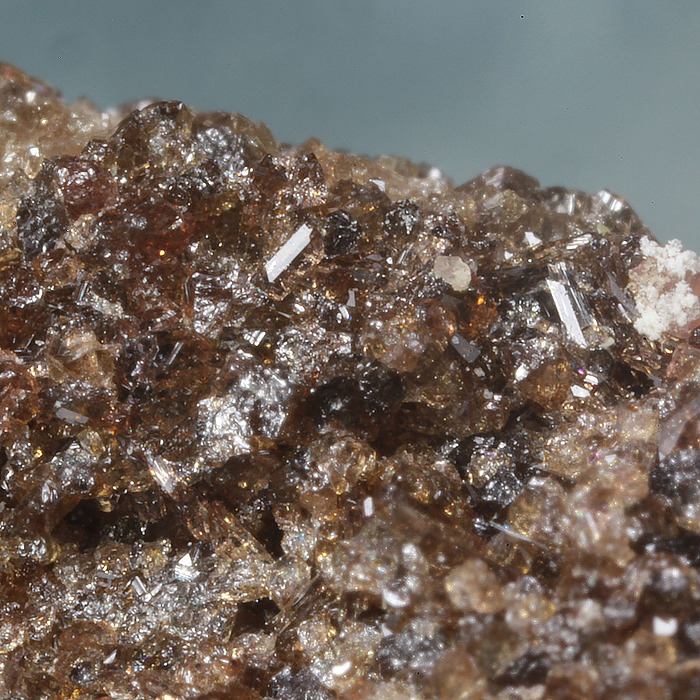
About Beryllium-bearing Vesuvianite
Formula:
(Ca,Na,◻)19(Al,Mg,Fe3+)13(◻,B,Al,Fe3+,Be)5(Si2O7)4(SiO4)10(OH,F,O)10
Name:
Named in 1935 by Charles Palache and Lawson H. Bauer for a vesuvianite with high BeO substitution. (Although original analyses varied up to 9% BeO, modern verified chemical analyses could have yielded a new species, but modern chemical analysts have not found a similarly high BeO-rich sample as was analyzed historically.)
First Recorded Locality:
A beryllium-bearing vesuvianite. Synonymous with "Beryllium vesuvianite".
Vesuvianite with an unexpectedly high content of BeO. Analyses vary up to 9% BeO.
This variety might be more common than known, as most common mineral analyses don’t detect Be easily.
Vesuvianite with an unexpectedly high content of BeO. Analyses vary up to 9% BeO.
This variety might be more common than known, as most common mineral analyses don’t detect Be easily.
Unique Identifiers
Mindat ID:
11520 (as Beryllium-bearing Vesuvianite)
4223 (as Vesuvianite)
4223 (as Vesuvianite)
Long-form identifier:
mindat:1:1:11520:1 (as Beryllium-bearing Vesuvianite)
mindat:1:1:4223:5 (as Vesuvianite)
mindat:1:1:4223:5 (as Vesuvianite)
Chemistry of Beryllium-bearing Vesuvianite
Mindat Formula:
(Ca,Na,◻)19(Al,Mg,Fe3+)13(◻,B,Al,Fe3+,Be)5(Si2O7)4(SiO4)10(OH,F,O)10
Element Weights:
Crystallography of Beryllium-bearing Vesuvianite
Morphology:
Crystals are simple elongated prisms [001], showing {111}, {100}, and {110}.
First Recorded Occurrence of Beryllium-bearing Vesuvianite
Synonyms of Beryllium-bearing Vesuvianite
Common Associates
Associations Based on Photo Data:
| 3 photos of Beryllium-bearing Vesuvianite associated with Bertrandite | Be4(Si2O7)(OH)2 |
Other Information
Health Risks:
No information on health risks for this material has been entered into the database. You should always treat mineral specimens with care.
Internet Links for Beryllium-bearing Vesuvianite
mindat.org URL:
https://www.mindat.org/min-11520.html
Please feel free to link to this page.
Please feel free to link to this page.
Search Engines:
Mineral Dealers:
References for Beryllium-bearing Vesuvianite
Reference List:
Palache, Charles, Bauer, L. H. (1930) On the occurrence of beryllium in the zinc deposits of Franklin, New Jersey. American Mineralogist, 15 (1) 30-33
Localities for Beryllium-bearing Vesuvianite
Showing 2 localities.
 symbol to view information about a locality.
The
symbol to view information about a locality.
The Locality List
 - This locality has map coordinates listed.
- This locality has estimated coordinates.
ⓘ - Click for references and further information on this occurrence.
? - Indicates mineral may be doubtful at this locality.
- This locality has map coordinates listed.
- This locality has estimated coordinates.
ⓘ - Click for references and further information on this occurrence.
? - Indicates mineral may be doubtful at this locality.
 - Good crystals or important locality for species.
 - World class for species or very significant.
(TL) - Type Locality for a valid mineral species.
(FRL) - First Recorded Locality for everything else (eg varieties).
- World class for species or very significant.
(TL) - Type Locality for a valid mineral species.
(FRL) - First Recorded Locality for everything else (eg varieties).
All localities listed without proper references should be considered as questionable.
USA | |
| Dale (1960) +1 other reference |
| Palache et al. (1930) +2 other references |

Franklin Mine, Franklin, Sussex County, New Jersey, USA