
Nealite
A valid IMA mineral species
This page is currently not sponsored. Click here to sponsor this page.
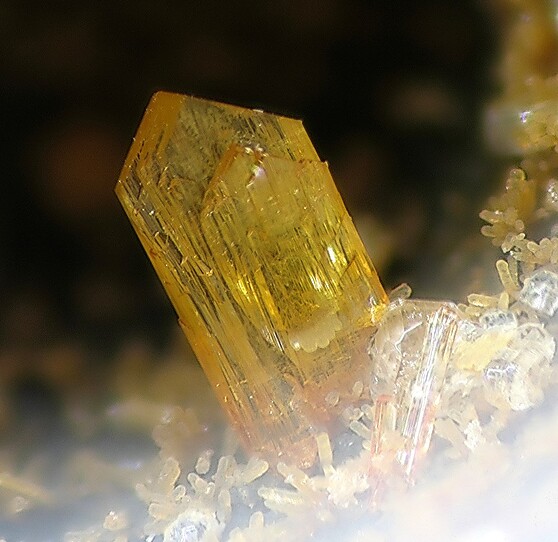


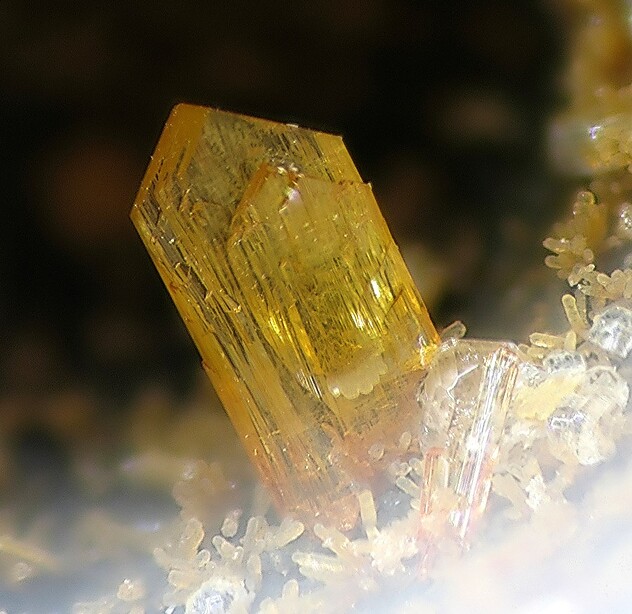
About Nealite

Leo Neal Yedlin
Formula:
Pb4Fe2+(As3+O3)2Cl4 · 2H2O
Colour:
Yellow brown to orange brown
Lustre:
Adamantine, Vitreous, Sub-Vitreous
Hardness:
4
Specific Gravity:
5.89 (Calculated)
Crystal System:
Triclinic
Name:
Named by Pete Dunn and Roland Rouse in 1980 for Leo Neal Yedlin (20 March 1908, Brooklyn, NY, USA - 7 October 1977, New Haven, CT, USA), American lawyer, author, and prominent mineral collector, who discovered the mineral. The mineral yedlinite is also named in his honor.
Bladed yellow brown to orange brown crystals.
Unique Identifiers
Mindat ID:
2869
Long-form identifier:
mindat:1:1:2869:7
Similar Names
IMA Classification of Nealite
Classification of Nealite
4.JD.05
4 : OXIDES (Hydroxides, V[5,6] vanadates, arsenites, antimonites, bismuthites, sulfites, selenites, tellurites, iodates)
J : Arsenites, antimonites, bismuthites, sulfites, selenites, tellurites; iodates
D : Arsenites, antimonites, bismuthites; with additional anions, with H2O
4 : OXIDES (Hydroxides, V[5,6] vanadates, arsenites, antimonites, bismuthites, sulfites, selenites, tellurites, iodates)
J : Arsenites, antimonites, bismuthites, sulfites, selenites, tellurites; iodates
D : Arsenites, antimonites, bismuthites; with additional anions, with H2O
46.1.6.1
46 : ANTIMONITES AND ARSENITES CONTAINING HYDROXYL OR HALOGEN
1 : (AB)m(XO3)pZq
46 : ANTIMONITES AND ARSENITES CONTAINING HYDROXYL OR HALOGEN
1 : (AB)m(XO3)pZq
22.2.18
22 : Phosphates, Arsenates or Vanadates with other Anions
2 : Phosphates, arsenates or vanadates with chloride
22 : Phosphates, Arsenates or Vanadates with other Anions
2 : Phosphates, arsenates or vanadates with chloride
Mineral Symbols
As of 2021 there are now IMA–CNMNC approved mineral symbols (abbreviations) for each mineral species, useful for tables and diagrams.
| Symbol | Source | Reference for Standard |
|---|---|---|
| Nea | IMA–CNMNC | Warr, L.N. (2021). IMA–CNMNC approved mineral symbols. Mineralogical Magazine, 85(3), 291-320. doi:10.1180/mgm.2021.43 |
Pronunciation of Nealite
Pronunciation:
| Play | Recorded by | Country |
|---|---|---|
| Jolyon Ralph | United Kingdom |
Physical Properties of Nealite
Adamantine, Vitreous, Sub-Vitreous
Transparency:
Transparent
Colour:
Yellow brown to orange brown
Streak:
Pale yellow to pale orange
Hardness:
4 on Mohs scale
Tenacity:
Very brittle
Cleavage:
None Observed
Fracture:
Irregular/Uneven
Density:
5.89 g/cm3 (Calculated)
Comment:
Measured greater than 4.27 g/cm3.
Optical Data of Nealite
Type:
Biaxial
Dispersion:
relatively weak
Pleochroism:
Non-pleochroic
Chemistry of Nealite
Mindat Formula:
Pb4Fe2+(As3+O3)2Cl4 · 2H2O
Element Weights:
Crystallography of Nealite
Crystal System:
Triclinic
Class (H-M):
1 - Pinacoidal
Space Group:
P1
Cell Parameters:
a = 6.53 Å, b = 10.23 Å, c = 5.58 Å
α = 96.41°, β = 89.52°, γ = 97.82°
α = 96.41°, β = 89.52°, γ = 97.82°
Ratio:
a:b:c = 0.638 : 1 : 0.545
Unit Cell V:
366.97 ų (Calculated from Unit Cell)
Z:
1
Morphology:
Prismatic to bladed in habit, occurring in clusters, which are either radially divergent or exhibit parallel growth. Bladed crystals tabular on {010}, and elongated and striated parallel to [001].
Twinning:
Always twinned with the two-fold twin axis in [001].
Crystal Structure
Load
Unit Cell | Unit Cell Packed
2x2x2 | 3x3x3 | 4x4x4
Unit Cell | Unit Cell Packed
2x2x2 | 3x3x3 | 4x4x4
Show
Big Balls | Small Balls | Just Balls | Spacefill
Polyhedra Off | Si Polyhedra | All Polyhedra
Remove metal-metal sticks
Big Balls | Small Balls | Just Balls | Spacefill
Polyhedra Off | Si Polyhedra | All Polyhedra
Remove metal-metal sticks
Display Options
Black Background | White Background
Perspective On | Perspective Off
2D | Stereo | Red-Blue | Red-Cyan
Black Background | White Background
Perspective On | Perspective Off
2D | Stereo | Red-Blue | Red-Cyan
View
CIF File Best | x | y | z | a | b | c
CIF File Best | x | y | z | a | b | c
Rotation
Stop | Start
Stop | Start
Labels
Console Off | On | Grey | Yellow
Console Off | On | Grey | Yellow
Data courtesy of the American Mineralogist Crystal Structure Database. Click on an AMCSD ID to view structure
| ID | Species | Reference | Link | Year | Locality | Pressure (GPa) | Temp (K) |
|---|---|---|---|---|---|---|---|
| 0014867 | Nealite | Giuseppetti G, Mazzi F, Tadini C (1993) The crystal structure of nealite: Pb4Fe(AsO3)2Cl4*2H2O Neues Jahrbuch fur Mineralogie, Monatshefte 1993 278-288 | 1993 | Laurion, Greece | 0 | 293 | |
| 0014634 | Nealite | Pertlik F, Schnorrer G (1993) A re-appraisal of the chemical formula of nealite, Pb4Fe(AsO3)2Cl4*2H2O, on the basis of a crystal structure determination Mineralogy and Petrology 48 193-200 | 1993 | Laurion, Greece | 0 | 293 |
CIF Raw Data - click here to close
X-Ray Powder Diffraction
Powder Diffraction Data:
| d-spacing | Intensity |
|---|---|
| 10.09 Å | (60) |
| 6.480 Å | (80) |
| 4.237 Å | (70) |
| 3.919 Å | (50) |
| 3.542 Å | (100) |
| 3.247 Å | (60) |
| 2.971 Å | (50) |
| 2.783 Å | (60) |
Comments:
Lavrion slag localities, Attica, Greece. Data from the type description. 33-0755.
Geological Environment
Paragenetic Mode(s):
| Paragenetic Mode | Earliest Age (Ga) |
|---|---|
| Stage 7: Great Oxidation Event | <2.4 |
| 47a : [Near-surface hydration of prior minerals] | |
| 47d : [Arsenates, antimonates, selenates, bismuthinates] | |
| 47g : [Halogen-bearing surface weathering minerals] | |
| Stage 10b: Anthropogenic minerals | <10 Ka |
| 56 : Slag and smelter minerals (see also #51 and #55) |
Type Occurrence of Nealite
General Appearance of Type Material:
Prismatic or bladed crystals in radial or parallel growth.
Place of Conservation of Type Material:
National Museum of Natural History, Washington, D.C., USA, number 137115 (type).
Geological Setting of Type Material:
Ancient refinery slags which interacted with sea water.
Associated Minerals at Type Locality:
Synonyms of Nealite
Other Language Names for Nealite
Common Associates
Associations Based on Photo Data:
| 19 photos of Nealite associated with Paralaurionite | PbCl(OH) |
| 14 photos of Nealite associated with Laurionite | PbCl(OH) |
| 11 photos of Nealite associated with Phosgenite | Pb2CO3Cl2 |
| 7 photos of Nealite associated with Cerussite | PbCO3 |
| 7 photos of Nealite associated with Georgiadesite | Pb4(As3+O3)Cl4(OH) |
| 4 photos of Nealite associated with Goethite | Fe3+O(OH) |
| 4 photos of Nealite associated with 'Unnamed (Pb-Fe-As-Cl-O-H)' | Pb, Fe, As, Cl, O, H |
| 2 photos of Nealite associated with Gypsum | CaSO4 · 2H2O |
| 1 photo of Nealite associated with Feroxyhyte | Fe3+O(OH) |
| 1 photo of Nealite associated with Lepidocrocite | Fe3+O(OH) |
Related Minerals - Strunz-mindat Grouping
| 4.JD.10 | Seelite | Mg(UO2)(As3+O3)0.7(AsO4)0.3 · 7H2O |
| 4.JD.15 | Tooeleite | Fe3+6(As3+O3)4(SO4)(OH)4 · 4H2O |
| 4.JD.20 | Prachařite | CaSb5+2(As3+2O5)2O2 · 10H2O |
Other Information
Notes:
Slowly soluble in cold 1:1 HCl.
Health Risks:
No information on health risks for this material has been entered into the database. You should always treat mineral specimens with care.
Internet Links for Nealite
mindat.org URL:
https://www.mindat.org/min-2869.html
Please feel free to link to this page.
Please feel free to link to this page.
Search Engines:
External Links:
Mineral Dealers:
References for Nealite
Reference List:
Dunn, Pete J., Rouse, Roland C. (1980) Nealite: a New Mineral from Laurion, Greece. The Mineralogical Record, 11 (5) 299-301
Localities for Nealite
Showing 17 localities.
 symbol to view information about a locality.
The
symbol to view information about a locality.
The Locality List
 - This locality has map coordinates listed.
- This locality has estimated coordinates.
ⓘ - Click for references and further information on this occurrence.
? - Indicates mineral may be doubtful at this locality.
- This locality has map coordinates listed.
- This locality has estimated coordinates.
ⓘ - Click for references and further information on this occurrence.
? - Indicates mineral may be doubtful at this locality.
 - Good crystals or important locality for species.
 - World class for species or very significant.
(TL) - Type Locality for a valid mineral species.
(FRL) - First Recorded Locality for everything else (eg varieties).
- World class for species or very significant.
(TL) - Type Locality for a valid mineral species.
(FRL) - First Recorded Locality for everything else (eg varieties).
All localities listed without proper references should be considered as questionable.
France | |
| P. Le Roch collection |
Germany | |
| "Lithothek" collection of the ... |
| |
Greece | |
| Fritz Schreiber collection (SXRD-analysed by Uwe Kolitsch) |
| Bonifazi Marco +1 other reference | |
| Kolitsch et al. (2014) |
| Lefteris Rantos collection | |
| Gelaude et al. (1996) | |
| Dunn et al. (1980) +2 other references |
| Gelaude et al. (1996) |
| Gelaude et al. (1996) | |
Italy | |
| Rivista Mineralogica Italiana (3) |
| Muenchener Micromounter-Lithothek |
Poland | |
| Warchulski et al. (2014) |
Spain | |
| Georges FAVREAU collection & EDX ... |
| Dill et al. (2023) |
| Van den Berg et al. (2020) |
Quick NavTopAbout NealiteUnique IdentifiersSimilar NamesIMA Classification Classification Mineral SymbolsPronunciation Physical Properties Optical Data Chemistry Crystallography Crystal StructureX-Ray Powder DiffractionGeological EnvironmentType Occurrence SynonymsOther LanguagesCommon AssociatesStrunz-MindatOther InformationInternet Links References Localities Locality List

Vrysaki Point slag locality, Velatouri, Lavreotiki, East Attica, Attica, Greece