Log InRegister
Search For:
Mineral Name:
Locality Name:
Keyword(s):
 
Home PageAbout MindatThe Mindat ManualHistory of MindatCopyright StatusWho We AreOur ScienceMindat Newsletter [Free Download]Contact Us
Donate to MindatSponsor a PageCorporate SponsorshipSponsored Pages
Learning CenterWhat Is a Mineral?The Most Common Minerals on EarthInformation for EducatorsMindat ArticlesMindat Newsletter [Free Download]The ElementsThe Mineral Quiz
Search FormMinerals by PropertiesMinerals by ChemistryMineral Visual ExplorerAdvanced Locality SearchRandom MineralRandom LocalitySearch by minIDMinerals by CountryAlphabetical Mineral IndexAlphabetical Locality SearchMineral Association SearchList of CountriesLocalities Near MePhoto SearchSearch ArticlesSearch GlossaryThe Rock H. Currier Digital LibraryMore Search Options
The Mindat ManualAdd a New PhotoRate PhotosLocality Edit ReportCoordinate Completion ReportAdd Glossary Item
MineralsPetrologyFossilsMeteoritesGeologic Time
Mining CompaniesStatisticsMineral MuseumsClubs & OrganizationsMineral Shows & EventsDevice SettingsTime Machine
Read DiscussionsIdentification Request
Photo SearchPhoto GalleriesSearch by ColourPhoto Colour ExplorerNew Photos TodayNew Photos YesterdayMembers' Photo GalleriesPast Photo of the Day GalleryPhotography

Hjelmite

A discredited species name
This page is currently not sponsored. Click here to sponsor this page.
Hide all sections | Show all sections

About HjelmiteHide

Formula:
Y, Fe, U, Sn, Mn, Ca, Nb, Ta, O
Colour:
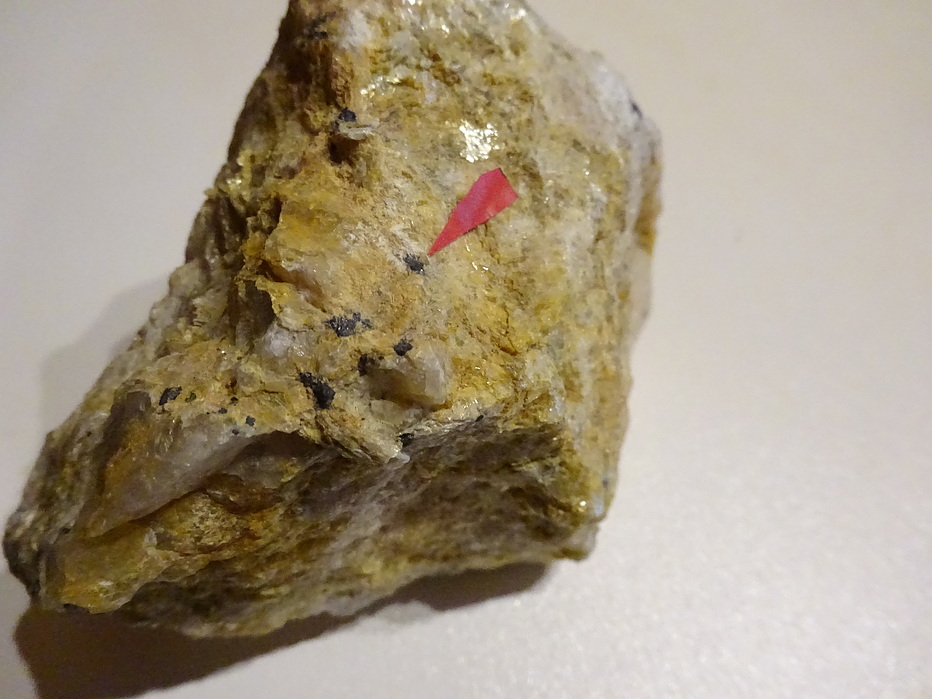
Black
Lustre:
Metallic
Hardness:
5
Specific Gravity:
5.2 - 5.8
Name:
After the Swedish chemist P.J. Hjelm (1746-1813). Named and described by Nordenskiöld (1860) from Kårarvet, Falun, Sweden. However, on the basis of the morphological data, he considered it to be a dubious species, related to tapiolite and samarskite. Crook (1979) investigated a sample labelled as hjelmite from Kårarvet, and found it to be the tantalum equivalent of yttropyrochlore, and named it yttromicrolite. Reinvestigation of co-type found Crook's analysis to be in error and concluded that the type "yttromicrolite" is an amorphous mixture of calcium sulfate, tantalite and heterogeneous microlite (Peacor et al., 1982).
An inadequately described/studied oxide or niobate-tantalate containing Y, Fe2+, U4+, Sn, Mn, Ca, Nb, Ta.

Hjelmite was first described from Kårarvet Mine near Falun, Sweden by Nordenskiöld (1860) who considered it, on the basis of morphological data, to be a dubious species, possibly related to tapiolite or samarskite. It may be yttromicrolite-(Y).


Unique IdentifiersHide

Mindat ID:
30172
Long-form identifier:
mindat:1:1:30172:9

IMA Classification of HjelmiteHide

Discredited, Questionable
Approval history:
Discredited by IMA in 1979 and renamed ytttromicrolite. Discredited again in 1982.

Physical Properties of HjelmiteHide

Metallic
Colour:
Black
Streak:
Grayish black
Hardness:
Fracture:
Irregular/Uneven
Density:
5.2 - 5.8 g/cm3 (Measured)    

Optical Data of HjelmiteHide

Chemistry of HjelmiteHide

Mindat Formula:
Y, Fe, U, Sn, Mn, Ca, Nb, Ta, O
Element Weights:
Element% weight
U26.855 %
Ta20.415 %
Sn13.393 %
Nb10.482 %
Y10.031 %
Fe6.301 %
Mn6.198 %
Ca4.522 %
O1.805 %

Calculated from ideal end-member formula.
U
Ta
Sn
Nb
Y
Fe
Mn
Ca
O

Crystallography of HjelmiteHide

Morphology:
Rough and indistinct crystals. Massive; rounded or prismatic aggregates.

Synonyms of HjelmiteHide

RadioactivityHide

Radioactivity:
Element % Content Activity (Bq/kg) Radiation Type
Uranium (U) 26.8547% 6,713,675 α, β, γ
Thorium (Th) 0.0000% 0 α, β, γ
Potassium (K) 0.0000% 0 β, γ

For comparison:

  • Banana: ~15 Bq per fruit
  • Granite: 1,000–3,000 Bq/kg
  • EU exemption limit: 10,000 Bq/kg

Note: Risk is shown relative to daily recommended maximum exposure to non-background radiation of 1000 µSv/year. Note that natural background radiation averages around 2400 µSv/year so in reality these risks are probably extremely overstated! With infrequent handling and safe storage natural radioactive minerals do not usually pose much risk.

Interactive Simulator:

Note: The mass selector refers to the mass of radioactive mineral present, not the full specimen, also be aware that the matrix may also be radioactive, possibly more radioactive than this mineral!

Activity: –

DistanceDose rateRisk
1 cm
10 cm
1 m

The external dose rate (D) from a radioactive mineral is estimated by summing the gamma radiation contributions from its Uranium, Thorium, and Potassium content, disregarding daughter-product which may have a significant effect in some cases (eg 'pitchblende'). This involves multiplying the activity (A, in Bq) of each element by its specific gamma ray constant (Γ), which accounts for its unique gamma emissions. The total unshielded dose at 1 cm is then scaled by the square of the distance (r, in cm) and multiplied by a shielding factor (μshield). This calculation provides a 'worst-case' or 'maximum risk' estimate because it assumes the sample is a point source and entirely neglects any self-shielding where radiation is absorbed within the mineral itself, meaning actual doses will typically be lower. The resulting dose rate (D) is expressed in microsieverts per hour (μSv/h).

D = ((AU × ΓU) + (ATh × ΓTh) + (AK × ΓK)) / r2 × μshield

Other InformationHide

Health Risks:
No information on health risks for this material has been entered into the database. You should always treat mineral specimens with care.

Internet Links for HjelmiteHide

References for HjelmiteHide

Localities for HjelmiteHide

Showing 2 localities.

This map shows a selection of localities that have latitude and longitude coordinates recorded. Click on the symbol to view information about a locality. The symbol next to localities in the list can be used to jump to that position on the map.
Hide all sections | Show all sections

Locality ListHide

- This locality has map coordinates listed. - This locality has estimated coordinates. ⓘ - Click for references and further information on this occurrence. ? - Indicates mineral may be doubtful at this locality. - Good crystals or important locality for species. - World class for species or very significant. (TL) - Type Locality for a valid mineral species. (FRL) - First Recorded Locality for everything else (eg varieties). Struck out - Mineral was erroneously reported from this locality. Faded * - Never found at this locality but inferred to have existed at some point in the past (e.g. from pseudomorphs).

All localities listed without proper references should be considered as questionable.
Sweden
 
  • Dalarna County
    • Falun
      • Kårarvet
Nordenskjöld (1860)
  • Västmanland County
    • Norberg
      • Häste ore field
Wilke (1997)
 
and/or  
Mindat.org® is an outreach project of the Hudson Institute of Mineralogy, a 501(c)(3) not-for-profit organization. Mindat® and mindat.org® are registered trademarks of the Hudson Institute of Mineralogy.
Copyright © mindat.org and the Hudson Institute of Mineralogy 1993-2026, except where stated. Most political location boundaries are © OpenStreetMap contributors. Mindat.org relies on the contributions of thousands of members and supporters. Founded in 2000 by Jolyon Ralph and Ida Chau.
Content on this site may not be used to train, fine-tune, or otherwise develop artificial intelligence or machine learning models without prior written permission - see our Terms & Conditions.
To cite: Ralph, J., Von Bargen, D., Martynov, P., Zhang, J., Que, X., Prabhu, A., Morrison, S. M., Li, W., Chen, W., & Ma, X. (2025). Mindat.org: The open access mineralogy database to accelerate data-intensive geoscience research. American Mineralogist, 110(6), 833–844. doi:10.2138/am-2024-9486.
Privacy Policy - Terms & Conditions - Contact Us / DMCA issues - Report a bug/vulnerability Current server date and time: October 21, 2026 20:39:46 Page updated: October 3, 2026 19:31:06
Go to top of page