
Quartz Gwindel
A variety of Quartz
This page kindly sponsored by Deborah Nickerson



About Quartz Gwindel
Formula:
SiO2
Name:
From the German name for twisted quartz, "Gwindel", derived from "gewunden" = contorted, twisted, wound. Pronounced "gvin-dell". There is no other thing called "Gwindel", any gwindel is necessarily a quartz.
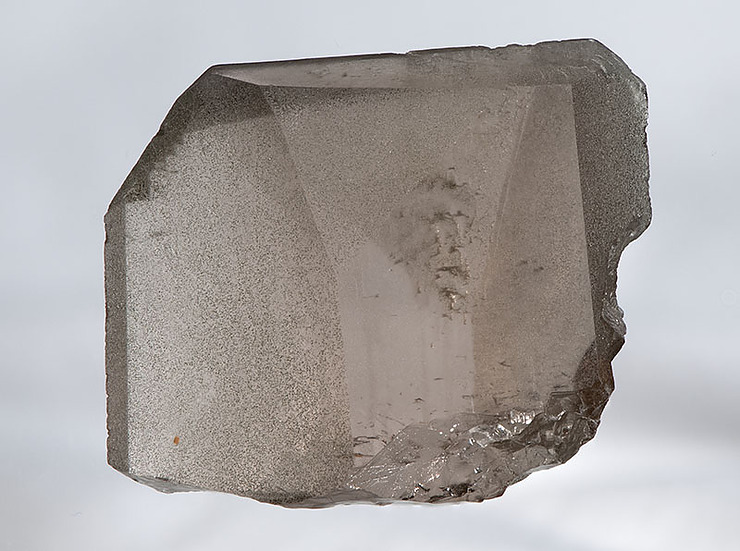
Quartz crystals that grew along and are slightly rotated around a single a-axis. This results in twisted and tabular crystals. The twist reflects the handedness of the quartz crystals. With increasing distance from the base
- right-handed gwindels twist clockwise.
- left-handed gwindels twist counter-clockwise.
In most gwindels the handedness can easily be determined by the position of the trapezohedral "x"-faces.
Gwindels are found in alpine-type fissures and are always accompanied by macromosaic quartz of normal habit. They are often smoky; colorless "rock crystal" gwindels are less common.
The structural base of the twist has just recently been discovered: A high number of straight screw dislocations cause a uniform so-called Eshelby twist (Cordier and Heidelbach, 2013; Eshelby, 1953) that is typical for slow growing crystals. This slow growth is in line with the occurrence of gwindels in certain alpine-type fissures.
Because of the often multiple tips and the strong development of sutures on the crystal surface, gwindels are often described as lateral stacks of quartz crystals. This is not correct: each gwindel starts as a single crystal, and only the overgrowth with quartz of a macromosaic structure causes the impression of a composite specimen (Kuzmina et al, 1987; Dolino and Bastie, 2009).
Note: Nobody says "Quarzgwindel" in Switzerland or Austria, it is just "Gwindel".
- right-handed gwindels twist clockwise.
- left-handed gwindels twist counter-clockwise.
In most gwindels the handedness can easily be determined by the position of the trapezohedral "x"-faces.
Gwindels are found in alpine-type fissures and are always accompanied by macromosaic quartz of normal habit. They are often smoky; colorless "rock crystal" gwindels are less common.
The structural base of the twist has just recently been discovered: A high number of straight screw dislocations cause a uniform so-called Eshelby twist (Cordier and Heidelbach, 2013; Eshelby, 1953) that is typical for slow growing crystals. This slow growth is in line with the occurrence of gwindels in certain alpine-type fissures.
Because of the often multiple tips and the strong development of sutures on the crystal surface, gwindels are often described as lateral stacks of quartz crystals. This is not correct: each gwindel starts as a single crystal, and only the overgrowth with quartz of a macromosaic structure causes the impression of a composite specimen (Kuzmina et al, 1987; Dolino and Bastie, 2009).
Note: Nobody says "Quarzgwindel" in Switzerland or Austria, it is just "Gwindel".
Unique Identifiers
Mindat ID:
39374 (as Quartz Gwindel)
3337 (as Quartz)
3337 (as Quartz)
Long-form identifier:
mindat:1:1:39374:8 (as Quartz Gwindel)
mindat:1:1:3337:0 (as Quartz)
mindat:1:1:3337:0 (as Quartz)
Pronunciation of Quartz Gwindel
Pronunciation:
| Play | Recorded by | Country |
|---|---|---|
| Jolyon Ralph | United Kingdom |
Chemistry of Quartz Gwindel
Mindat Formula:
SiO2
Elements listed:
Synonyms of Quartz Gwindel
Other Language Names for Quartz Gwindel
French:Peigne
Quartz Helicoidal
Sucre
Quartz Helicoidal
Sucre
German:Gwindl
Common Associates
Associations Based on Photo Data:
| 27 photos of Quartz Gwindel associated with 'Smoky Quartz' | SiO2 |
| 14 photos of Quartz Gwindel associated with Quartz | SiO2 |
| 12 photos of Quartz Gwindel associated with Chlorite Group | |
| 5 photos of Quartz Gwindel associated with 'Rock Crystal' | SiO2 |
| 5 photos of Quartz Gwindel associated with Chalcopyrite | CuFeS2 |
| 2 photos of Quartz Gwindel associated with 'Faden Quartz' | SiO2 |
| 2 photos of Quartz Gwindel associated with 'Adularia' | KAlSi3O8 |
| 1 photo of Quartz Gwindel associated with Hematite | Fe2O3 |
| 1 photo of Quartz Gwindel associated with Clinochlore | Mg5Al(AlSi3O10)(OH)8 |
| 1 photo of Quartz Gwindel associated with Feldspar Group |
Other Information
Health Risks:
No information on health risks for this material has been entered into the database. You should always treat mineral specimens with care.
Internet Links for Quartz Gwindel
mindat.org URL:
https://www.mindat.org/min-39374.html
Please feel free to link to this page.
Please feel free to link to this page.
Search Engines:
Mineral Dealers:
References for Quartz Gwindel
Reference List:
www.articlearchives.com (n.d.) http://www.articlearchives.com/science-technology/earth-atmospheric-science/1541521-1.html
Haidinger, W. (1855) Note über gewundene Bergkrystalle. Annalen der Physik und Chemie, 171. 623-626 doi:10.1002/andp.18551710812
Friedlaender, C. (1951) Untersuchung über die Eignung alpiner Quarze für piezoelektrische Zwecke. Beiträge zur Geologie der Schweiz, Geotechnische Serie, 29. 126-135
Eshelby, J. D. (1953) Screw dislocations in thin rods. Journal of Applied Physics, 24 (2). 176-179 doi:10.1063/1.1721234
Localities for Quartz Gwindel
Showing 53 localities.
 symbol to view information about a locality.
The
symbol to view information about a locality.
The Locality List
 - This locality has map coordinates listed.
- This locality has estimated coordinates.
ⓘ - Click for references and further information on this occurrence.
? - Indicates mineral may be doubtful at this locality.
- This locality has map coordinates listed.
- This locality has estimated coordinates.
ⓘ - Click for references and further information on this occurrence.
? - Indicates mineral may be doubtful at this locality.
 - Good crystals or important locality for species.
 - World class for species or very significant.
(TL) - Type Locality for a valid mineral species.
(FRL) - First Recorded Locality for everything else (eg varieties).
- World class for species or very significant.
(TL) - Type Locality for a valid mineral species.
(FRL) - First Recorded Locality for everything else (eg varieties).
All localities listed without proper references should be considered as questionable.

Mont Blanc Massif northwest flank, Auvergne-Rhône-Alpes, France