Log In


Libyan Desert Glass
A rock subtype
This page is currently not sponsored. Click here to sponsor this page.


About Libyan Desert Glass
Name:
For the locality.
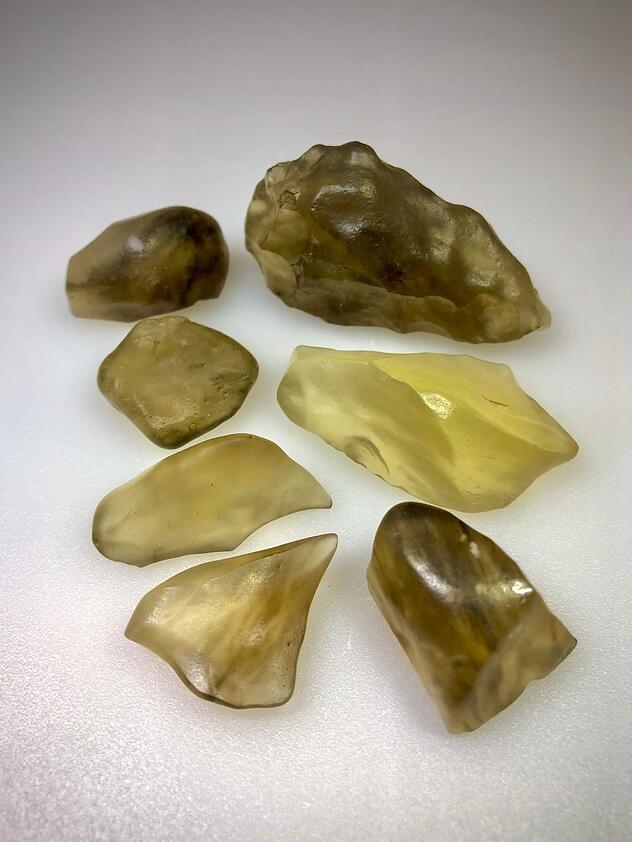
An impact-melt-rock (impact glass) from a strewnfield in the Western Desert of Egypt. The impact origin is disputed, however, by some scientists. The impact site has not been located yet, although there is clear evidence an impact happened (e.g., Kleinmann et al., 2001). In 2013, Kramers et al. published analyses of a small black rock and proposed it to be the remnant of a cometary nucleus fragment that impacted after incorporating gases from the atmosphere.
The major component of Libyan Desert Glass is almost pure molten silica glass, Lechatelierite.
The glass was discovered by the international scientific community in 1932, but it had been used by the Ancient Egyptians as a gemstone.
"The hottest naturally occurring silica". Bears high-temperature (>1350 °C) oscillatory zoned β-cristobalite of magmatic origin.
 Visit gemdat.org for gemological information about Libyan Desert Glass.
The major component of Libyan Desert Glass is almost pure molten silica glass, Lechatelierite.
The glass was discovered by the international scientific community in 1932, but it had been used by the Ancient Egyptians as a gemstone.
"The hottest naturally occurring silica". Bears high-temperature (>1350 °C) oscillatory zoned β-cristobalite of magmatic origin.
Visit gemdat.org for gemological information about Libyan Desert Glass.Unique Identifiers
Mindat ID:
39796
Long-form identifier:
mindat:1:1:39796:6
Classification of Libyan Desert Glass
- Rock
- Metamorphic rock
- Impactite
- Single impact impactite
- Impact-melt-rock
- Libyan Desert Glass
- Impact-melt-rock
- Single impact impactite
- Impactite
- Metamorphic rock
Synonyms of Libyan Desert Glass
Other Language Names for Libyan Desert Glass
German:Libysches Wüstenglas
Common Associates
Associations Based on Photo Data:
| 4 photos of Libyan Desert Glass associated with Cristobalite | SiO2 |
| 1 photo of Libyan Desert Glass associated with 'Tektite' |
Internet Links for Libyan Desert Glass
mindat.org URL:
https://www.mindat.org/min-39796.html
Please feel free to link to this page.
Please feel free to link to this page.
Search Engines:
References for Libyan Desert Glass
Reference List:
Clayton, P. A., Spencer, L. J. (1934) Silica-glass from the Libyan Desert. Mineralogical Magazine and Journal of the Mineralogical Society, 23 (144) 501-508 doi:10.1180/minmag.1934.023.144.04
Weeks, R.A., Underwood, James R., Giegengack, Robert (1984) Libyan Desert glass: A review. Journal of Non-Crystalline Solids, 67 (1) 593-619 doi:10.1016/0022-3093(84)90177-7
KLEINMANN, Barbara, HORN, Peter, LANGENHORST, Falko (2001) Evidence for shock metamorphism in sandstones from the Libyan Desert Glass strewn field. Meteoritics & Planetary Science, 36 (9) 1277-1282 doi:10.1111/j.1945-5100.2001.tb01960.x
Pratesi, Giovanni, Viti, Cecilia, Cipriani, Curzio, Mellini, Marcello (2002) Silicate-silicate liquid immiscibility and graphite ribbons in Libyan desert glass. Geochimica et Cosmochimica Acta, 66 (5) 903-911 doi:10.1016/s0016-7037(01)00820-1
Kramers, Jan D., Andreoli, Marco A.G., Atanasova, Maria, Belyanin, Georgy A., Block, David L., Franklyn, Chris, Harris, Chris, Lekgoathi, Mpho, Montross, Charles S., Ntsoane, Tshepo, Pischedda, Vittoria, Segonyane, Patience, Viljoen, K.S. (Fanus), Westraadt, Johan E. (2013) Unique chemistry of a diamond-bearing pebble from the Libyan Desert Glass strewnfield, SW Egypt: Evidence for a shocked comet fragment. Earth and Planetary Science Letters, 382. 21-31 doi:10.1016/j.epsl.2013.09.003
Cavosie, Aaron J., Rickard, William D.A., Evans, Noreen J., Rankenburg, Kai, Roberts, Malcolm, Macris, Catherine A., Koeberl, Christian (2022) Origin of β-cristobalite in Libyan Desert Glass: The hottest naturally occurring silica polymorph?. American Mineralogist, 107 (7) 1325-1340 doi:10.2138/am-2021-7922

Libyan Desert Glass area, New Valley Governorate, Egypt