
Buchite
A rock classification type
This page is currently not sponsored. Click here to sponsor this page.
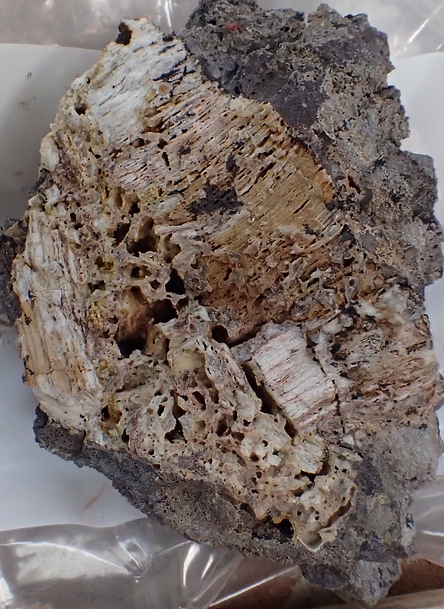


About Buchite
Name:
Buchite is named for German mineralogist Baron Christian L. von Buch, who died in 1853.
A compact, vesicular or slaggy metamorphic rock of any composition containing more than 20% vol. of glass, either produced by contact metamorphism in volcanic to subvolcanic settings or generated by combustion metamorphism.
An uncommon metamorphic rock type composed mostly of glass, formed by the melting of a sedimentary rock or soil by extreme heat from an adjacent lava flow or scoria eruption, or the burning of an underground coal bed. Buchite is a product of a special type of metamorphism, called pyrometamorphism (contact type, high to very high temperature, low pressure, often connected with coal fires). Buchites are often confused with obsidian, which is a volcanic glass rather than metamorphic glass. The so-called para-obsidian is a buchite with small amounts of mullite and tridymite forming microlites. Rarely, buchites can be colorful and transparent, and faceted as gemstones, as for example a few blue-green gems from the Eifel hills in Germany.
The original description of buchite was for partly fused, glassy sandstones associated with basalts (in Germany). Now the term also covers more pelitic rocks. The first described buchite contained relic, cracked quartz with tridymite overgrowths and inclusions, feathery or needle-like clinopyroxene, magnetite, cordierite crystals, tiny crystals of a spinel, small voids, pores interfilled with goethite and brown glass.
According to Grapes (2006), buchite also occurs as xenoliths and within contact aureoles.
An uncommon metamorphic rock type composed mostly of glass, formed by the melting of a sedimentary rock or soil by extreme heat from an adjacent lava flow or scoria eruption, or the burning of an underground coal bed. Buchite is a product of a special type of metamorphism, called pyrometamorphism (contact type, high to very high temperature, low pressure, often connected with coal fires). Buchites are often confused with obsidian, which is a volcanic glass rather than metamorphic glass. The so-called para-obsidian is a buchite with small amounts of mullite and tridymite forming microlites. Rarely, buchites can be colorful and transparent, and faceted as gemstones, as for example a few blue-green gems from the Eifel hills in Germany.
The original description of buchite was for partly fused, glassy sandstones associated with basalts (in Germany). Now the term also covers more pelitic rocks. The first described buchite contained relic, cracked quartz with tridymite overgrowths and inclusions, feathery or needle-like clinopyroxene, magnetite, cordierite crystals, tiny crystals of a spinel, small voids, pores interfilled with goethite and brown glass.
According to Grapes (2006), buchite also occurs as xenoliths and within contact aureoles.
Unique Identifiers
Mindat ID:
50131
Long-form identifier:
mindat:1:1:50131:0
Similar Names
Classification of Buchite
Sub-divisions of Buchite
Mineralogy of Buchite
Essential minerals - these are minerals that are required within the classification of this rock:
| Glass | A non-crystalline, amorphous, relatively homogeneous solid material with a random liquid-like structure generally ... |
Non-essential minerals - these minerals are common, sometimes major components, but are not always present:
| Feldspar > Alkali Feldspar > K Feldspar | Potassium-dominant feldspars with variable crystal symmetry and Al-Si ordering state; they are a subgroup of ... |
| Silica > Quartz | SiO2 |
Common Associates
Associations Based on Photo Data:
| 3 photos of Buchite associated with 'Glass' | |
| 3 photos of Buchite associated with Hematite | Fe2O3 |
| 2 photos of Buchite associated with 'Porcellanite' | |
| 2 photos of Buchite associated with Mullite | Al4+2xSi2-2xO10-x |
| 2 photos of Buchite associated with 'Metacarbonate slag' | |
| 2 photos of Buchite associated with Gehlenite | Ca2Al[AlSiO7] |
| 2 photos of Buchite associated with Cuspidine | Ca8(Si2O7)2F4 |
| 1 photo of Buchite associated with Siderite | FeCO3 |
| 1 photo of Buchite associated with 'Clinker' | |
| 1 photo of Buchite associated with 'Basalt' |
Internet Links for Buchite
mindat.org URL:
https://www.mindat.org/min-50131.html
Please feel free to link to this page.
Please feel free to link to this page.
References for Buchite
Reference List:
Localities for Buchite
Showing 14 localities.
 symbol to view information about a locality.
The
symbol to view information about a locality.
The Locality List
 - This locality has map coordinates listed.
- This locality has estimated coordinates.
ⓘ - Click for references and further information on this occurrence.
? - Indicates mineral may be doubtful at this locality.
- This locality has map coordinates listed.
- This locality has estimated coordinates.
ⓘ - Click for references and further information on this occurrence.
? - Indicates mineral may be doubtful at this locality.
 - Good crystals or important locality for species.
 - World class for species or very significant.
(TL) - Type Locality for a valid mineral species.
(FRL) - First Recorded Locality for everything else (eg varieties).
- World class for species or very significant.
(TL) - Type Locality for a valid mineral species.
(FRL) - First Recorded Locality for everything else (eg varieties).
All localities listed without proper references should be considered as questionable.
Australia | |
| Spry et al. (1964) |
| Bottrill et al. (2020) |
Germany | |
| Juroszek et al. (Ti 5 Fe) +1 other reference |
Indonesia | |
| Knuever et al. (2023) | |
Italy | |
| Renzulli +4 other references |
Poland | |
| Łukasz Kruszewski PXRD data +1 other reference |
| Łukasz Kruszewski PXRD & EPMA data + ... +1 other reference |
| Łukasz Kruszewski PXRD & EPMA data + ... |
| Ł. Kruszewski visual inspection & ... |
| Ł. Kruszewski visual inspection & ... | |
| Ł. Kruszewski PXRD & EPMA data + field ... |
| Ł. Kruszewski PXRD & EPMA data + field ... |
| Ł. Kruszewski PXRD & EPMA data + field ... |
Russia | |
| Sokol et al. (2019) |

Skillion Hill, Clarence city, Tasmania, Australia