Log In


Oncolite
A rock subtype
This page is currently not sponsored. Click here to sponsor this page.
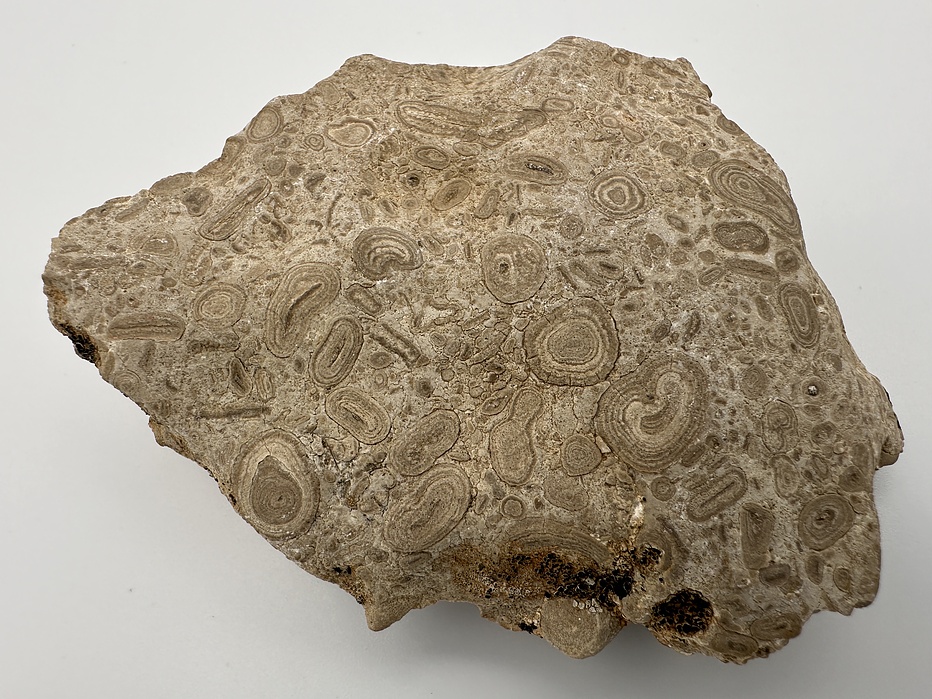


About Oncolite
An oncolite is a carbonate rock composed mostly of oncoids; the term, however, is also often used as a synonym for “oncoid” (essentially a sub-spherical stromatolitic structure). Mostly an oncoid-limestone or dolostone.
Usage is inconsistent, see: https://www.mindat.org/mesg-646228.html
The SEPM site (Society for Sedimentary Geology) says:
“Pisolites, oncoids, and oncolites are enveloped by irregular layers. All these grains are frequently larger than ooids and commonly are over a centimeter in diameter. Pisolites form by the precipitation of calcium Carbonate around nuclei trapped in sediment within the vadose zone of soils or marine tidal flats (Figure 24). Oncoids form on the surface of intertidal and supratidal flats where Carbonate precipitates from salt water spray and marine flood waters (left figure). Though these grains are termed oncoids, in Limestones they probably cannot be distinguished from pisolites. Finally, other grains resembling pisolites but termed oncolites are formed by accretions of blue-green algae and trapped sediment around a nucleus in moderately protected marine environments (figure below).” http://www.sepmstrata.org/page.aspx?pageid=107
This suggests that these three terms may be differentiated in sediments but maybe not in lithified rocks. Probably we need a broader term (nodular limestone?) when we don’t know the origin?
Another page on this site suggests oncolites should refer to algae produced structures while similar structures of unknown origin should be called pisolites.
http://www.sepmstrata.org/page.aspx?pageid=211
“pisolites and oncolites: Blue-green algae form concentric structures about a nucleus. These are known as oncolites. If the concentric grain is of questionable origin it's called a pisolite. In the following slides give average size of the oncolites or pisolites, note nucleus and thickness of concentric layers.”
Unique Identifiers
Mindat ID:
55140
Long-form identifier:
mindat:1:1:55140:3
Similar Names
| Ancylite | ||
| Ancylite-(Ce) | A valid IMA mineral species - grandfathered | CeSr(CO3)2(OH) · H2O |
| Ancylite-(Ce)-Calcioancylite-(Ce) Series | A solid-solution series between two end-member minerals | |
| Ancylite-(La) | A valid IMA mineral species | LaSr(CO3)2(OH) · H2O |
| Oncoite | A synonym of 'Ripidolite' |
Classification of Oncolite
Common Associates
Associations Based on Photo Data:
| 2 photos of Oncolite associated with 'Limestone' |
Internet Links for Oncolite
mindat.org URL:
https://www.mindat.org/min-55140.html
Please feel free to link to this page.
Please feel free to link to this page.
References for Oncolite
Reference List:
Localities for Oncolite
Showing 4 localities.
 symbol to view information about a locality.
The
Locality List
 - This locality has map coordinates listed.
- This locality has estimated coordinates.
ⓘ - Click for references and further information on this occurrence.
? - Indicates mineral may be doubtful at this locality.
 - Good crystals or important locality for species.
 - World class for species or very significant.
(TL) - Type Locality for a valid mineral species.
(FRL) - First Recorded Locality for everything else (eg varieties).
All localities listed without proper references should be considered as questionable.
Austria | |
| Franz Bernhard collection |
Dominican Republic | |
| Domínguez-Carretero et al. (2026) |
Germany | |
| Pape (1974) |
Italy | |
| Galdenzi (2025) |

La Barge Thrust Fault, Lincoln County, Wyoming, USA