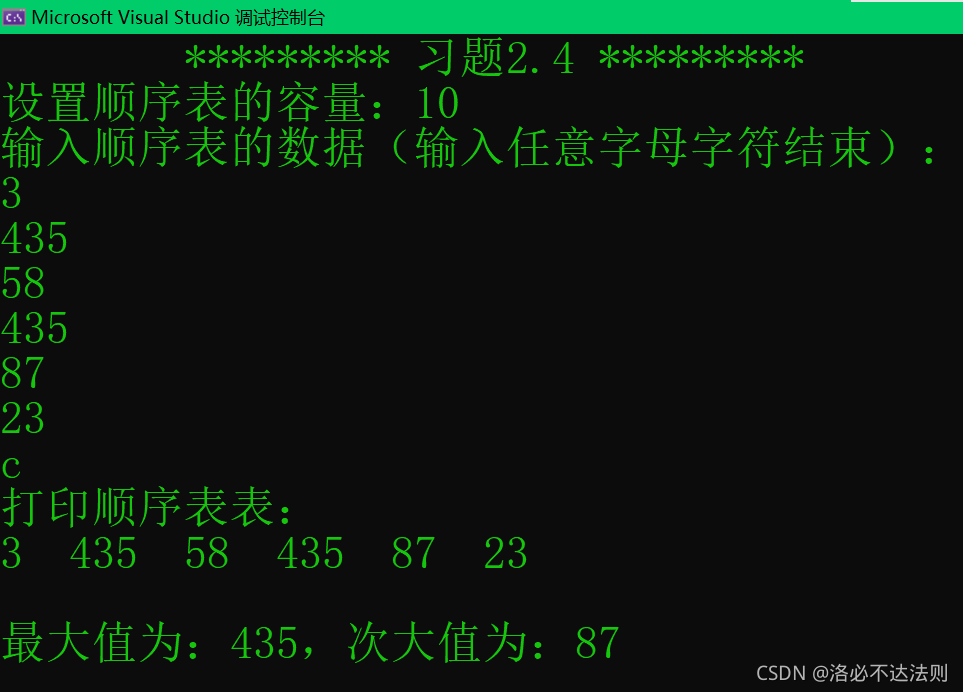
2.4、求顺序表中的最大值和次大值

hdu 2025 查找最大元素 查找最大元素<br />Time Limit: 2000/1000 MS (Java/Others)    Memory Limit: 65536/32768 K (Java/Others)<br />Total Submission(s): 8707    Accepted Submission(s): 4740<br /><br /><br />Problem Description对于输入的每个字符串,查找其中的最大字母,在该字母后面插入字符串“(max)”。<br /> <br /><br />In 阅读详情

2.4、求顺序表中的最大值和次大值

2.5、元素 x 插入递增有序的顺序表

 2.6、合并两个递增顺序表 / 单链表

2.7、求俩递增单链表的交集单链表

Dev-C++ 6.6 安装程序

Visual Studio 2019 安装程序

/************************************************************
* Windows 10下,Dev-C++ 6.6、Visual Studio 2019 中测试通过	*
*															*
* @file		习题2.4.c										*
*															*
* @brief	习题2.4											*
*			编写算法输出已知顺序表 A 中						*
*			数据元素的最大值和次大值。用					*
*			非形式算法描述,并编写C语言程序。				*
*															*
* @author	CSDN@洛必不达法则								*
*															*
* @date		2021-10-17										*
*************************************************************/

#define _CRT_SECURE_NO_WARNINGS		// VS2019中 scanf 被认为是不安全的,需要加上该宏才能使用
#include <stdio.h>
#include <stdlib.h>

/**
* @brief	定义顺序表结构体
*/
typedef struct
{
	int* data;		// 存储数据元素的一段内存
	int last;		// 最后一个元素的下标
	int maxsize;	// 最大容量
}SeqList;

/**
* @brief	初始化顺序表
* @param maxsize	顺序表的容量
* @return	初始化成功的顺序表地址
*/
SeqList* InitSeqList(int maxsize)
{
	SeqList* pList = (SeqList*)malloc(sizeof(SeqList));
	if (!pList)
	{
		printf("内存申请失败!\n");
		return NULL;
	}
	pList->data = (int*)malloc(sizeof(int) * maxsize);
	if (!pList->data)
	{
		printf("内存申请失败!\n");
		return NULL;
	}
	pList->maxsize = maxsize;
	pList->last = -1;
	return pList;
}

/**
* @brief	创建顺序表
* @return	创建的顺序表的地址
*/
SeqList* CreateSeqList()
{
	int maxsize = 0;
	int data = 0;
	printf("设置顺序表的容量:");
	scanf("%d", &maxsize);
	SeqList* pList = InitSeqList(maxsize);
	printf("输入顺序表的数据(输入任意字母字符结束):\n");
	while (pList->last < pList->maxsize - 1)
	{
		if (!scanf("%d", &data))
			break;
		pList->data[++pList->last] = data;
	}
	return pList;
}

/**
* @brief	遍历打印顺序表表数据
* @param pList	需要遍历的顺序表
*/
void PrintSeqList(SeqList* pList)
{
	for (int i = 0; i <= pList->last; i++)
	{
		printf("%d  ", pList->data[i]);
	}
	printf("\n");
}

/**
* @brief	获取顺序表中的最大值和次大值,以数组形式返回
* @param pList	待求顺序表
* @return	一个长度为2的整型数组,下标0为最大值,下标1为次大值
*/
int* GetSeqListMaxAndSec(SeqList* pList)
{
	// int max[2]; 在 Dev-C++ 6.6 中测试不通过
	int* max = (int*)malloc(sizeof(int) * 2);

	// 空表,最大值和次大值都取0
	if (pList->last == -1)
	{
		max[0] = 0;
		max[1] = 0;
		return max;
	}
	// 顺序表不为空
	else
	{
		// 最大值和次大值初始值为data[0]
		max[0] = pList->data[0];
		max[1] = pList->data[0];
		// 从data[1]开始比较
		for (int i = 1; i <= pList->last; i++)
		{
			if (pList->data[i] > max[0])
			{
				max[1] = max[0];
				max[0] = pList->data[i];
			}
			else if (pList->data[i] < max[0] && (pList->data[i] > max[1] || max[0] == max[1]))
			{
				max[1] = pList->data[i];
			}
		}
		return max;
	}
}

int main()
{
	printf("\t********* 习题2.4 *********\n");
	SeqList* A = CreateSeqList();

	printf("打印顺序表表:\n");
	PrintSeqList(A);

	int* max2 = GetSeqListMaxAndSec(A);
	printf("\n最大值为:%d,次大值为:%d\n", max2[0], max2[1]);

	return 0;
}

数据结构 顺序表—插入 删除 最大值 考研笔记 数据结构代码 本人小白一个,考研的科目是数据结构 就用此博客来记录练习的代码。借鉴了别人的很多地方和天勤书上的内容。 顺序表 构建一个顺序表 实现以一下功能 1.找出最大值 2.正序输出 3.插入一个元素 4.删除一个元素 5.逆序输出 #include<stdio.h> #include<iostream> #define maxSize 100 #define ERROR 0; using namespace std; typedef struct{ 阅读详情

相关推荐

从零到一:基于Blazor和Elsa Workflows的工作流系统开发实战

本文详细介绍了如何利用Blazor和Elsa Workflows构建高效的工作流系统,从技术选型到生产环境部署,涵盖动态工作流建模、Blazor前端集成及性能优化等核心内容。通过实战案例,展示如何实现订单处理系统的自动化与灵活性,提升企业流程效率。

weixin_26875109的博客 433

C语言-查找顺序表中的最大值

【问题描述】 编写算法:在顺序表中查找最大值,输出最大值及其在顺序表中的位置(若出现多个相同最大值,位置为第一次出现的) 【输入形式】 输入若干个整数建立顺序表。(若输入整数个数为0,则表示建立空表) 【输出形式】 输出顺序表中最大值及其第一次出现的位置(位序)。(若为空表,则输出“no”) 【样例输入1】 12 34 -90 87 126 -3 【样例输出1】 126 5 【样例输入2】 12 12 12 9 -3 -2 【样例输出2】 12 1 【样例输入3】 e 【样.

w_nxsxs的博客 7585

深入解析YT8521S千兆以太网PHY芯片的设计与调试要点

本文深入解析了YT8521S千兆以太网PHY芯片的设计与调试要点。重点剖析了硬件设计中的电源方案、RGMII接口电平配置(尤其是1.8V电平方案)以及PCB布局布线等关键细节,并提供了从硬件检查、驱动配置到性能测试的完整调试流程,帮助工程师规避常见陷阱,实现稳定可靠的千兆网络连接。

weixin_29190573的博客 694

算法与数据结构-------递归查找最大元素

用两种递归方式查找数组中的最大元素。 方法1: #include #include int cmp1(int a[],int s,int e) {     int max1,max2;     int m;     int n = e - s + 1;     m = s + n/2 - 1;          if(n == 1)     {         r

happyAnger6的专栏 2057

网络可视化工具netron详细安装流程

netron安装目录1.netron 简介2.不同操作系统下的安装使用方式2.1 在线版本:只要有浏览器就可以2.2 不同操作系统安装使用3.netron支持的网络框架4.netron测试演示 1.netron 简介 在实际的项目中,经过会遇到各种网络模型,需要我们快速去了解网络结构。如果单纯的去看模型文件,脑海中很难直观的浮现网络的架构。 这时,就可以使用netron可视化工具,可以清晰的看到每一层的输入输出,网络总体的架构,而且支持各种不同网络框架,简单好用。 2.不同操作系统下的安装使用方式 2.1

江南研习社 12万+

【Godot4自学手册】第一节配置Godot运行环境

Godot是一款自由开源、由社区驱动的 2D 和 3D 游戏引擎!它是一款功能丰富的跨平台游戏引擎,可以通过统一的界面创建 2D 和 3D 游戏。它提供了一套全面的通用工具,因此用户可以专注于制作游戏,而无需重新发明轮子。游戏可以一键导出到多个平台,包括主流的桌面平台(Linux、macOS、Windows)、移动平台(Android、iOS)、基于 Web 的平台以及主机平台。

zhaoyang314的博客 5990

求顺序表中的最大的元素

将顺序表分为左子表和右子表,然后分别求出左右子表中最大的元素,然后选择最大的元素,就是整个表的最大的元素。 ElemType Max(SqlList L,int i,int j) { int mid; ElemType max,maxp1,maxp2; if(i==j) max=L.data[i]; else{ mid=(i+j)/2; max1=Max(L,i,mid); max2=Max(L,mid+1,j); max=(max

chenmoit的博客 2076

OceanBase全局索引深度解析:分布式环境下的高效索引设计与实战优化指南

全局索引(Global Index)是OceanBase数据库在分布式环境中提供的一种跨分区、跨服务器的索引结构,它允许用户创建跨越多个分区的索引,为分布式查询提供高效的数据访问路径。与局部索引(Local Index)不同,全局索引不是与表分区一一对应的,而是作为一个独立的逻辑结构存在。 在分布式数据库系统中,全局索引解决了以下几个关键问题: 跨分区查询性能:当查询条件不包含分区键时,全局索引可以避免全表扫描 唯一性约束维护:全局索引能够保证索引键在全局范围内的唯一性 分布式事务支持:全局索引与主表数

本博客聚焦 YOLOv11 全流程落地,涵盖架构优化、数据集处理、训练技巧与多场景部署,兼及国产数据库、Java 开发与 AI 模型应用,内容兼顾理论与工程实践,为开发者提供系统干货,助力高效提升技术能力。 726

求顺序表中最大值和次大值的最优算法

问题描述 给一个 n 个数字的顺序表,求其中的最大值和次大值。求一个比较次数不大于 n−⌈logn⌉−2n-\lceil logn \rceil-2n−⌈logn⌉−2 的算法。 算法 顺序比较 初始化最大值和次大值是下标为 0 的元素,之后每次更新最大值时,把上次最大值给次大值;不能更新最大值时也要和次大值比较看能否更新次大值。易得最坏情况下比较次数为 2(n−1)2(n-1)2(n−1)。 堆 我们发现,堆的结构可以在常数时间内找到最大值和次大值。但是在构建堆的时候,每次调整的比较次数约为 2h2h2h

小胡同的诗 3846

3dmax文件格式转换——.max 转换为 .flt(解决转换后.flt没有纹理贴图的问题)

本文主要介绍如何在3dmax中将.max格式文件转换为.flt格式文件,并解决转换后的文件没有纹理贴图的问题。 在3dmax中,将.max文件转换为.flt格式,只需导出选择.flt格式即可,但是导出的文件在osgEarth中加载后,缺少纹理和贴图。 下面是解决方案: 1、选中加载的模型,然后点击 渲染-> 渲染到纹理 2、将 渲染到纹理 子窗口往下拉,点击 添加 按钮,添加 ...

cchangcs 6191

YOLOv9实战:刀具磨损实时监控从摄像头到预测性维护(附车间落地代码)

摘要: 本文针对制造业刀具磨损监控痛点,提出基于YOLOv9的实时视觉检测方案。通过工业相机采集刀具图像,结合图像预处理(去油污、增强对比度)和深度学习模型,实现磨损等级分类与寿命预测。系统集成硬件选型(抗油污相机、红色环形光源)、数据增强(旋转、噪声模拟)及预测性维护(PLC联动),实测刀具利用率提升30%,工件报废率降至0.5%以下。详解车间部署、模型训练到系统落地的全流程,附代码与避坑指南,为工业视觉项目提供实战参考。

专注于Python爬虫开发,分享爬虫技巧、项目实战与反爬经验,使用Scrapy、BeautifulSoup等工具,解决数据抓取难题。 544

PTA 6-1 求顺序表最大值 (10分)

本题要求实现一个函数,要求返回顺序表的最大值,空表返回0。题目保证顺序表中所有元素都为正整数。 函数接口定义: int GetMax(SqList L); 其中SqList结构定义如下: t ypedef struct{ ElemType *elem; int length; }SqList; 裁判测试程序样例: #include <stdio.h> #include <stdlib.h> #define MAXSIZE 5 typedef int ElemType; ty

qq_40468936的博客 7386

2025_NIPS_RAGRouter: Learning to Route Queries to Multiple Retrieval-Augmented Language Models

该研究聚焦检索增强生成(RAG)场景下的大语言模型(LLM)路由问题,提出了首个RAG感知的路由框架RAGRouter。核心解决现有路由方法依赖静态参数知识、忽略检索文档动态影响的缺陷,通过融合文档嵌入、RAG能力嵌入与对比学习,捕捉RAG引发的模型知识表征变化,为每个查询-文档对选择最优LLM。实验覆盖5个知识密集型任务、15个开源/闭源LLM,验证了RAGRouter在性能上超越最佳单LLM和非RAG感知路由方法,且通过阈值机制实现低延迟约束下的性能-效率平衡。

UnknownBody_2的博客 277

删除顺序表的最大值

Problem Description 有一顺序表List,现要求删除表中的所有最大值(可能有多个),并输出删除后的新表。 Input 有多组数据,每组数据占两行。 每组第一行有一个整数,为表长n(0&lt;n&lt;50); 第二行为表的各元素值。 Output 每组数据的输出占一行,每两个元素之间有一空格。注意删除后为空表的情况。 Sample Input 5 12 24 4 54 15 5 ...

wq6ylc88的博客 4991

精雕软件(JDpaint) 5.5 绿色版

精雕软件(JDpaint) 5.5 绿色版精雕软件(JDpaint) 5.5 绿色版精雕软件(JDpaint) 5.5 绿色版

深度学习工具包 DeepLearningToolbox

深度学习工具包Deprecation notice.-----This toolbox is outdated and no longer maintained.There are much better tools available for deep learning than this toolbox, e.g. [Theano](http://deeplearning.net/software/theano/), [torch](http://torch.ch/) or [tensorflow](http://www.tensorflow.org/)I would suggest you use one of the tools mentioned above rather than use this toolbox.Best, Rasmus.DeepLearnToolbox================A Matlab toolbox for Deep Learning.Deep Learning is a new subfield of machine learning that focuses on learning deep hierarchical models of data.It is inspired by the human brain's apparent deep (layered, hierarchical) architecture.A good overview of the theory of Deep Learning theory is[Learning Deep Architectures for AI](http://www.iro.umontreal.ca/~bengioy/papers/ftml_book.pdf)For a more informal introduction, see the following videos by Geoffrey Hinton and Andrew Ng.* [The Next Generation of Neural Networks](http://www.youtube.com/watch?v=AyzOUbkUf3M) (Hinton, 2007)* [Recent Developments in Deep Learning](http://www.youtube.com/watch?v=VdIURAu1-aU) (Hinton, 2010)* [Unsupervised Feature Learning and Deep Learning](http://www.youtube.com/watch?v=ZmNOAtZIgIk) (Ng, 2011)If you use this toolbox in your research please cite [Prediction as a candidate for learning deep hierarchical models of data](http://www2.imm.dtu.dk/pubdb/views/publication_details.php?id=6284)```@MASTERSTHESIS\{IMM2012-06284, author = "R. B. Palm", title = "Prediction as a candidate for learning deep hierarchical models of data", year = "2012",}```Contact: rasmusbergpalm at gmail dot comDirectories included in the toolbox-----------------------------------`NN/` - A library for Feedforward Backpropagation Neural Networks`CNN/` - A library for Convolutional Neural Networks`DBN/` - A library for Deep Belief Networks`SAE/` - A library for Stacked Auto-Encoders`CAE/` - A library for Convolutional Auto-Encoders`util/` - Utility functions used by the libraries`data/` - Data used by the examples`tests/` - unit tests to verify toolbox is workingFor references on each library check REFS.mdSetup-----1. Download.2. addpath(genpath('DeepLearnToolbox'));Example: Deep Belief Network---------------------```matlabfunction test_example_DBNload mnist_uint8;train_x = double(train_x) / 255;test_x = double(test_x) / 255;train_y = double(train_y);test_y = double(test_y);%% ex1 train a 100 hidden unit RBM and visualize its weightsrand('state',0)dbn.sizes = [100];opts.numepochs = 1;opts.batchsize = 100;opts.momentum = 0;opts.alpha = 1;dbn = dbnsetup(dbn, train_x, opts);dbn = dbntrain(dbn, train_x, opts);figure; visualize(dbn.rbm{1}.W'); % Visualize the RBM weights%% ex2 train a 100-100 hidden unit DBN and use its weights to initialize a NNrand('state',0)%train dbndbn.sizes = [100 100];opts.numepochs = 1;opts.batchsize = 100;opts.momentum = 0;opts.alpha = 1;dbn = dbnsetup(dbn, train_x, opts);dbn = dbntrain(dbn, train_x, opts);%unfold dbn to nnnn = dbnunfoldtonn(dbn, 10);nn.activation_function = 'sigm';%train nnopts.numepochs = 1;opts.batchsize = 100;nn = nntrain(nn, train_x, train_y, opts);[er, bad] = nntest(nn, test_x, test_y);assert(er < 0.10, 'Too big error');```Example: Stacked Auto-Encoders---------------------```matlabfunction test_example_SAEload mnist_uint8;train_x = double(train_x)/255;test_x = double(test_x)/255;train_y = double(train_y);test_y = double(test_y);%% ex1 train a 100 hidden unit SDAE and use it to initialize a FFNN% Setup and train a stacked denoising autoencoder (SDAE)rand('state',0)sae = saesetup([784 100]);sae.ae{1}.activation_function = 'sigm';sae.ae{1}.learningRate = 1;sae.ae{1}.inputZeroMaskedFraction = 0.5;opts.numepochs = 1;opts.batchsize = 100;sae = saetrain(sae, train_x, opts);visualize(sae.ae{1}.W{1}(:,2:end)')% Use the SDAE to initialize a FFNNnn = nnsetup([784 100 10]);nn.activation_function = 'sigm';nn.learningRate = 1;nn.W{1} = sae.ae{1}.W{1};% Train the FFNNopts.numepochs = 1;opts.batchsize = 100;nn = nntrain(nn, train_x, train_y, opts);[er, bad] = nntest(nn, test_x, test_y);assert(er < 0.16, 'Too big error');```Example: Convolutional Neural Nets---------------------```matlabfunction test_example_CNNload mnist_uint8;train_x = double(reshape(train_x',28,28,60000))/255;test_x = double(reshape(test_x',28,28,10000))/255;train_y = double(train_y');test_y = double(test_y');%% ex1 Train a 6c-2s-12c-2s Convolutional neural network %will run 1 epoch in about 200 second and get around 11% error. %With 100 epochs you'll get around 1.2% errorrand('state',0)cnn.layers = { struct('type', 'i') %input layer struct('type', 'c', 'outputmaps', 6, 'kernelsize', 5) %convolution layer struct('type', 's', 'scale', 2) %sub sampling layer struct('type', 'c', 'outputmaps', 12, 'kernelsize', 5) %convolution layer struct('type', 's', 'scale', 2) %subsampling layer};cnn = cnnsetup(cnn, train_x, train_y);opts.alpha = 1;opts.batchsize = 50;opts.numepochs = 1;cnn = cnntrain(cnn, train_x, train_y, opts);[er, bad] = cnntest(cnn, test_x, test_y);%plot mean squared errorfigure; plot(cnn.rL);assert(er<0.12, 'Too big error');```Example: Neural Networks---------------------```matlabfunction test_example_NNload mnist_uint8;train_x = double(train_x) / 255;test_x = double(test_x) / 255;train_y = double(train_y);test_y = double(test_y);% normalize[train_x, mu, sigma] = zscore(train_x);test_x = normalize(test_x, mu, sigma);%% ex1 vanilla neural netrand('state',0)nn = nnsetup([784 100 10]);opts.numepochs = 1; % Number of full sweeps through dataopts.batchsize = 100; % Take a mean gradient step over this many samples[nn, L] = nntrain(nn, train_x, train_y, opts);[er, bad] = nntest(nn, test_x, test_y);assert(er < 0.08, 'Too big error');%% ex2 neural net with L2 weight decayrand('state',0)nn = nnsetup([784 100 10]);nn.weightPenaltyL2 = 1e-4; % L2 weight decayopts.numepochs = 1; % Number of full sweeps through dataopts.batchsize = 100; % Take a mean gradient step over this many samplesnn = nntrain(nn, train_x, train_y, opts);[er, bad] = nntest(nn, test_x, test_y);assert(er < 0.1, 'Too big error');%% ex3 neural net with dropoutrand('state',0)nn = nnsetup([784 100 10]);nn.dropoutFraction = 0.5; % Dropout fraction opts.numepochs = 1; % Number of full sweeps through dataopts.batchsize = 100; % Take a mean gradient step over this many samplesnn = nntrain(nn, train_x, train_y, opts);[er, bad] = nntest(nn, test_x, test_y);assert(er < 0.1, 'Too big error');%% ex4 neural net with sigmoid activation functionrand('state',0)nn = nnsetup([784 100 10]);nn.activation_function = 'sigm'; % Sigmoid activation functionnn.learningRate = 1; % Sigm require a lower learning rateopts.numepochs = 1; % Number of full sweeps through dataopts.batchsize = 100; % Take a mean gradient step over this many samplesnn = nntrain(nn, train_x, train_y, opts);[er, bad] = nntest(nn, test_x, test_y);assert(er < 0.1, 'Too big error');%% ex5 plotting functionalityrand('state',0)nn = nnsetup([784 20 10]);opts.numepochs = 5; % Number of full sweeps through datann.output = 'softmax'; % use softmax outputopts.batchsize = 1000; % Take a mean gradient step over this many samplesopts.plot = 1; % enable plottingnn = nntrain(nn, train_x, train_y, opts);[er, bad] = nntest(nn, test_x, test_y);assert(er < 0.1, 'Too big error');%% ex6 neural net with sigmoid activation and plotting of validation and training error% split training data into training and validation datavx = train_x(1:10000,:);tx = train_x(10001:end,:);vy = train_y(1:10000,:);ty = train_y(10001:end,:);rand('state',0)nn = nnsetup([784 20 10]); nn.output = 'softmax'; % use softmax outputopts.numepochs = 5; % Number of full sweeps through dataopts.batchsize = 1000; % Take a mean gradient step over this many samplesopts.plot = 1; % enable plottingnn = nntrain(nn, tx, ty, opts, vx, vy); % nntrain takes validation set as last two arguments (optionally)[er, bad] = nntest(nn, test_x, test_y);assert(er < 0.1, 'Too big error');```[![Bitdeli Badge](https://d2weczhvl823v0.cloudfront.net/rasmusbergpalm/deeplearntoolbox/trend.png)](https://bitdeli.com/free "Bitdeli Badge")

求顺序表中最大值最小值的最优算法

题目描述 给一个 n 个数字的顺序表,求其中的最大值和最小值。求一个比较次数不大于 ⌈3n/2⌉−2\lceil 3n/2 \rceil-2⌈3n/2⌉−2 的算法。 思路 顺序查找 首先最大、最小值初始化为第一个数,对于之后的数我们都进行比较更新。易得最坏情况下比较次数为 2n−32n-32n−3 。实现见代码 f0 部分。 分组比较 我们可以预处理数组:每两个数字划成一组,较小的放前面,较大的放后面。于是,最小值就可以从前面的数字中获取,最大值从后面的数字获取。比较次数计算如下: 复杂度符合要求。实现见

小胡同的诗 4831

ssm框架搭建

这个是一个在idea上成功跑起来的ssm框架项目,保存在这里方便以后使用直接下载

定位顺序表中的最大值和最小值

定位顺序表中的最大值和最小值 #include <stdio.h> int main() {  int n,i,a[1000];  scanf("%d",&n);  for(i=0;i<n;i++)  {  scanf("%d",&a[i]); } int Lmax=0,Lmin=1000,k1,k2; for(i...

qq_45014448的博客 2172

win10 跳过U8环境检测的IE WebControls.rar

win10 安装u8的时候 提示IE WebControls 不通过,这个工具可以欺骗u8的检查。 跳过U8环境检测的IE WebControls。提示导入失败后,重新检测通过。

順序表最大值

public class SeqList { private static final int MAXSIZE = 10;// 定义顺序表的最大存储容量 private int last; // 用于顺序表的最后一个元素的存储位置 private int[] data; SeqList() { InitSeqList(MAXSIZE); } private void InitSeqList(...

Watch3的博客 784

设顺序表L中所有的元素均为正整数,且无序排列。请编写完成以下功能的算法: (1) 找出顺序表结点中的最大值,并将之打印出来; (2) 统计顺序表中一共有多少个相同的最大值结点数。

设顺序表L中所有的元素均为正整数,且无序排列。请编写完成以下功能的算法: (1) 找出顺序表结点中的最大值,并将之打印出来; (2) 统计顺序表中一共有多少个相同的最大值结点数。 顺序表结构如下: typedef struct{ ElemType *elem; int length; }SqList; #include<stdio.h> #include<stdlib.h> #define size 5 typedef int ElemType; typedef struct{

不会敲代码的咸鱼 1637

C语言实现在顺序表中找到最大值

然后在主函数中,首先输入顺序表的大小,然后输入顺序表的元素,最后通过调用`findMax`函数找到最大值并输出。// 调用findMax函数找到最大值。if (arr[i] > max) { // 如果当前元素大于最大值。// 输入顺序表的元素。// 输入顺序表的大小。printf("最大值为:%d\n", maxValue);printf("请输入顺序表的大小:");printf("请输入顺序表的元素:");

qq_55615339的博客 1588

Python123:求最大值及其下标、将数组中的数逆序存放(C语言)

python123(C语言练习)

chat8052的博客 1085

查找并打印顺序表中的最大值及其下标

PTA查找并打印顺序表中的最大值及其下标

qq_52043172的博客 2647

数据结构:设计一个算法:用不多于3n/2的平均比较次数,在一个有n个整数的顺序表中找出最大值和最小值的元素

题目: 设计一个算法:用不多于3n/2的平均比较次数,在一个有n个整数的顺序表中找出最大值和最小值的元素 出错原因: 当初,想的是分别设一个max=min=data[0],然后求最大值最小值的时候,分别遍历顺序表,但是这样的比较次数为2n,因此排除了,然后想用If与else if,直接将max和min与data[j]比较,然后当时觉得,这平均次数也是2n,其实并不是,因为是if和else if 两个分支只能执行一个,不可以同时执行的。 正确思路: 用If和else if ,将max和min 分别和data[

Warddamn的博客 3415

【甜妹的问题】基于顺序表,写出求顺序表元素最大值的算法

知道了顺序表的数据结构(是一种线性结构,可以看作是个数组),那就是把顺序表里的元素一个一个挨个比较(默认把索引为0的元素为最大值,如果下一个元素大于最大值就更新最大值)。顺序表中的元素按照它们在内存中的物理顺序依次存放,元素之间的关系是通过它们在内存中的相对位置来决定的。顺序表的优势在于随机访问元素的效率高,因为通过索引可以直接计算出元素的地址。而顺序表的另一种常见实现是动态数组,它允许在需要时动态扩展容量,以提供更灵活的操作。基于顺序表,写出求顺序表元素最大值的算法(将最大值保存到e中)

Studying_Code_的博客 559

一次遍历顺序表同时找到最大值和最小值

#include &lt;stdio.h&gt; /* 题目:天勤40页思考题(3) 在一个有n个整数的顺序表L中,以不多于3n/2的平均比较次数,找出最大值和最小值 即 通过一次遍历顺序表找出顺序表的最大值和最小值,平均比较次数=n&lt;3n/2 */ #define maxlen 50 #define DATATYPE int typedef struct{ DATATYPE...

linking_lin的博客 5939

分治算法求n个元素的最大值和最小值

分治算法求n个元素的最大值和最小值 算法思想: 1.将n个数均分为s1和s2 2.分别求解s1和s2的最大值和最小值 s1最大值为max1,s1最小值为min1 s2最大值为max2,s2最小值为min2 3.计算min(min1,min2),max(max1,max2) void Maxm...

相似的人适合一起打闹 4850

顺序表作业

1:第二章 实验题2:2.1 顺序表——调整数据元素 总时间限制: 10000ms 内存限制: 10000kB 描述 假设一个顺序表L中所有元素为整数,设计一个算法调整该顺序表,使其中所有小于零的元素移动到所有大于等于零的元素的前面。 输入 无 输出 2 -1 0 2 -2 3 -3 -3 -1 -2 2 0 3 2 样例输入 无 样例输出 2 -1 0 2 -2 3 -3 -3 -1 -2 2 0 3 2 ac代码: #include <stdio.h> #include <iostre

weixin_50849959的博客 5807
上一篇: 01、Qt中的基础类(上)
下一篇: 2.5、元素 x 插入递增有序的顺序表
洛必不达法则
博客等级 码龄6年 324粉丝 18原创
评论 1
成就一亿技术人!
拼手气红包6.0元
还能输入1000个字符
 
 条评论被折叠 查看
添加红包

请填写红包祝福语或标题

个

红包个数最小为10个

元

红包金额最低5元

当前余额3.43元 前往充值 >
需支付:10.00元
成就一亿技术人!
领取后你会自动成为博主和红包主的粉丝 规则
hope_wisdom
发出的红包
实付元
使用余额支付
点击重新获取
扫码支付
钱包余额 0

抵扣说明:

1.余额是钱包充值的虚拟货币,按照1:1的比例进行支付金额的抵扣。
2.余额无法直接购买下载,可以购买VIP、付费专栏及课程。

余额充值