A connectivity hub with end-to-end security
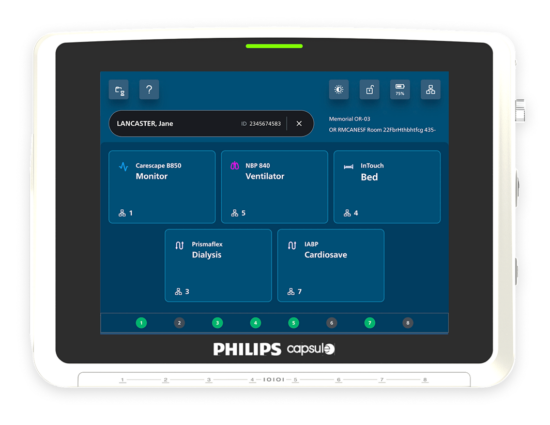
Designed for secure integration across healthcare settings, the Neuron is available in multiple configurations and supports USB, serial, and network-connected devices. Each module comes preloaded with workflow-specific software tailored to its care environment:
- Vitals Stream enables continuous data capture in critical-care areas.
- Chart Xpress supports periodic device data transfer for spot-check monitors.
Powerful, flexible, mobile, secure
Encryption in transit and at rest
Security is built in the Philips Capsule Neuron. There is end-to-end encryption of the data in transit and at rest. It is also compatible with wireless security standards WPA2-PSK and WPA2 Enterprise and has a secure boot and flash.
Economic advantage
Philips Capsule offers a 2-year standard warranty for the Neuron Connectivity Hub. This translates to no out-of-pocket expense for 2 years rather than 1 year or even 6 months for some manufacturers.
Simple to manage for IT & Biomeds
For IT and Biomed teams, Neuron simplifies troubleshooting and supports broad device compatibility, streamlining integration across diverse healthcare environments. Its rechargeable battery adds portability, making it easier to deploy and maintain in dynamic clinical settings. These features support improved system reliability, reduced downtime, and more efficient support workflows – ultimately supporting the goal of better care delivery through optimized infrastructure.
Easy to use for clinicians
Clinicians benefit from quick login access, a large screen for detailed insights, and accurate patient-device association at the point of care – potentially supporting a reduction in errors and accelerating decision-making. The Neuron facilitates seamless connectivity with monitoring and treatment equipment for real- time data availability that potentially enhances clinical responsiveness and care quality. The Neuron’s software applications – Chart Xpress and Vitals Stream – allow clinicians to configure a Neuron based on their care area’s acuity level.
Take a closer look at the Capsule Neuron and find out how it can help your organization benefit from data-driven care in any setting.
What leading healthcare organizations say about partnering with us
Are you ready to advance
your care delivery?