


Red blood cell indices
| Red blood cell indices | |
|---|---|
| Purpose | information about the hemoglobin content and size of red blood cells |

Red blood cell indices are blood tests that provide information about the hemoglobin content and size of red blood cells. Abnormal values indicate the presence of anemia and which type of anemia it is.[1]
Mean corpuscular volume
[edit source]Mean corpuscular volume (MCV) is the average volume of a red blood cell and is calculated by dividing the hematocrit (Hct) by the concentration of red blood cell count.[citation needed]
- Normal range: 80–100 fL (femtoliter)
![{\displaystyle {\textit {MCV}}={\frac {\textit {Hct}}{[{\textit {RBC}}]}}}](https://wikimedia.org/api/rest_v1/media/math/render/svg/547ed6004880a7e84924f34370e8f37f7027fe9a)
Mean corpuscular hemoglobin
[edit source]| Abbreviation | MCH |
| Normal range | 27–33 pg |
| Unit | picograms (pg) |
| Calculated from | HGB ÷ RBC × 10 |
| Stability at 4°C | Up to 18 h |
Mean corpuscular haemoglobin (MCH) is the average mass of haemoglobin contained in a single red blood cell, expressed in picograms (pg). It is calculated from the haemoglobin concentration and RBC count: MCH = HGB (g/dL) ÷ RBC (×10¹²/L) × 10. It is reported as part of the CBC red cell indices. [2]
Storage Stability
[edit source]MCH remained stable for up to 18 hours when stored at 4±1°C. After this period, significant changes were observed. [3]
Clinical Significance
[edit source]Mean corpuscular hemoglobin concentration
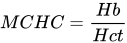
[edit source]Mean corpuscular hemoglobin concentration (MCHC) is the average concentration of hemoglobin per unit volume of red blood cells and is calculated by dividing the hemoglobin by the hematocrit. [citation needed]
- Normal range: 32-36 g/dL
Red blood cell distribution width
[edit source]Red blood cell distribution width (RDW or RDW-CV or RCDW and RDW-SD) is a measure of the range of variation of red blood cell (RBC) volume, yielding clues about morphology.[citation needed]
Erythropoietic precursor indices
[edit source]The reticulocyte production index (RPI) or corrected reticulocyte count (CRC) represents the true significance of the absolute reticulocyte count to provide some reflection of erythropoietic demand and supply. The immature reticulocyte fraction (IRF) goes a step further to cast more light on the same question.[citation needed]
Worked example
[edit source]| Measure | Units | Conventional units | Conversion |
|---|---|---|---|
| Hct | 40% | ||
| Hb | 100 grams/liter | 10 grams/deciliter | (deci- is 10−1) |
| RBC | 5E+12 cells/liter | 5E+6 cells/μL | (micro is 10−6) |
| MCV = (Hct/100) / RBC | 8E-14 liters/cell | 80 femtoliters/cell | (femto- is 10−15) |
| MCH = Hb / RBC | 2E-11 grams/cell | 20 picograms/cell | (pico- is 10−12) |
| MCHC = Hb / (Hct/100) | 250 grams/liter | 25 grams/deciliter | (deci is 10−1) |
References
[edit source]- ↑ MedlinePlus Medical Encyclopedia: R BC indices
- 1 2 3 4 Barbara J., Leach, Bain, Mike (2025). Blood Cells: A Practical Guide (7th ed.). John Wiley \& Sons (published 10 November 2025). ISBN 978-1-394-33205-2.
{{cite book}}: CS1 maint: multiple names: authors list (link) - ↑ Hussain, Sajid, Mehmood, Rubaida, Arshad,Farhatul-Ain, Khan,Saqib (2018). "Evaluation and Comparison of Stability and Reliability of CBC Parameters Determined by Using Automatic Celltac G MEK-9100 Hematology Analyzer during Extended Storage at 4°C". Journal of Clinical Research & Bioethics. 9 (2): 324 – via OMICS International.
{{cite journal}}: CS1 maint: multiple names: authors list (link)
