

An ideal is a subset  of elements in a ring
 that forms an additive
group and has the property that, whenever
 belongs to
 and
 belongs to
 , then
 and
 belong to
 . For example, the set
of even integers is an
ideal in the ring of integers
 . Given an ideal
 , it is possible to define a quotient
ring
 . Ideals are commonly denoted using
a Gothic typeface.
In a commutative ring, a finitely generated ideal is generated by a finite list  ,
 , ...,
 and contains all elements of the form
 , where the coefficients
 are arbitrary elements
of the ring. The list of generators
is not unique, for instance
 in the integers.
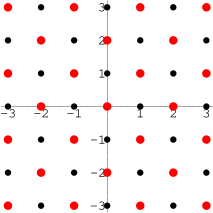
In a number ring, ideals can be represented as lattices, and can be given a finite basis of algebraic integers
which generates the ideal additively. Any two bases for
the same lattice are equivalent. A product
ideal is generated additively by the pairwise products of elements
from bases of the two factors. The illustration above shows
an ideal in the Gaussian integers generated by
2 and  , where elements
of the ideal are indicated in red.
In algebraic geometry, an ideal in a polynomial ring over  defines an algebraic variety as the common solution
set of its polynomial
equations.
In the full ring of integers of a number field, for every nonzero ideal  there is a nonzero ideal
 such that
 |
(1)
|
where  is a nonzero principal ideal, i.e., an ideal generated by one
element. Moreover, there is a finite list of nonzero ideals
 such that this equation may
be satisfied for every nonzero
 . Taking one representative from each inverse ideal class,
the size of this list is known as the class
number. Two nonzero ideals are equivalent when one
is a nonzero scalar multiple
of the other in the number field. The number of these
equivalence classes is the class
number. When the class number is 1, the full
ring of integers has unique
factorization, so the class number measures the
failure of unique factorization in this ring.
Dedekind (1871) showed that every nonzero ideal in the full ring of integers of a number
field is a unique product of nonzero prime ideals. All ideals of  are principal ideals.
Ideals can be added, multiplied and intersected. The union of ideals usually is not an ideal since it may not be closed
under addition. For ideals in a polynomial
ring over  ,
the addition of ideals corresponds to the intersection
of varieties and the intersection
of ideals corresponds to the union of varieties.
Also, the multiplication of ideals corresponds
to the union of varieties.
Intersection and multiplication are different, for instance consider the ideal  in
 . Then
 |
(2)
|
Sometimes they are the same. If  ,
then
 |
(3)
|
There is also an analog of division, the ideal quotient  ,
and there is an analog of the radical, also called the
ideal radical
 . Given a ring homomorphism
 , ideals in
 extend to ideals in
 , while ideals in
 contract to ideals in
 .
The following formulas summarize operations on ideals in commutative rings, where  denotes ideal contraction,
 denotes ideal extension,
and
 denotes an ideal
quotient:
 |
(4)
|
 |
(5)
|
 |
(6)
|
 |
(7)
|
 |
(8)
|
 |
(9)
|
 |
(10)
|
 |
(11)
|
 |
(12)
|
 |
(13)
|
 |
(14)
|
 |
(15)
|
 |
(16)
|
 |
(17)
|
 |
(18)
|
 |
(19)
|
 |
(20)
|
 |
(21)
|
 |
(22)
|
 |
(23)
|
 |
(24)
|
 |
(25)
|
If  is an algebra
with an identity element, a left
ideal (respectively, a right ideal) of
 is a subspace
 of
 such that
 whenever
 and
 .
A two-sided ideal is a subset
of
 that is both a left
ideal and a right ideal. For each such algebra
 and an element
 , the sets
 and
 are examples of left
ideals and right ideals respectively, and
 is an example of a two-sided ideal.
Every two-sided ideal of an associative algebra is a Mathieu subspace, but not every Mathieu subspace is an ideal (Zhao 2012).

