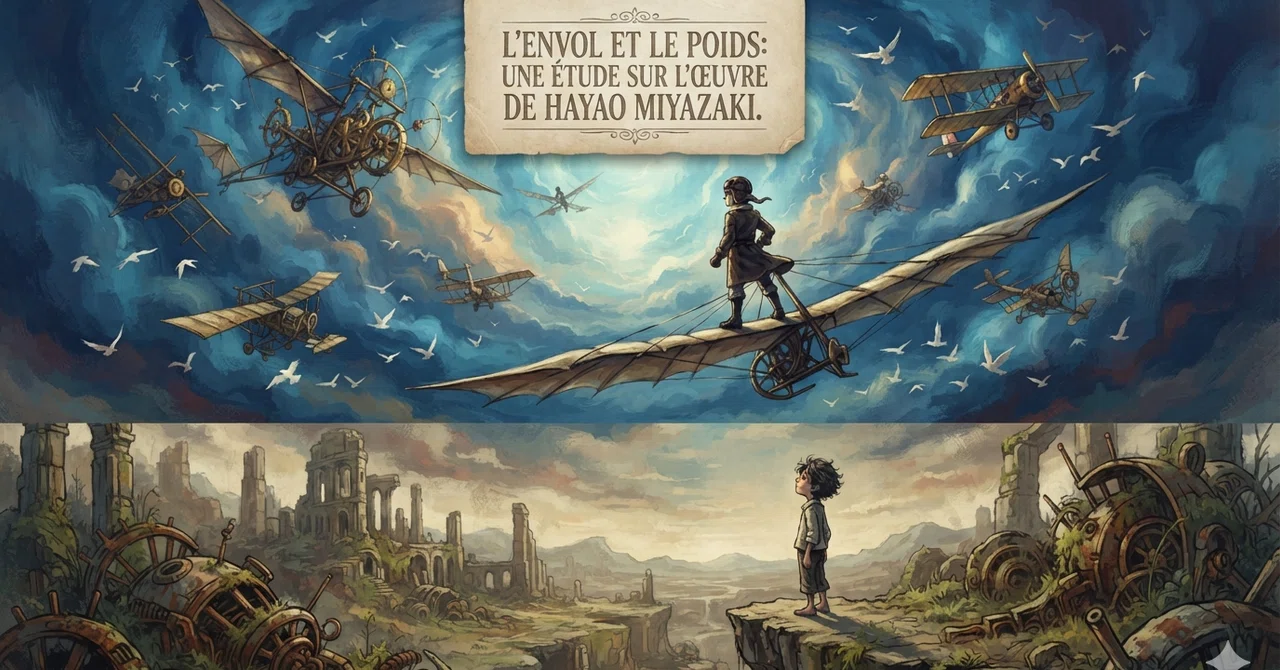
[En] Why do today’s young audiences struggle to find “real life” in Hayao Miyazaki’s films?

— PDF essay now available
Have you ever watched a Studio Ghibli film and felt that, while beautiful, its world seems somehow distant from the realities of everyday life? Miyazaki’s films are celebrated worldwide as timeless masterpieces—lush landscapes, noble communities, and heroic struggles. Yet for many teenagers and young adults today, these worlds feel strangely out of sync with their own lived experience.
For decades, critics have interpreted Miyazaki through grand themes such as politics, ecology, or mythology. But the essay I’m sharing today approaches his work from a completely different angle.
It asks a simple but overlooked question:
Why do Miyazaki’s communities feel idealized, even “too clean,” compared to the messy, bodily realities of modern relationships and cohabitation?
This essay explores that blind spot through the concept of bodily intimacy—the everyday physical and emotional practices that sustain real shared life.
Three insights that challenge conventional Ghibli criticism
1. The Tatara Ironworks has no children — a deliberately purified utopia
By examining places like the ironworks in Princess Mononoke or the bathhouse in Spirited Away, the essay shows how Miyazaki systematically removes the bodily messiness of family life from his communities.
2. “Energetic labor” mirrors the role‑based family of postwar Japan
The reason earlier audiences embraced these communities is tied to the social structure of Japan’s postwar family: the absent corporate father, the role‑performing mother, and the symbolic child. Miyazaki’s worlds echo this structure almost perfectly.
3. A decisive gap with Shinkai Makoto and today’s youth
Modern works—Weathering With You, Belle, and many 2020s anime—depict cohabitation, finances, emotional dependency, and bodily intimacy as everyday realities. Young audiences expect “substance,” not symbolism. This creates a growing gap between Miyazaki’s idealized communities and contemporary sensibilities.
Download the full PDF
You can read the complete preprint (full essay) here:
I’d love to hear your thoughts
This essay attempts to peel Miyazaki away from politics and myth, and instead examine him through the lens of everyday bodily life—cohabitation, intimacy, and the realities of modern relationships.
If you find the perspective refreshing or thought‑provoking, your support (even a small tip) would mean a lot. Comments and discussions on SNS (use #MiyazakiEssay ) are also very welcome.
Related Posts
● Hayao Miyazaki Is Not a “Creator of Hope” — Reading the Structural Reversion in His Works
