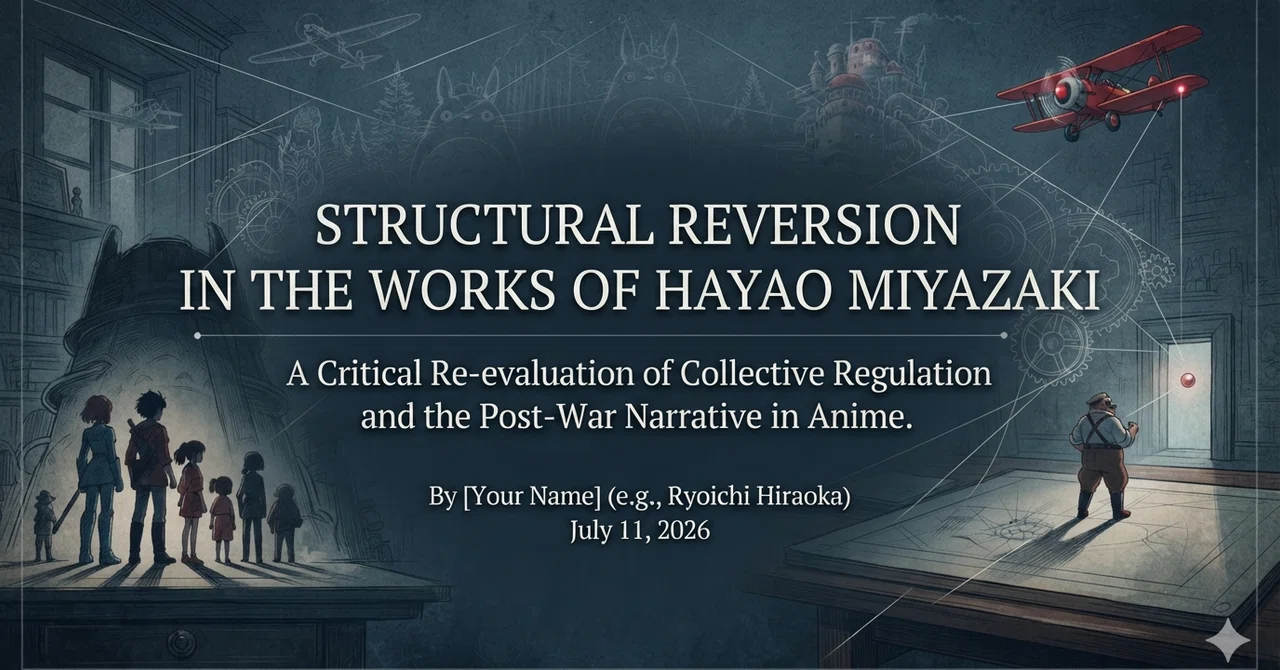
[En] Hayao Miyazaki Is Not a “Creator of Hope” — Reading the Structural Reversion in His Works

For decades, Hayao Miyazaki’s films have been framed as stories of hope, solidarity, and purity. Early works like Future Boy Conan, Castle in the Sky, and Nausicaä established a powerful ideal: the belief that the world can be changed through human connection.
But this ideal no longer applies to the late works.
Starting with Porco Rosso, Miyazaki’s narrative structure reverses:
community dissolves,
protagonists become isolated,
maturity is avoided,
flight becomes the central drive,
core conflicts remain unresolved.
Yet audiences continue to interpret these motifs through the early-period lens, transforming isolation into noble solitude, flight into freedom, and immaturity into purity.
This psychological mechanism — which I call overrun — extends the early interpretive framework beyond its valid domain, making the structural transformation of the late works effectively invisible.
Using a tripartite model — author / work / audience — this article reveals how these three layers aligned over time, producing a blind spot in the reception of Miyazaki’s cinema.
Porco Rosso is the turning point: the first film where collective regulation loosened, allowing Miyazaki’s original authorial structure to surface clearly.
◆ Download the full text here
Japanese version available here
◆ Regarding Redistribution and Citation
Please refrain from redistributing or re-uploading the PDF.
Quotations are welcome as long as the source is clearly indicated.
You are free to write any impressions or critiques.
Related Posts
● Why do today’s young audiences struggle to find “real life” in Hayao Miyazaki’s films?
