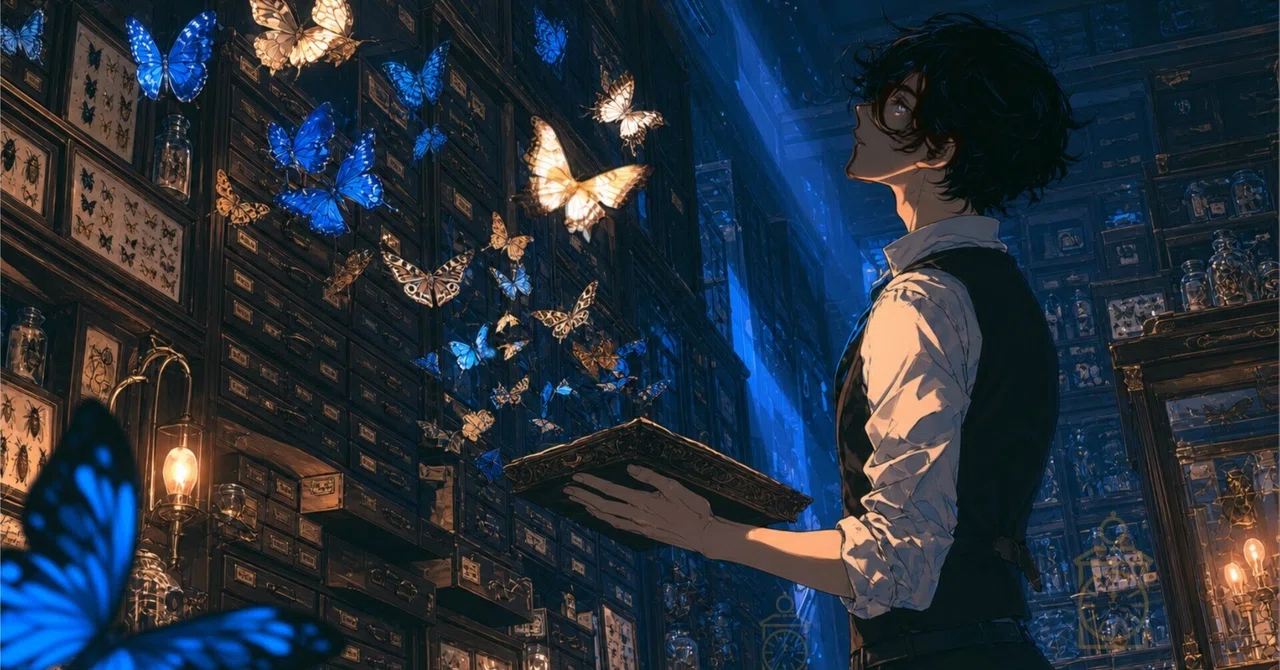
Memories of the Wunderkammer II — A Record of Naturalia

日本語版はこちら →ヴンダーカンマーの記憶② Naturaliaの記録
Today I am inspecting the specimen room.
The room where the light-sensitive specimens are kept is dark, though it is the middle of the day.
The few windows that let in light are glazed to filter out ultraviolet light.
Walls lined with specimen cases, and small drawers.
Butterflies and beetles, plants, shells, minerals.
Further back on the shelves there are specimens in jars, and mounted birds and small animals.
The things nature has made—Naturalia.
Of all the rooms in this museum, it is one of my favourites.
I check the condition of the insect specimens, one at a time.
I carry an old case to the worktable and open the lid carefully.
Blue butterflies lie in rows.
They were collected a very long time ago, and still a deep blue remains in their wings.
When I change the angle of the light, even the colour seems to change.
Beautiful.
And then, having thought that, I feel a little strange.
The person who collected this butterfly must have thought the same.
To keep something beautiful.
For curiosity—the desire to know its structure.
Here are lives cut down while still young, at the height of their beauty.
Before the wings could be damaged.
Before the colour could fade.
To hold them for ever in their most beautiful form.
The butterflies in the case are beautiful still, more than a hundred years on.
But that beauty was kept by stopping this butterfly’s time.
The living eat what has life.
Human beings, though, have taken a great many lives not only in order to live, but out of curiosity and an appetite for knowledge.
I look at the blue butterfly in front of me.
I want to see more.
I want to know more.
I want to find what no one has found yet.
I want to know how the body works.
I want to find the differences, give them names, and set them in order.
I know that feeling too.
Through that curiosity, human beings have come to know a great deal about the world.
These butterflies, too, must have become part of that knowledge.
So there was meaning in their being sacrificed.
—If I let myself think that, it would be simple enough.
But I cannot say it so plainly.
Gaining knowledge and ending a single life in order to gain it are two different things.
I do not think it is enough to look at only one of them.
I record the butterfly’s condition and return the case to its place.
I cannot bring this butterfly back to life.
So at the very least, I keep what has been left here from being damaged.
When it was collected, and where.
What kind of creature it was.
What was learned from the specimen.
To record what can be known, and pass it on.
That is all I can do, for now.
I move to the next set of shelves.
When I open the drawer with the smaller cases in it, there is a sheet of card lining the bottom.
Browned with age, a very old piece of paper.
There are countless small holes in it.
“Ah, one of these.”
The old storage boxes in this museum sometimes have paper like this laid in them.
Left in place it traps the damp, so it has to be changed from time to time.
It seems to have been in use since before this house became a museum.
There has been no reason to throw it away, so it has been dried again and again and has gone on being used.
It really is far too old; perhaps I should start replacing it with new paper.
I lift the case out, set the paper on top of it and carry both to the worktable.
The blue butterflies in the case show through the countless holes.
I am looking at it idly when my hands stop.
The holes are oddly regular.
Holes in a vertical line.
A little gap, then another line.
Not a tear, and not the work of insects.
If it were for ventilation, would there be any need for an arrangement like this—one that looks regular at first, and yet is intricate?
I look in another drawer.
There is a similar sheet of card there too.
I lay one over the other.
In some places the holes line up; in others they do not.
As though—
as though something were written on them.
Having thought that far, I have to smile at myself.
What could anyone write by making holes in paper?
“Reading too much into it, perhaps.”
I came here today to inspect the specimens.
I decide not to throw the paper away, and to note its number together with the specimen record.
Some day, when there is time, I will look into it.
Under the work lamp, I open the next case.
Another butterfly appears.
Wings spread, quite still.
Looking at it, a thought comes to me.
Perhaps human beings have always done this.
To keep what is beautiful.
To hold it before it is lost.
And to know.
How much have that wish and that curiosity left behind for the future—and how much have they caused to be lost?
I do not know yet.
Only that today, again, I go on checking what has been left in this room.
One at a time.
Without damaging them.
Without letting them be lost.
Previous Record ◇ Next Record — A Record of Exotica(Coming Friday)
This story has a musical companion.
※ In morpho butterflies, and in most other blue butterflies, the blue comes not from pigment but from the microscopic structure of the wing scales—what is called structural colour.
It fades very little, and it shifts as the angle of view changes.
What the darkness of a specimen room protects is chiefly the pigments, which do fade in light.
▼ A story connected to this world
