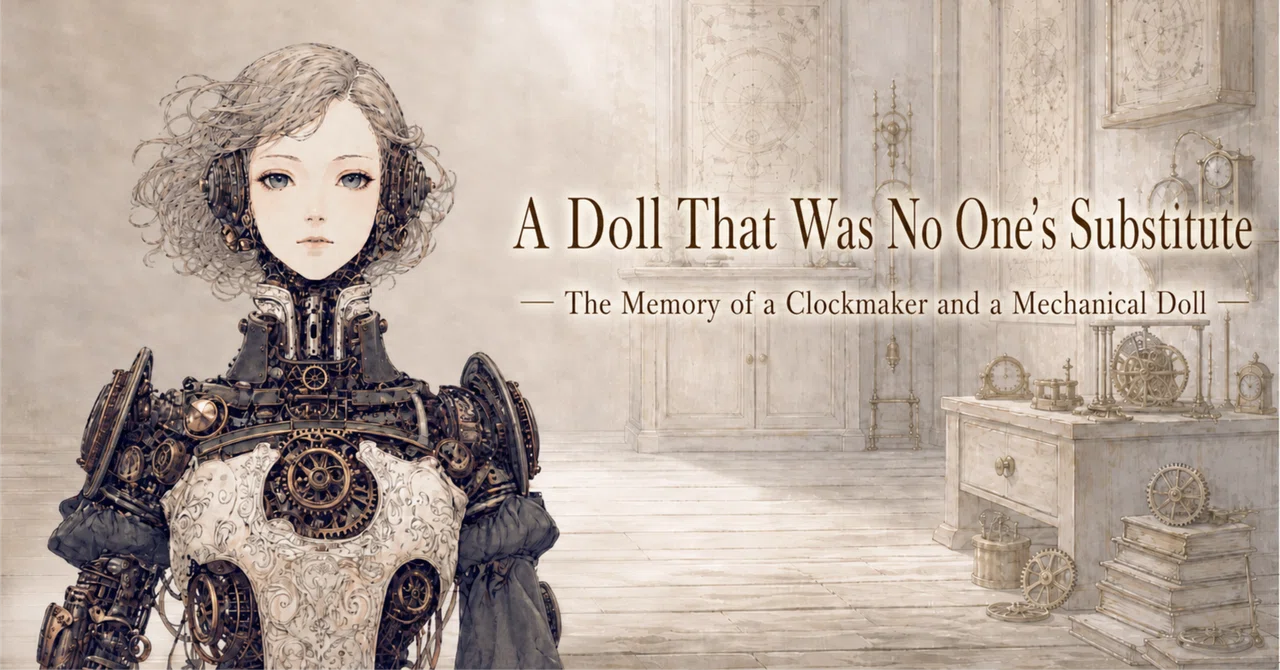
A Doll That Was No One’s Substitute

日本語版はこちら → 誰の身代わりでもない人形(オートマタ②)
A Doll That Was No One’s Substitute
― The Memory of a Clockmaker and a Mechanical Doll ―
This article is a derivative work of “The Prayer Left Behind the Gears,”
the first piece in the YouTube series “Memories of Hitogata.”
In “The Prayer Left Behind the Gears,”
we followed the memory left inside a mechanical doll.
But was the doll the only one
that left a prayer behind the gears?
This time,
we will look, just a little,
into the memory of the clockmaker
who created that doll
and spent many long years beside it.
Listen first.
Then read.
In a corner of an old town,
there was a small clock workshop.
The person who lived there
was an elderly clockmaker.
When he was young,
he took pride in fitting tiny gears together
and making the hands of clocks move correctly.
But the times
began to change little by little.
Large factories rose in the town.
Smoke climbed from their chimneys,
and whistles could be heard in the distance.
It was an age when things
that had once been made one by one by human hands
came to be made by great machines.
It was the age known as the Industrial Revolution.
The new machines
made people’s lives faster.
Many things were produced.
The town grew lively.
Some people gained great wealth.
Among those who owned the new factories,
there were even people whose power surpassed
that of old aristocrats.
That was, without doubt,
the light of a new age.
But beside that light,
there was also a deep shadow.
The sky grew dim with soot.
The rivers became polluted.
And sometimes,
small voices were drowned out
by the sound of great machines.
The handwork of old craftsmen
was also pushed little by little
toward the edge of the age.
Even so,
the old man remained in his workshop.
A soot-stained window.
Faded blueprints.
Brass parts.
The smell of oil.
The sound of tiny gears.
Only there,
as if a little left behind by the current of the age,
a quiet time continued to flow.
The old man
once had a family.
In his memory,
the one who remained in the youngest form
was his daughter.
His daughter
was never able to grow into an adult.
Factory smoke.
A soot-darkened sky.
Polluted air.
Within the shadow of that age,
his daughter remained in his memory
with the face of a child.
He also had a son.
His son crossed the sea
in search of a new life.
His destination
was faraway America.
At first,
letters arrived from across the ocean.
But as the years passed,
those letters became fewer,
and life in that distant country
became his son’s new everyday life.
His son never returned
to the workshop.
And then, there was his wife.
His wife spent many long years by his side,
grew old,
and eventually passed away quietly.
It was a natural parting,
the kind that comes someday to everyone.
But for the old man,
sending off the person
who had been beside him for so long
was a very quiet
and very great event.
Left alone in the workshop,
the old man tried at last
to give form to a wish
he had kept hidden deep in his heart.
As if chasing the image of his daughter,
he created a single mechanical doll.
The doll, moved by gears,
was called an automaton.
A face as white as ivory.
Eyelids that lowered quietly.
Slender fingers tracing a fixed movement.
Gears turning faintly within its chest.
Perhaps the old man
wanted to take back the time he had lost.
I want you to stay by my side.
I want to see that face
just one more time.
He placed such wishes
one by one
deep behind the gears.
But
the doll was not human.
Its hands
had no warmth.
Even when he held them,
they did not hold his hand in return.
No matter how beautifully he made it,
no matter how precisely it moved,
the doll could not become
his lost daughter herself.
The old man must have touched
those cold hands
many times.
But no warmth returned.
No voice returned.
The lost time did not return.
At that time,
it must have seemed to the old man
that nothing at all
would ever return to him.
In the beginning,
he must have grieved over that.
But over the long years,
the old man’s gaze
slowly began to change.
People change.
They grow old.
Their voices change.
The speed of their steps changes.
And one day,
the time of parting comes.
His wife was gone.
His son had crossed to a distant country.
His daughter remained in his memory
with the face of a child.
But the doll
continued to stand in the old workshop,
unchanged in form.
And over the long passage of time,
the doll gradually ceased to be
a substitute for his daughter.
Not only because it resembled her.
Not only to fill what had been lost.
The old man came to see the doll
as itself.
This doll
is no one’s substitute.
No longer a substitute for anyone.
You are you,
my proud doll.
As the old man grew even older,
his eyesight weakened,
and he could no longer continue
his fine work as he once had.
Even so,
people came to his workshop.
Aristocrats who loved rare things
came to catch a glimpse
of the mechanical doll.
They were captivated
not only by the doll’s beauty,
but also by the way it moved.
Its eyelids lowered quietly.
Its fingertips moved ever so slightly.
Deep within its chest,
gears marked the passage of time.
It did not look
like a mere mechanism.
The aristocrats smiled
as if they had not simply seen a rare object,
but had witnessed a small miracle.
Then they said,
“Thank you for showing us something so precious,”
and left money as a sign of gratitude.
The old man
could no longer work enough to support himself fully.
But because that doll was beside him,
he was somehow able to continue living alone.
Something the old man had once created
was now supporting his life.
Eventually,
people from museums
and collectors of rare things
also began to visit the workshop.
They looked at the doll
with the same eyes they might use
when gazing at specimens from distant countries,
old musical instruments,
or pieces of craftsmanship
that could never be made again.
Then they offered
a sum of money the old man had never seen before,
and asked him to give them the doll.
But the old man
would never let it go.
It was not
a rare object.
It was not an ornament.
It was not something to be given a price and sold.
That doll was
the very time the old man had spent
losing,
creating,
maintaining,
and watching.
And even if someone had bought it,
there was no one who could truly preserve the doll.
The habits of its gears.
The faint creak of its axis.
The right amount of oil.
The difference in its sounds.
A movement that lagged by the smallest amount.
The only one who could notice these things,
repair them,
and keep putting them right
was the old man.
The doll seemed
like something unchanging.
But in truth,
it was not something that could go on forever
without care.
It was because the old man watched it every day,
listened closely,
and kept correcting the smallest misalignments
that it seemed to remain unchanged.
Perhaps the old man
had wanted to create something perfect.
But in the end,
what he loved was not a perfect doll.
It was the doll that stayed beside him,
even with gears
that slowly fell out of alignment.
Perhaps even those misalignments
became dear to him.
Eventually,
the old man too
passed away.
It was
a very quiet thing.
It was as if the time of the old workshop
had softly come to a stop.
After the old man was gone,
there was no one left
to care for the doll’s gears.
Small misalignments
began to overlap little by little.
The sound grew faintly clouded.
The movements became slower.
And after leaving behind
one final gesture
unlike its usual movements,
one morning,
the doll had stopped quietly.
It did not look
like a major breakdown.
Rather than being broken,
it seemed to have completed
a long duty.
As if
it had followed after the old man.
As if
it were offering a silent prayer for him.
Quietly,
the sound of the gears disappeared.
But that does not mean
nothing remained behind them.
The wish to recover what had been lost.
The hand that never held his hand in return.
The time in which the doll ceased to be someone’s substitute.
The hands of the old man, who cared for it until the end.
And
the quiet pride of saying,
You are my proud doll.
All of these, I believe,
remained behind the gears.
Can a created thing
hold a heart?
I still do not know the answer.
But people sometimes
turn their hearts toward things
that do not answer them.
They take a hand without warmth,
and place their precious feelings there.
Did it seem as if a heart had been born
inside the doll?
Or was it inside the old man,
who continued to gaze at the doll?
Or did something certainly come into being
only in the space between them,
during the long time they spent together?
I would like to leave the answer undecided.
Only this much is certain:
even after the sound of the gears disappeared,
something remained behind them.
This story is here
so that we may look, just a little,
at the trace of that presence.
▼Continue the story here
About the Creation
“Memories of Hitogata” is a BGM series
that weaves quiet stories and music
from the memories left behind
in beings shaped like human forms.
The story, worldbuilding, and structure are original works by Furiko.
Listen to this story with music ▼YouTube
