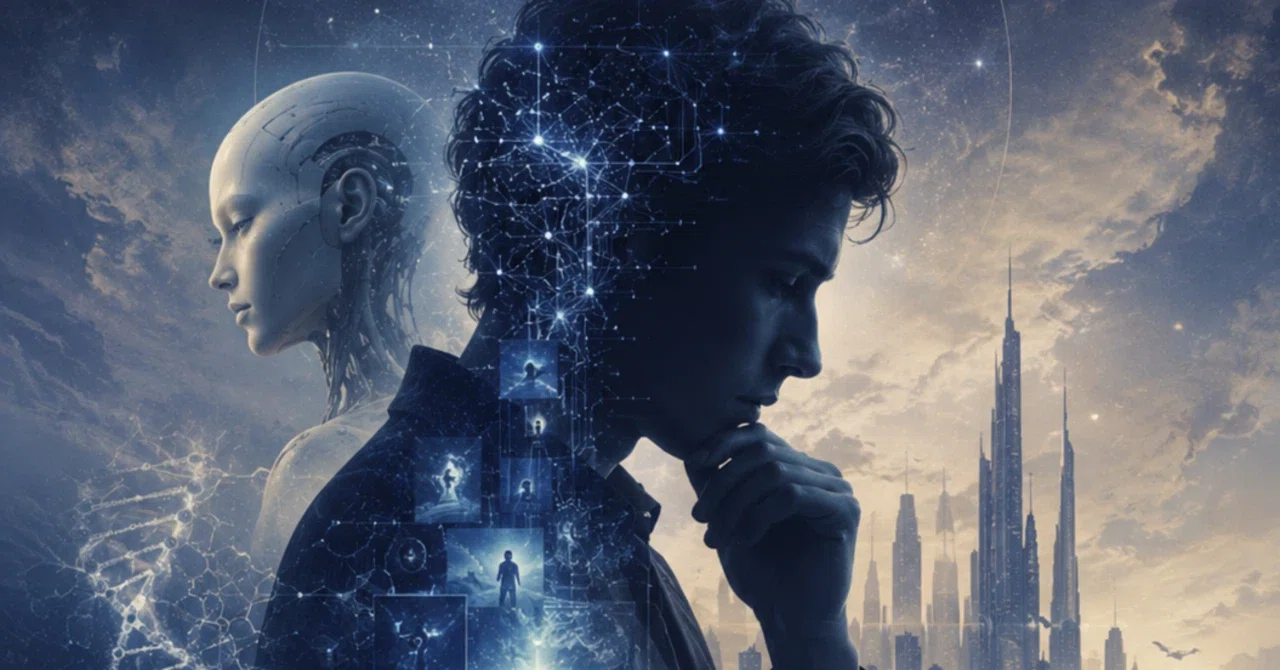
How Has Science Fiction Answered What It Means to Be Human: Part 1 - What It Means to Be Human in Twentieth-Century Science Fiction

My books are available as e-books; I would be very grateful if you read them. I am also on X, so I would be delighted if you followed me there.
This four-part series examines how science fiction has responded to the question “What does it mean to be human?”
Part 1 addresses twentieth-century science fiction; Part 2, twenty-first-century science fiction; Part 3, the reasons science fiction converges on this question; and Part 4, conceptions of the human in the future of science fiction. By depicting the future, science fiction is a genre that reexamines the boundaries of the human and ethical questions.
In twentieth-century science fiction, the question “What does it mean to be human?” often arises through comparison with figures and conditions placed outside the human: aliens, robots, androids, mutants, regimented societies, and survivors of nuclear war. These are not merely narrative devices. They are thought experiments that test the grounds on which human beings have considered themselves human.
The science fiction of this period asked whether human beings are truly rational beings, whether they possess free will and emotions, whether they bear ethical responsibility, and whether being mortal and finite is a condition of humanness. Twentieth-century science fiction did not stabilize the definition of the human. Rather, by juxtaposing the human with the nonhuman, it exposed just how unstable that definition is.
■ 1. The Human as a Rational Being
Since the advent of modernity, human beings have often been defined as beings endowed with reason: beings that advance science, operate technology, plan for the future, and master nature. This is the modern conception of the human. It is also strongly reflected in the science fiction of the early twentieth century. Visions of humanity venturing into space, exploring unknown planets, and overcoming adversity through scientific intelligence were bound up with faith in science and technology.
At the same time, however, twentieth-century science fiction cast doubt on this rational conception of the human. Science and technology do not merely liberate humanity. Nuclear weapons, totalitarianism, surveillance technology, environmental destruction, human experimentation, and vast systems of social control are likewise products of reason and technology. In twentieth-century science fiction, therefore, human beings are at once beings that progress through reason and beings that use reason to lead themselves toward destruction.
Here lies the fundamental paradox of twentieth-century science fiction. Human beings are not great simply because they are rational. Rather, their peril lies in the fact that they possess reason yet cannot fully control it. Scientific rationality is both evidence of humanness and a force that threatens humanity.
In this respect, twentieth-century science fiction inherited an Enlightenment conception of the human while criticizing it from within. A human being is a rational being. Yet that is not enough, because reason does not guarantee ethics. Twentieth-century science fiction repeatedly depicted this disjunction.
■ 2. What Robots and Androids Call into Question
In twentieth-century science fiction, the robot was one of the figures that most directly embodied the question “What does it mean to be human?” Although created by human beings as a tool, the robot was portrayed as taking human form, replacing human labor, and eventually imitating human intelligence and emotion.
As long as a robot remains merely a machine, the difference between it and a human being is clear. A machine obeys orders, has no emotions, and pursues no purpose of its own. A human being, by contrast, thinks, feels, and chooses freely. Science fiction, however, does not leave this distinction intact. If a robot understands language, complains of pain, fears death, loves others, and questions its own reason for existing, is it still merely a thing?
This question becomes sharper still in works about androids and artificial humans. When an artificial being appears that cannot be distinguished from a human by its outward appearance, the definition of the human becomes detached from the body. Faced with a being that has a human face, a human voice, human memories, and human emotions, on what grounds can one still say, “It is not human”?
What matters here is that the closer robots and androids come to being human, the more human superiority is destabilized. Human beings have regarded themselves as special because of their intelligence, emotions, ethics, and free will. Yet if artifacts can possess these qualities, human distinctiveness disappears. Conversely, when robots are more honest, logical, and ethical than human beings, humanness no longer necessarily resides on the human side.
Twentieth-century representations of robots did not seek to affirm the distinction between humans and machines, but to depict the moment when that distinction collapses. Is a human being a being with emotions? A being with free will? A being that fears death? Or a being recognized by others as human? Through questions such as these, robot science fiction revealed that no single condition can sustain the definition of the human.
■ 3. Dystopia and Free Will
Another central domain of twentieth-century science fiction is dystopia. Through regimented societies, surveillance states, class systems, thought control, chemically induced happiness, and information manipulation, dystopian science fiction problematized human freedom.
What is at stake here is whether being human entails choosing freely. If a state or system can control an individual’s life, occupation, romantic relationships, beliefs, desires, and even memories, can human beings still be considered free? Moreover, if a regimented society is safe and comfortable, has little conflict, and guarantees a certain degree of happiness, should human beings nevertheless seek freedom?
The importance of dystopian science fiction lies in the fact that it does more than portray oppression as a simple evil. Regimented societies often espouse positive ideals such as order, efficiency, happiness, security, and peace. Human beings are freed from pain and the anxiety of choice and protected from danger. Nevertheless, something essential is missing.
What is missing is free will. A human being does not merely live in comfort. A human being chooses, fails, suffers, makes irrational judgments, and sometimes rejects the happiness provided by an institution. Twentieth-century science fiction did not simply idealize freedom; it also depicted freedom as something accompanied by pain and anxiety. Freedom is not a mechanism that guarantees happiness. Rather, it is the capacity to reject that guarantee.
The conception of the human in dystopian science fiction is therefore profoundly paradoxical. Human beings cannot be rationally optimized because they cannot endure optimization. They feel uneasy even when an institution presents the correct future, and they resist being predicted, classified, and controlled.
In this sense, twentieth-century science fiction portrayed the human not as “a free being” but as “a being that cannot endure being completely controlled.”
■ 4. Encounters with Aliens and the Destabilization of Anthropocentrism
Encounters with aliens also constitute an important strand of twentieth-century thought about the human. An alien is at once an extraterrestrial life-form and a device for destabilizing anthropocentrism. What it means to be human cannot be understood by looking at humanity alone. The contours of the human first become visible in an encounter with a being that possesses a radically different intelligence, body, sense of time, language, and ethics.
Stories of first contact ask more than whether the other can be understood. They ask how human beings behave when confronted with a being they cannot understand. Do they respond with fear? Do they attack? Do they colonize? Do they attempt translation? Do they continue the dialogue?
Here, humanness manifests itself not in the height of human intelligence but in how relationships with others are formed. If aliens possess intelligence superior to that of human beings, humanity ceases to occupy the center of the universe. Human language, ethics, religion, science, and political institutions are revealed not as universal, but as merely particular forms that arose within a single environment called Earth.
Twentieth-century science fiction often portrayed aliens as objects of fear. Yet more accomplished works portrayed aliens not merely as enemies but as mirrors reflecting human limitations. Human beings cannot fully understand what is alien to them. Nevertheless, they attempt to understand. Here lies one of the mature conceptions of the human at which twentieth-century science fiction arrived.
A human being does not form relationships only with what can be completely understood. Even when faced with an incomprehensible other, a human being continues to search for a language and attempts to form a relationship.
■ 5. The Nuclear Age and Finitude
Any account of twentieth-century science fiction must confront the nuclear question. After the Second World War, science fiction became the imaginative expression of an age in which humankind had acquired the technology to drive itself to extinction. What was at stake was whether human beings are beings that progress or beings that destroy themselves.
In science fiction depicting a world after nuclear war, human beings are portrayed not as masters of civilization but as beings that survive amid its ruins. Science and technology are at once sources of hope for the future and causes of irreversible destruction. Human beings are toolmaking beings. Yet when those tools have the potential to annihilate their makers, human intelligence comes up against its own limits.
What emerges here is human finitude. Human beings die, and civilization, too, can perish. Even as twentieth-century science fiction imagined dreams of immortality and expansion into space, it repeatedly affirmed that human beings carry their own ending within them. Death, loss, ruins, memory, regret: these are not merely dark themes. Because human beings are finite, their choices carry weight. Because some things cannot be undone, ethics becomes necessary.
Human beings possess power. More importantly, however, they are held accountable for how that power is used. The science fiction of the nuclear age made this recognition decisive.
■ 6. Cyberpunk and the Transformation of the Body
In the latter half of the twentieth century, science fiction’s conception of the human changed further. With the advent of cyberpunk, the human body ceased to be a fixed natural object. Bodies became mechanized, the senses were extended, memories were manipulated, and consciousness was connected to networks. What was depicted here was not a confrontation between human beings and machines, but a situation in which machines became embedded within the human.
This change is crucial. In robot science fiction, human beings and machines still faced one another. In cyberpunk, however, human beings themselves become cyborgs, are transformed into data, and become part of the information environment. Questions of whether a human being is a body, a consciousness, a memory, or information move to the foreground.
Science fiction at the end of the twentieth century anticipated the set of problems that would define twenty-first-century science fiction. Human beings could no longer be understood as purely biological beings. They are beings extended by technology, controlled by capitalism, and reconfigured by information networks. Here, the question “What does it mean to be human?” shifts into the question “How far can one change and still remain human?”
By this stage, twentieth-century science fiction had almost completely dismantled the classical conception of the human. Simple definitions identifying the human with the body, reason, emotion, or free will could no longer be sustained. Human beings had already come to be portrayed as hybrids of machines, institutions, information, memory, desire, capital, and environment.
■ Conclusion: The Conception of the Human in Twentieth-Century Science Fiction
What, then, was the human in twentieth-century science fiction?
First, human beings are rational, yet reason does not guarantee ethics and can also bring about destruction.
Second, human beings possess emotions. Yet if artificial beings can do the same, emotion alone cannot define the human.
Third, human beings seek freedom, yet freedom often conflicts with happiness and security.
Fourth, human beings form relationships with others, yet those others are not necessarily comprehensible.
Fifth, human beings are mortal and finite. That is precisely why choice, responsibility, memory, and ethics have meaning.
Sixth, human beings change: they modify their bodies, join with machines, and reconfigure themselves within an information environment.
Twentieth-century science fiction therefore offered no single answer. Rather, it refused to give the question “What does it mean to be human?” a single definition. Attempts were made to define human beings as that which is not a machine, not an alien, not something that merely obeys institutions, and not something that can escape death. Yet each time, science fiction dismantled the definition.
The human in twentieth-century science fiction is a being that seeks to affirm itself through comparison with an external other, yet loses its own boundaries through that very comparison.
In this sense, twentieth-century science fiction can be said to have answered the question “What does it mean to be human?” as follows:
A human being possesses reason yet cannot fully obey it; seeks freedom yet is tempted by control; takes pride in emotion yet discovers emotion in machines as well; fears others yet needs relationships with them; and fears death yet creates meaning through finitude.
Twentieth-century science fiction did not establish human essence. One by one, it destabilized the grounds on which human beings believe themselves to be human. That instability would be pursued still further in the science fiction of the twenty-first century.
Next episode:
