「流れに棹さす」指揮とは何か?——楽譜の距離感と『コリオラン』序曲の運動論

「流れに棹(さお)さす」という言葉は、例えば「会議の好調な雰囲気に流れに棹さすような発言をして、場を冷めさせた」というように、悪影響を与える・邪魔をする意味で誤用されることがあります。しかし、本来の語源は川の流れに棹をさして舟を進める動作であり、「波に乗る」「勢いに乗って順調に進める」という肯定的な意味で使われます。
The phrase "nagare ni sao sasuing" (setting a pole in the stream) is often misused to mean causing a negative disruption—as in, "He made a comment that set a pole in the stream of the meeting's positive atmosphere, cooling everyone off." Originally, however, the phrase describes using a pole to propel a boat along a river's current, carrying a positive meaning: "riding the wave" or "proceeding smoothly with momentum."
指揮者の本質——音楽の「運動」を駆動させる存在
指揮という動作も、まさに演奏の流れを良くする意味での「流れに棹さす」ものでなければなりません。音楽の運動を帰着点に向かって誘導していくこと――それこそが指揮者の仕事です。しかし現実には、指揮者が拍やアクセントを細かく取りすぎることで、かえって音楽の停滞を招いてしまっているケースも少なくありません。
A conductor’s movements must similarly "set a pole in the stream" by enhancing the flow of the performance. A conductor’s core task is to guide the musical movement toward its resolution. In reality, however, many conductors beat every measure and accent too finely, inadvertently causing the music to stall.
演奏動画を見ていると、拍やアクセントに合わせて一生懸命に振り続けている指揮者をよく目にします。しかし、その懸命さが動きの切れ味を奪い、音楽の推進力を抑え込んでしまうことがあります。指揮という行為を機械的に捉えてしまうと、こうした罠に陥るのです。
Watching performance videos, one often sees conductors working feverishly to mark every beat and accent. Yet that very effort can rob their gestures of crispness and stifle the music’s forward momentum. Viewing conducting as a mechanical routine leads straight into this trap.
指揮者とは、ある種の「演奏者」であるべきだと私は考えます。奏者とともにアンサンブルを組み立て、その演奏を楽曲の流れに「乗せていく」役割を担うパート、それが指揮者です。生き生きとした音楽は流動的なものであり、決して緻密な構成物を機械的に積み上げる作業ではありません。それは作曲家の仕事です。指揮者の運動の意味は、提示された情報から「流れを作り、それを操る」ことにあります。
I believe a conductor should be a performer in their own right. Their role is to shape the ensemble with the players and propel that performance along the stream of the piece. Living music is fluid; it is not a mechanical assembly of intricate components. That assembly is the composer’s work. The meaning of a conductor's movement lies in creating and shaping that stream from the score's information.
楽譜との「適切な距離感」がもたらす構造的視野
音楽の運動性を活かした演奏を行うには、楽曲の構造を深く理解し、「構造そのものを」指揮しなければなりません。そのためには、楽譜との距離が近すぎると逆効果です。あまりに近すぎると全体像が見えず、大きなまとまりを掴めなくなります。楽譜から少し離れた視点でアプローチし、楽曲やフレーズを組み立てている適切な「単位」を理解した上で、それが演奏の呼吸となるよう導く必要があるのです。
To deliver a performance that breathes movement, a conductor must deeply understand a work's architecture and conduct "the structure itself." Getting too close to the score is counterproductive: up close, you lose sight of the big picture and miss the overarching units. One must step back, grasp the broader structural units that build the phrases, and guide them so they become the very pulse of the performance.
『コリオラン』序曲冒頭の真実——「第0小節」という視点
ここで、ベートーヴェンの『コリオラン』序曲を例に考えてみましょう。冒頭の小節構造は、視覚的にも感覚的にも「タイで括られた2つの全音符 + 4分音符」という形として捉えがちです。しかし、もう少し視点を引き、楽譜全体を眺めてみてください。この形は3回繰り返されています。自由な視点でその規則性に目を向けると、積み重ねられるフレーズの真の構造は「タイで括られた2つの全音符 + 4分音符 + 全休符」となっていることが分かります。
Let us examine the opening of Beethoven’s Coriolan Overture as an example. Visually and intuitively, one tends to perceive the opening measure structure as "two tied whole notes + a quarter note." Stepping back to view the score as a whole, however, reveals that this pattern repeats three times. Looking closely at this regularity, the true building block of the repeated phrase becomes clear: "two tied whole notes + a quarter note + a whole rest."
さらに、ここに3小節おきに規則的に置かれる全休符の「呼吸的な意味」を考えてみましょう。連続する流れの中で観察すると、この全休符の中にこそ、直後の「フレーズの発音のきっかけ」が存在することに気がつくはずです。全休符の存在が、その後に続くフレーズの発音の硬軟や呼吸に決定的な影響を与えているのです。
Consider the breath-like function of this whole rest occurring every three measures. Observed as a continuous flow, one realizes that this rest contains the very impulse that triggers the entry of the next phrase. The presence of this whole rest decisively governs the articulation and breath of the subsequent phrase.
つまり、運動論としてこのフレーズを捉えるならば、構造は「タイで括られた2つの全音符 + 4分音符 + 全休符」ではなく、「全休符 + タイで括られた2つの全音符 + 4分音符」の連続なのです。この分析から、第1小節の前には全休符で構成される「第0小節」が補完されなければならないことが証明されます。
In kinetic terms, the structure is not "two tied whole notes + a quarter note + a whole rest," but rather a chain of "a whole rest + two tied whole notes + a quarter note." This analysis proves that a "Measure 0"—consisting of a whole rest—must be interpolated before Measure 1.
整理すると、冒頭で繰り返されるフレーズの構造は、以下のように「1小節を1拍と見なす大きな4拍子」として捉えることができます。
(1拍目)第0小節[全休符]
(2拍目)第1小節[タイの全音符①]
(3拍目)第2小節[タイの全音符②]
(4拍目)第3小節[4分音符]
(1拍目)第4小節[全休符]…
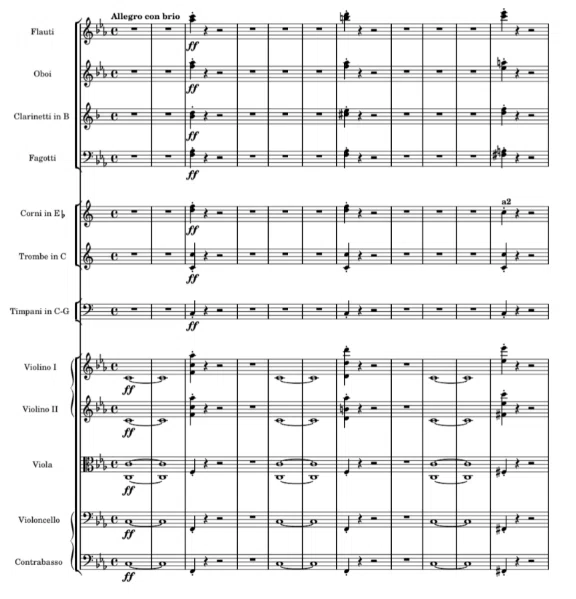
In summary, the repeating opening phrase can be understood as a "large four-beat meter where one measure equals one beat":
(Beat 1) Measure 0 [Whole rest]
(Beat 2) Measure 1 [Tied whole note 1]
(Beat 3) Measure 2 [Tied whole note 2]
(Beat 4) Measure 3 [Quarter note]
(Beat 1) Measure 4 [Whole rest] ...
全休符のダンパー機能とシンコペーションの推進力
例えば、第4小節目に注目すると、運動的には第3小節(4拍目)の鋭い4分音符によって起こされた「投げ上げ」運動をしっかりと受け止める場所として機能しています。すなわち全休符小節は、直後のタイの発音のきっかけであると同時に、フレーズ運動の衝撃を和らげる「ダンパー」の役割も果たしているのです。
Focusing on Measure 4, for instance, it acts kinetically as the landing spot that absorbs the upward throw initiated by the sharp quarter note in Measure 3 (Beat 4). Thus, the whole rest measure serves both as the trigger for the next tied note and as a damper cushioning the kinetic impact of the phrase.
ここで、第3小節が「拍節でみる4拍目」にあたることに違和感を感じる方は少なくないのではないでしょうか。自分も長い間その一人でした。しかし、これまでの構造理解で進めていくと、第3小節を下向きなインパクトで考えることのほうが全体像から見れば矛盾していることになります。ここに違和感を感じるのは、第4小節にある全休符の意味が見えていない、感覚的な誤認なのです。ここに楽譜から考える醍醐味があります。
Many readers might feel uncomfortable viewing Measure 3 as the "fourth beat of a broader metric frame." I felt the same way for a long time. Yet within this structural logic, viewing Measure 3 as a heavy downward impact contradicts the overarching motion. Discomfort here stems from misperceiving the function of the whole rest in Measure 4. This realization highlights the sheer thrill of reading the score analytically.
このような理解の結果、この冒頭フレーズでは、音符の配列上、2拍目(第1小節)と4拍目(第3小節)にアクセントがつくことになります。つまり、この冒頭フレーズはシンコペーション・リズムで構成されているのです。この事実に気づかないと、この楽曲は単に重苦しいだけの演奏になってしまいます。しかし、これがシンコペーションであると理解すれば、冒頭11小節間にわたって推進力と鋭い発音を備えた進行が存在していることが読み取れます。なお、第2〜3小節のタイで括られた2つの全音符はテヌートではありません。視覚的にそう見えるだけです。演奏の基本に立ち返れば、タイの後半部分は第4小節の発音に向けた「余白(準備)」として取られるべき場所なのです。
Through this lens, accents fall naturally on Beat 2 (Measure 1) and Beat 4 (Measure 3), meaning the opening phrase is fundamentally built on syncopation. Without this insight, the piece risks sounding merely heavy and cumbersome. Recognizing the syncopation unlocks an eleven-measure progression packed with forward momentum and crisp articulation. Furthermore, the tied whole notes across Measures 2 and 3 are not a tenuto—they merely look that way visually. Fundamentally, the second half of the tie serves as preparation for the attack in Measure 4.
「1小節=1拍」で指揮する真の理由
記憶や先入観ではなく、楽譜から冷静に情報を読み取ろうとすれば、冒頭の演奏に対する見通しは劇的に変わります。「遅い」のではなく「運動が大きい」。「重く沈んでいる」のではなく「鋭く、敏捷」なのです。なぜこの曲の冒頭から Allegro con brio(生き生きと速く)と指示されているのか、その真意が浮かび上がってきます。
Setting aside memory and preconception to read the score analytically alters one's perspective on the opening entirely. It is not "slow," but "broad in movement." It is not "heavy and sunken," but "sharp and agile." Suddenly, Beethoven's direction Allegro con brio (lively and fast) at the very start makes complete sense.
以前の記事( https://note.com/mizuzu21/n/n925e66db60e1 )で、この序曲は伝統的な「序曲」の緩急対比を継承しているとお伝えしましたが、今回の構造分析からも、冒頭部分は十分に Allegro con brio たるエネルギーを秘めていることが分かります。
In a previous article ( https://note.com/mizuzu21/n/n925e66db60e1 ), I noted that this overture inherits the traditional tempo contrast of classical overtures. Our structural analysis confirms that the opening possesses more than enough energy to warrant Allegro con brio.
さて、この冒頭部(緩部)だけでなく、その後に続く本格的な展開部(急部)や終結部においても、音楽は「1小節を単位とする」形で書かれています。小節を自在に組み替えることで、実にドラマティックな展開が作り出されているのです。例えば、1小節を1拍とする「大きな6拍子」の中で、pp(ピアニッシモ)からクレシェンドを重ねて ff(フォルティッシモ)に至る展開などは、小節の構造的組み合わせによって作られた、この楽曲ならではの白眉と言えるドラマです。
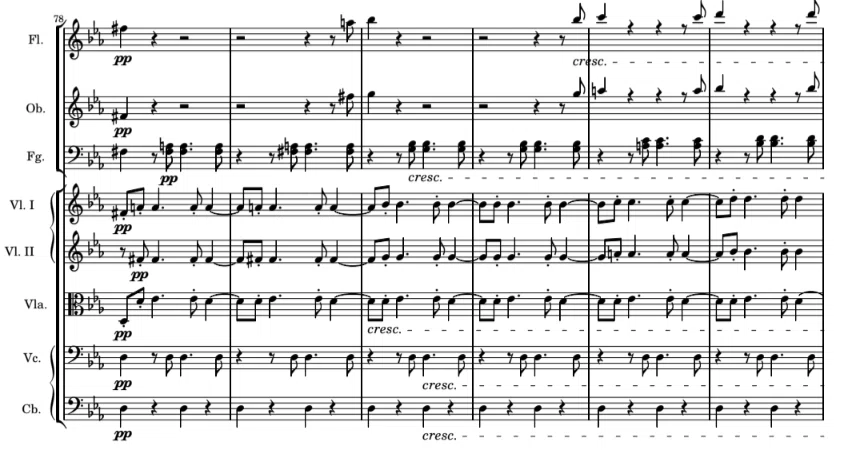
Beyond this opening, the subsequent development, main section, and coda are also written using "one measure as a single unit." By recombining these measure-units, Beethoven constructs a dramatically compelling arc. For instance, building a crescendo from pianissimo to fortissimo across a "large six-beat frame" is a brilliant structural highlight unique to this piece.
こうして検証していくと、『コリオラン』序曲は全曲を通じて「1小節を1拍(ひとつの単位)」として捉えて指揮することが妥当である、という結論に至ります。小節の中を2拍や4拍で細かく振ることは、音楽の流れをかえって淀ませる結果になりかねません。「分かりやすく丁寧な」細かい指揮は、アンサンブルを細部で合わせるには有効ですが、この曲においては楽譜が本来目指している構造的意図を覆い隠してしまうのです。それはまさに間違えた意味での「流れに棹さす」です。指揮者が音楽の停滞や淀みの原因になってしまうのは、本末転倒なのです。
This analysis leads to a natural conclusion: the Coriolan Overture should be conducted throughout with "one measure as one beat." Subdividing measures into two or four fine beats risks clogging the musical stream. While clear, detailed beating helps align delicate ensemble work, here it obscures the structural vision of the score. That would be "setting a pole in the stream" in its misused, obstructive sense. A conductor causing musical stagnation is putting the cart before the horse.
