諦める力——楽譜の事実と向き合うための音楽的覚悟

The Power of "Giving Up": The Musical Resolve to Face the Facts of a Score
「諦める」という言葉は、一般的には「挫折」や「断念」といったネガティブな文脈で捉えられがちです。しかし、仏教における「諦める(諦める)」の真意は「明らめる」、すなわち「真実を明らかに知る」という能動的な意味を持っています。
The word "akirameru" (to give up) is generally perceived in a negative context, implying frustration or resignation. However, in Buddhism, the true meaning of "akirameru" is "akiarameru"—an active pursuit of "clearly knowing the truth."
この教えを音楽解釈に援用すると、非常に興味深い視点が開けます。私たちは往々にして、自らが抱く「こうあるべきだ」という思い込みや、長年の聴取体験によって形成された固定観念に固執しがちです。しかし、その執着こそが、楽譜に刻まれた真実や新しい解釈の可能性を遮断してしまう要因となります。自らの先入観を一度「諦める」ことで、初めて作品の新たな展開が見えてくるのではないでしょうか。真実を知るためには、時に今の自分を乗り越える勇気と、既存の感覚を手放す覚悟が必要です。
Applying this teaching to musical interpretation opens up a fascinating perspective. We often cling to our own assumptions of "how it should be" and the fixed ideas formed by years of listening. Yet, this very attachment acts as a barrier, blocking the truths engraved in the score and the possibilities for fresh interpretation. By "giving up" our preconceptions, we can finally discover new unfoldings within a work. To know the truth, one must sometimes possess the courage to transcend one's current self and the resolve to let go of existing sensibilities.
現代の感性と過去の設計のズレを認識する
Recognizing the Gap Between Modern Sensibilities and Historical Design
さて、現代の私たちがクラシック音楽の演奏を聴く際、感覚的に納得しがたいことの一つに「緩急の対比」があります。特に古典派やロマン派初期の楽曲において、当時の感覚と現代の私たちの感覚には大きな隔たりがあるため、テンポの対比が小さいと、つい不満を感じてしまうのです。
When we listen to classical music performances today, one thing that often defies our modern intuition is the "contrast in tempo." Especially in works from the Classical and early Romantic periods, there is a significant gulf between the sensibilities of that time and our own; consequently, when the tempo contrast is subtle, we tend to feel dissatisfied.
しかし、当時の演奏環境に思いを馳せれば、その理由も自ずと見えてきます。その作品の演奏実例も情報も乏しく、演奏経験も少なかった時代、極端なテンポ変化を伴う演奏は容易ではありませんでした。だからこそ、当時の作曲家たちは緩急の変化を、作品の設計そのものや演奏者側の合理的な読み替えによって実現するように設定したのです。多くの作品に触れるほどに、この確証は強固なものとなります。
However, if we reflect on the performance environment of the past, the reason becomes clear. In an era with scarce recorded examples, limited information, and fewer performance opportunities, playing with extreme tempo shifts was no simple task. Thus, composers of the time built these shifts into the very design of their works, relying on the performer's rational reinterpretation. The more one engages with these works, the firmer this conviction becomes.
楽譜から紐解く「緩急の設計」:バッハからシューベルトまで
Deciphering the "Design of Tempo" from the Score: From Bach to Schubert
バッハの『管弦楽組曲』の序曲はその典型です。BWV1066(第1番)やBWV1068(第3番)において、緩急の対比があっても音符の速さは変わりません。その音楽の基本となる音符の単位(2分音符から4分音符などの細かい音符へ)が変化することで、音楽の進行感が変わる仕組みになっています。
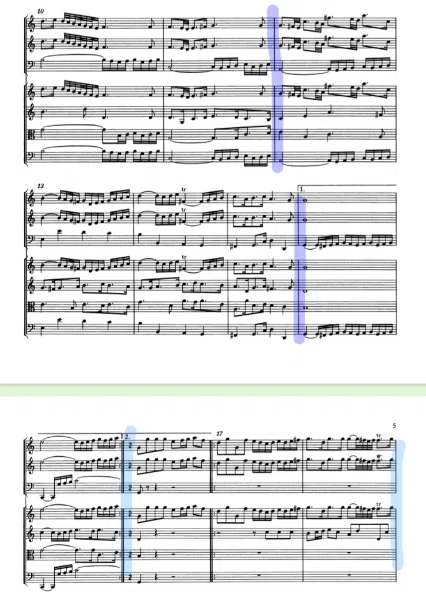
2番括弧から「急部」に入っていきます。
From the overture to Bach's Orchestral Suite No. 1:
The section enters its "fast section" from the second bracket.
The overtures to Bach's Orchestral Suites are quintessential examples. In BWV 1066 (No. 1) and BWV 1068 (No. 3), the speed of the notes remains constant even through tempo shifts; the perceived progress of the music changes because the fundamental unit of the notes transitions (e.g., from half notes to quarter notes).
また、BWV1067(第2番)やBWV1069(第4番)の序曲も、冒頭の緩部における2分音符と、急部における小節の拍感が一致するように書かれています。これらはすべて、演奏者の「割り算的な読み替え」によって成立しているのです。
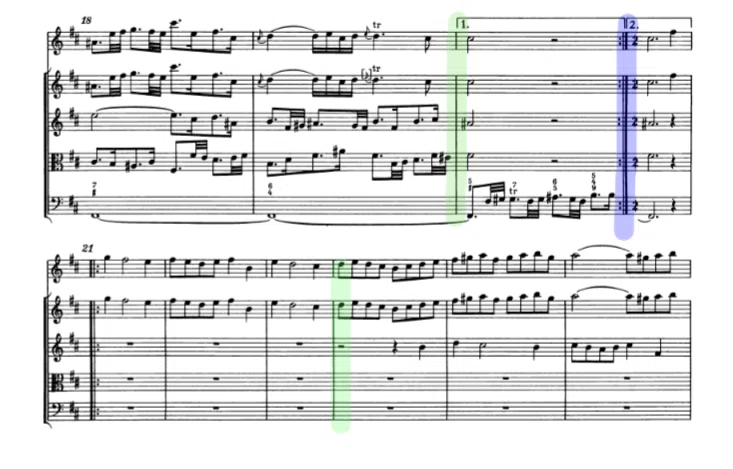
2番括弧から急部が始まりますが1番括弧の前までの
楽譜上の2分音符分の速さが2番括弧以降の小節の速さになっています
From the "Overture" of Bach's Orchestral Suite No. 2:
The fast section begins at the second bracket, and the tempo of the measures from the second bracket onward is the same as the tempo of the measures before the first bracket, which is equivalent to the tempo of the half notes in the score.
Similarly, in the overtures to BWV 1067 (No. 2) and BWV 1069 (No. 4), the half notes in the slow introduction are written to align with the pulse of the measures in the fast section. These are all achieved through the performer's "divisional reinterpretation."
この「作品の設計による緩急の交代」という伝統は、後世にも受け継がれています。グルックの『アウリスのイフィゲニア』序曲は音符の速さを変えないで実現する対比ですし、シューベルトの交響曲第9番「グレイト」(D944)第1楽章終結部における冒頭再現も、テンポを固定したままAndanteが再現されるよう、使用する音符を変更することで、精緻に設計されています。この設計は、後期ロマン派を経てきた私たちに、失われたAndanteのテンポ感を取り戻すための貴重なヒントを与えてくれます。ブラームスの交響曲第1番や第4番におけるテンポの設定についても同様のことが言えるでしょう。
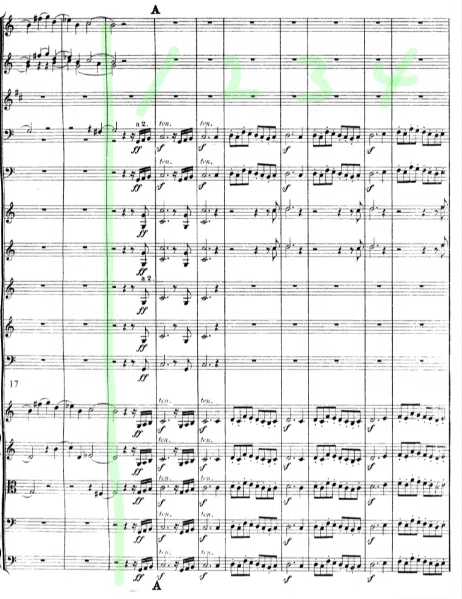
「A」から「急部」に入りますが、テンポを変える指示はありません。
Gluck, from the Iphigenia Overture in Aulis
The piece begins with "A" and moves into the "urgent section,"
but there are no indications to change the tempo.
This tradition of "tempo shifts through design" was inherited by later generations. Gluck's overture to "Iphigénie en Aulide" achieves contrast without changing note speed, and the recapitulation at the end of the first movement of Schubert's Symphony No. 9 "Great" (D 944) is meticulously designed to allow the Andante to return at a fixed tempo by altering the note values. This design offers us—who have passed through the late Romantic era—a valuable hint for regaining the lost sense of Andante tempo. The same can be said for tempo settings in Brahms's Symphony No. 1 and No. 4.
ベートーヴェン『コリオラン』における序曲形式の融合
The Fusion of Overture Forms in Beethoven's "Coriolan"
問題は、私たちが後期ロマン派以降のドラマチックな対比感に慣れすぎてしまい、古い時代の論理を理解できなくなっている点です。楽譜に書かれた事実を正しく読み取るためには、好き嫌いを越えて、この感覚の隔たりを自覚しなければなりません。
The problem is that we have become too accustomed to the dramatic sense of contrast found in the late Romantic era, making it difficult to understand the logic of earlier times. To read the facts written in the score correctly, we must transcend our personal tastes and become aware of this gap in sensibility.
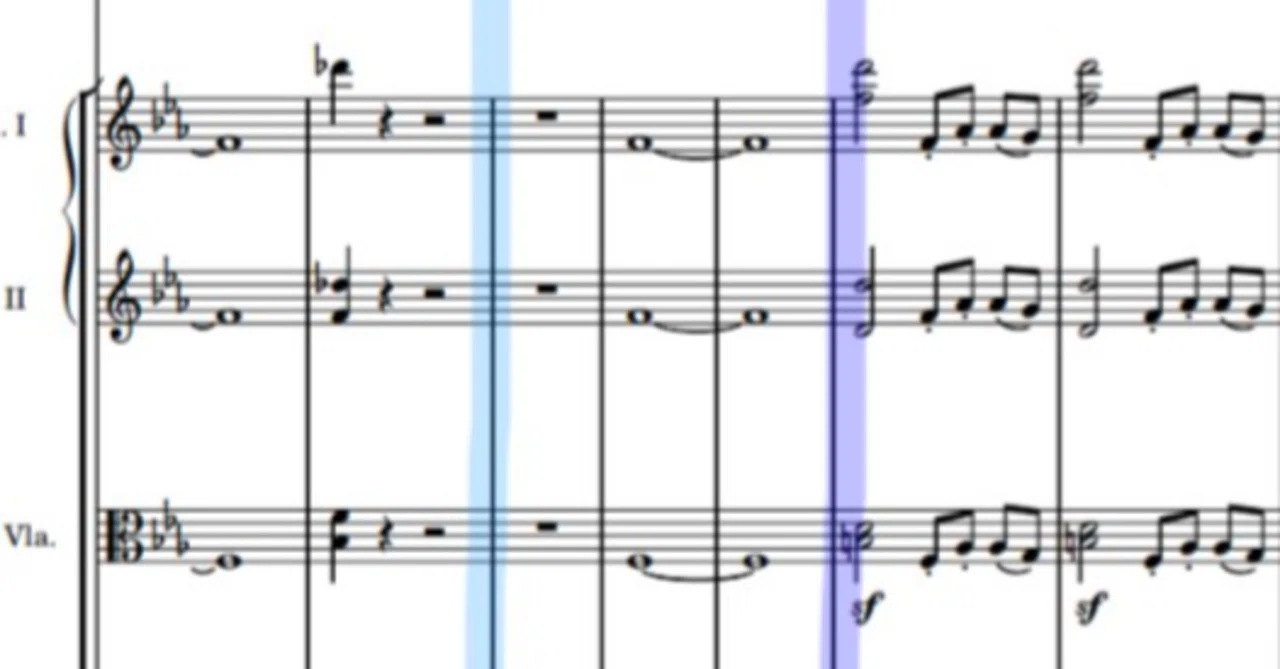
この視点からベートーヴェンの『コリオラン』序曲(op62)を眺めると、その構造は「緩ー急ー緩ー急ー緩」という、バロック時代から続く序曲形式の伝統を色濃く残していることが見て取れます。表面上はAllegro con brioのソナタ形式に見えますが、実は古い序曲形式との融合を目指しているのではないでしょうか。この曲の場合、Allegro con brioという指定のままとはいえ、例えば冒頭は、強大な構築物のように感じさせます。それは15小節目からの新しいフレーズと対照的な性格になっています。この冒頭部は曲中で再現され、さらに終結部の入口でまた顔を出します。整理すると次のようになるのです。
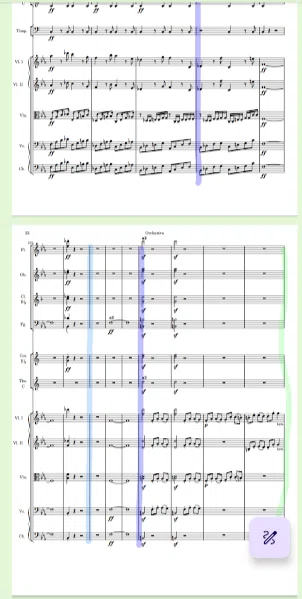
急部の最中に突如、冒頭が再現されます。
From the Coriolan Overture:
The opening is suddenly reprised in the middle of the fast section.
【緩】1~14小節目 【急】15~151小節目 【緩】152~157小節目 【急】158~275小節目 【緩】276小節目~終止
Viewing Beethoven's "Coriolan" Overture (Op. 62) from this perspective, we can see that its structure strongly retains the tradition of the overture form dating back to the Baroque era: "Slow–Fast–Slow–Fast–Slow." While it appears to be a sonata form in Allegro con brio on the surface, it may actually be aiming for a fusion of the old overture form and sonata form. In this work, despite the Allegro con brio marking, the opening feels like a massive structure, contrasting with the new phrasing that begins at measure 15. This opening section is recapitulated throughout the work and reappears at the entrance to the coda.
【Slow】mm. 1–14 【Fast】mm. 15–151 【Slow】mm. 152–157
【Fast】mm. 158–275 【Slow】mm. 276–End
過去の記憶を超えて、楽譜の事実と向き合う
Beyond Past Memories: Facing the Facts of the Score
ただし、感覚的には冒頭の巨大さゆえに、全曲を統一するAllegro con brioのテンポ感が見つけにくいとも言えます。つまり、冒頭の雰囲気に捉われると、テンポを遅く設定してしまうという罠に陥ってしまうのです。 However, due to the sheer scale of the opening, it can be difficult to find a consistent Allegro con brio tempo that unifies the whole work. That is to say, if we are captured by the atmosphere of the opening, we fall into the trap of setting the tempo too slow.
ここで必要となるのが、先に述べた「緩急の対比に関する教養」です。緩急の対比とは、極端な速度の振幅だけを指すのではありません。ハイドンやモーツァルトの交響曲における序奏と主部の関係と同様、過度な遅さは作品の設計との矛盾を生むのです。
What is needed here is the aforementioned "literacy regarding tempo contrast." Tempo contrast does not merely refer to extreme fluctuations in speed. Just like the relationship between the introduction and the main section in Haydn or Mozart's symphonies, excessive slowness creates contradictions with the work's internal design.
『コリオラン』を演奏する際、冒頭の「重い」イメージは、過去の記憶に支配されているからかもしれません。
作品と向き合うときは、まず「楽譜の事実」からスタートしなければならない。自分の感覚を「諦める」ことは、楽譜の声を真に聴くための第一歩なのです。
When performing "Coriolan," the "heavy" image of the opening may be due to the weight of our past listening memories.
When we engage with a work, we must start from the facts written in the score. To "give up" one's own feelings is the first step toward truly hearing the voice of the score.
