[en] Thinking About "Generational Harm" Through Hayao Miyazaki - Chapter 2: Why Do Young People Use the Word "Rōgai"?

← Chapter 1: The Danger of Labeling — Rōgai as Scapegoat
In the previous chapter, I argued that labeling something rōgai (generational harm) is dangerous. But before that critique can stand on its own, I need to honestly examine why young people reach for that word in the first place. Without doing so, the argument is only half-finished.
Chapter 2 | Why Do Young People Use the Word "Rōgai"?
2-1. Three Ruptures (The Inner World of Youth)
Behind the reasons young people use the word rōgai lies a profound fracture — one where social statistics and psychology collide. That fracture was born from three overlapping shifts.
The first is economic despair.
Through the "Lost Three Decades" following the collapse of Japan's bubble economy, young people have lived through a glacial job market, the expansion of precarious employment, and declining real wages. Meanwhile, pension, healthcare, and long-term care costs have continued to balloon — costs largely borne by the working generation. The feeling of "being left to clean up the mess of a generation that used everything up and got out" is not emotionally driven. It stands on economic fact.
When the return on future investment becomes uncertain, human behavior changes. "Just keep trying" works as a motivating principle only when there is a reasonable expectation that things will improve. When that expectation disappears, people begin asking a different question first: is this effort actually worth it? Because the cost of misplaced effort is one they cannot afford.
"Is this rule rational?" "Is this burden fair?" "Does this explanation hold up?" — what gets dismissed as an obsession with cost-benefit thinking is not a sign that modern people have become overly argumentative. It is a rational response to uncertainty: when returns are unreliable, the cost of verifying an action before taking it goes up.
The second is asymmetry in voice.
In meetings, the older speak; the younger are told to listen first. In recent years, the sheer opportunity to express an opinion has increased. But the sense that one's expressed opinion actually leads to institutional or cultural change remains scarce.
Remote work, flexible hours, side work, performance review systems — it's not unusual for younger generations to put forward proposals or requests across all of these areas. But whether or not those proposals are adopted, what often goes unshared is why — why something was accepted, why something was passed over. The process stays opaque.
On social media, young voices can reach far. But the power to make decisions about institutions and policy remains concentrated in older hands. What results is not a feeling of "having no voice." It is something more deflating: the voice reaches, but nothing changes. When this experience accumulates, people gradually stop speaking — not from lack of ability or motivation, but because the link between speaking and outcome has become invisible.
In the corporate world of a previous era, a single chain connected things: work hard → get promoted → gain a voice. Even when things were unreasonable, you could endure them because both the incentive (reward for performance) and the voice that came with seniority were real expectations. Today, working hard can still lead to reassignment, relocation, or stagnant pay. The relationship between effort and reward has become difficult to see. As established earlier: when returns grow uncertain, people increase the cost of verification before acting. Young people have not lost their sense of ownership. They have become more careful about where they invest their time and effort, because the guarantee that speaking up leads to change has weakened.
The third is the visibility of comparison.
The spread of social media and data journalism has made visible what was once hidden: a manager's salary, executive compensation, wage gaps with other countries, the balance of contributions and benefits across generations. Numbers can be lined up, and anyone can compare them.
Once, people measured their lives primarily against those around them: can I pay rent on this salary? Can I support a family? Am I slightly better off than yesterday? The reference point was relatively contained.
Now it is different. Your own salary, your manager's salary, the CEO's compensation package, the pay of peers in other countries — all visible. The social insurance premiums you pay, the benefits another generation receives — laid out side by side as numbers.
People are more sensitive to relative fairness than to absolute prosperity. When inequity is presented not as a feeling but as a figure, it stops being vague dissatisfaction and becomes a sharper question: why am I the one carrying this?
What has been made visible is not only a basis for anger — it is the relationship between burden and reward itself. In a society where comparison is possible, people demand coherence and fairness more strongly than before. The working generation now asks, with greater precision than any prior generation, why do I bear this alone?
That question needed a word — something to compress its complexity into a single, portable label. "Generational harm" (rōgai) stepped in to fill that function.
2-2. Why Did the Contract Break Down? (Historical Change)
Why did this structure emerge as a visible problem in the present? Looking back through history, the answer comes into focus.
For most of human history, elders were infrastructure — essential to the survival of the group. From the Stone Age through the Edo period, through famine, war, and epidemic, accumulated experience and knowledge were what kept communities alive. The same was true in the scorched aftermath of postwar Japan. There was no room — and no need — to question the calculus of elder authority.
The problem became visible when that premise collapsed. As material survival threats receded and the central question shifted from how do we stay alive to how do we navigate human society, the relative value of elder experience declined. Knowledge for survival translates across generations with relative ease. Knowledge for navigating social environments is heavily dependent on the era and conditions in which it was formed. That is precisely why experience must be continually updated to remain useful — and why it often is not.
In Japan, what entrenched this dynamic was the high-growth era of the 1950s through 1980s. In a corporate culture built on lifetime employment and seniority-based promotion, tenure mattered more than results and loyalty mattered more than capability. One particular pattern of success became embedded as the normal way of doing things.
The corporate soldiers who came of age in that era absorbed a specific set of survival strategies into their bodies: cover ambiguous instructions with time and willpower; read the intent of your superiors and move accordingly. This was a perfect adaptation to the environment of its time. And that adaptation was validated repeatedly — for over thirty years, from the economic miracle through the bubble.
The problem is not that they adapted. The problem is that the adaptation succeeded too completely.
After the bubble collapsed in 1991, the environment transformed. The job market froze. Precarious employment expanded. Performance-based pay was introduced. Lifetime employment hollowed out. "Freeter" entered the vocabulary as a permanent social category. Awareness of workplace harassment rose. Social media made previously invisible costs visible. Within a single generation — roughly thirty years — the foundational assumptions of society were rewritten.
A pattern of success formed over thirty years became obsolete in the next thirty. And yet it survived — as "common sense."
The shift itself is not the problem. The problem is that when the environment changed, the old success pattern continued to be treated as the correct answer — unexamined. The values of the high-growth era were rational in their time. But what was once rational and what remains rational now are not the same thing. The issue is not the values themselves. It is that they persisted, unverified, long after the conditions that made them rational had disappeared.
2-3. Why Did Endurance Once Work?
Consider an extreme example. It is said that in old yakuza organizations, there was a custom like this.
A young member goes to prison as a stand-in for the boss. He is told: "Do ten years. When you get out, you'll be made underboss." And it actually happened. Status. Money. Belonging. The promise was honored. So he could endure.
The society of the previous generation was one in which this contract functioned. Lifetime employment, seniority-based advancement, rising land values — these were institutions that said to individuals: bear it now, we'll pay you back later. And they did pay back. That is why the previous generation could endure. Not because of superior willpower. Because the contract was valid.
Now imagine the same scenario in the present. "Do ten years. We'll make it worth it." He gets out and the organization is gone.
The problem is not the young man's fortitude. The problem is the credibility of the contract. In a society where contracts function, endurance is an investment — in yourself, in your family. In a society where they do not, endurance is simply a one-sided loss: you absorb all the cost, and the return never comes.
This is not unrelated to Miyazaki.
When Miyazaki was young, the animation industry was hardly a comfortable place to work. But the industry itself was growing. Many creators carried a genuine sense that their suffering was an investment in their future. Most young creators today hear the same words and cannot receive them as the same contract. (Chapter 5 will trace that arc.)
Suppose those young yakuza members had been told from the start: "The organization might not exist in ten years — but do your time anyway." Would they have agreed? Most, in all likelihood, would have refused.
The same holds today. Young people are repeatedly told the numbers don't point toward a brighter future. There is no guarantee that effort will be rewarded. The felt sense of improvement is hard to come by. Telling someone in that position to "endure for now" — that phrase does not sound like a contract. It sounds like a wish.
This resembles the succession crisis in traditional crafts and arts. Once, a contract existed: train, and you will become a master; carry on the tradition, and you will be able to live. When that contract's credibility became unclear, "endure for now" stopped sounding like a promise and began sounding like a demand — a kind of imposition.
The previous generation was not simply more patient. They lived in an environment where hope in the future was a reasonable thing to hold.
And the cost-benefit thinking of today's young people, the absence of organizational loyalty — these are not signs of weakness. The contract has lapsed.
When the previous generation finds the current generation "soft," it is not malice. They are applying their own measuring stick — an honest response. But that measuring stick cannot see that the terms of the contract have changed.
When the current generation calls the previous generation rōgai, it is not pure emotion either. But that word does not reach the fact that the previous generation lived honestly within a contract that was, at the time, real.
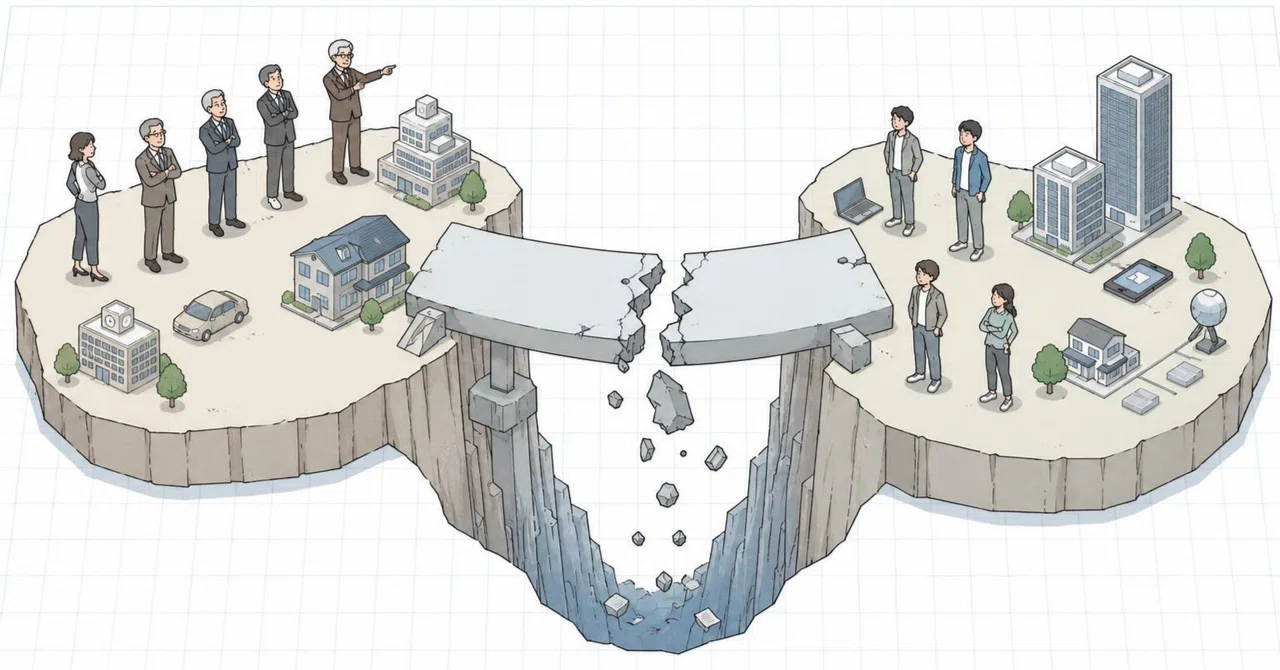
Neither generation is reading the other's contract. So words fly back and forth. And nothing lands.
This asymmetry appears in language itself. When those labeled rōgai face criticism, the phrase "can't help it, they're old" functions as a kind of social exemption — it looks like humility but operates as a pass, a way to exit accountability. Age as attribute becomes an escape from the obligation to explain.
But this pass is not issued to the young. "Can't help it, they're young" is not an exemption. If anything, it is answered with "so grow up." The same structure of language functions for one side only.
When this asymmetry accumulates, the label rōgai begins to carry meaning not as emotional explosion, but as resistance to structure — a form of pushback.
But that is not the only outcome. When the expected return on being earnest declines, people gradually disengage from long-term cooperation. Some lose loyalty to their organizations. Some do the minimum. Some abandon the legitimate path entirely and become drawn to short-term extraction. Behind that, of course, lie various factors — poverty, isolation, the recruitment of criminal networks. But in its most extreme form, this may be what underlies the recent social problem of yami baito1.
The problem is not individual morality. When contracts stop working, society makes short-term extraction a more rational option than long-term effort.
This collapse of the contract also affects what people live for. The old contract rested on a premise: work hard, and you will be happy. Get promoted. Buy a house. Support a family. There was a visible reward at the end of effort. People could work toward happiness.
Now that the contract has broken down, what lies at the end of effort is no longer clear. Running toward something you cannot see is difficult for anyone. Perhaps that is why so many people now prioritize not breaking down — before they even consider succeeding.
Then, it was: I work to become happy.
Now, it is: I live to not fall apart.
This is not a problem of individual motivation. It is the result of the reward the contract once guaranteed becoming something no one can trust.
Having established all of this — I still say: rōgai labeling is a problem.
Even when the anger has legitimate grounds, the moment a personal grievance is converted into a verdict against an attribute, legitimacy is lost. Furthermore: when the feeling of "we are being exploited" intensifies, it can serve simultaneously as a valid basis for anger and as a shield that pre-exempts all of one's own actions from scrutiny.
The moment words that expose injustice become the reason not to pay one's own costs, the anger of the young reproduces the same structure as rōgai.
The line between legitimate anger and converting anger into a shield is thin.
The problem lies in the structure, not the people. This is the consistent theme of this essay. It will be examined again in Chapter 7.
What is happening here is that neither side is reading the other's contract. Words fly. Nothing lands.
To the younger generation, it looks like the previous generation keeps insisting that the success patterns and measuring sticks from a contract that has already expired are still universally correct — and pushing those patterns onto others.
"Effort will be rewarded." "Unreasonableness should be endured." The words themselves are not wrong. But the conditions under which they were true are not being shared.
That is why young people use the word rōgai — to name a dissonance for which they otherwise have no language.
But not every generational conflict is rōgai. So what is it that actually makes rōgai what it is?
The next chapter defines those conditions.
→ Continues to Chapter 3
Footnotes
Yami baito (闇バイト, lit. "shadow part-time work"): a term that emerged in Japan in the 2010s and became a serious social concern in the 2020s. It refers to gig-style jobs recruited through social media — seemingly ordinary part-time work — that turn out to involve criminal activities: package theft rings, fraud call center operations, money mule tasks, or in extreme cases, robbery and violence. Recruiters deliberately obscure the criminal nature of the work during recruitment, often targeting people in financial distress. The phenomenon is seen as a symptom of the breakdown of legitimate economic contracts for those on the margins — when the legal path to survival feels closed off, illegal short-term extraction becomes comparatively rational. ↩
