SocraticGadfly: atheism
Showing posts with label atheism. Show all posts

November 03, 2021

Updating Chris Stedman, because

 Material at top taken from a LONG blog post about Chris Stedman's "Faitheist" book, his marketing of it, and even more of himself, and how he was likely full of crap and marketing crap way back then, and still is today.
 
If you’re not familiar with that name, it appears to have been something  largely developed by Chris Stedman, now the recently published author of a book by that name, which is what this blog post is all about.

First, some personal identification by me.

Regular readers of this blog, or at least the part of it that deals with religion, philosophy and metaphysics, know that I normally don’t have a lot of use for the New Atheist, or Gnu Atheist, “movement.” I've written about my issues with Gnus on many occasions, most recently here. I consider them too confrontational, for one thing. I consider them too … fundamentalist, to be wry, secondly. Third, unlike them, I have no desire to “evangelize” the religious, let alone conduct an intellectual browbeating quasi-jihad.

A brief 2017 update from the original: Stedman is no longer doing the secularist chaplaincy work at Harvard, per his Twitter. To complete the rebranding cycle, this fall, he'll be ....

TEACHING AT AUGSBURG!

So, OK, he won't be a Buddhist in two years. He'll be an ELCA Lutheran.

And now, the new. Looking at this 20 months after my last comment at my original post? First, I'm wondering if Chris' dad was an abuser, and that's why he's largely written out of Chris' story. Would explain a LOT on Chris' psychology.
 
Second, I looked up Chris' new book that came out last year. Teaching at Augsburg, and thus, even within the liberal wing of Lutheranism and Minnesota nice, almost certainly NOT an atheist, per what I ventured above. The "about" on his own website also doesn't mention the Big A. He doesn't identify as such on the bio for his new book at Amazon, which sounds like Minnesota nice dreck about how to be nice on the Internet, mixed with a steaming pile of Jungian psychology-related bullshit, which sounds just about right for Stedman.
 
Even if he DID call himself an atheist, I would not consider him one. Since atheism is not a "faith" or a "religion," it's an oxymoron at minimum to for himself to peddle himself as an "interfaith activist" if he does, elsewhere, call himself an atheist. 

In addition, that gets back to atheist critiques at the time he wrote "Faitheist" and earlier — he softpedals what atheism is. But, for him? It's also surely all about the "brand."

That said, a full decade ago, Stedman was peddling misleading claims about the parallels between interfaith movements and atheism.

As for me? If you asked me to participate in a "humanist movement" meeting with religious as well as secular humanists involved? I'd be there. But not an interfaith movement. And, this in turn means that Stedman probably needs to read some Gilbert Ryle. Ditto for Jesse Galef and others he name-dropped. If they're conflating "interfaith" and "humanism," they made a big-assed category mistake. And that is another reason not to want to play ball on their field. 

And, as Stedman either knows and ignores, or else doesn't know and is not trustable intellectually, names do mean something. Per ordinary language analysis, it is a "game" as to what name we use, because it does frame what the conversations will be about.

Third, he has a podcast (but of course) listed by Mashable (but of course) at No. 18 on its best new podcasts list. Surely some branding going on there, too. Next, we will find out that Chris is either "trans" (without the suffixed adjective, but surely "-gender" not "-sexual") or else that he's straight.

Fourth, for laughs, read the reviews at Goodreads, especially the one-star ones. As I told a reviewer that is identified as "Augsburg University," I doubt the atheism part.

All in all? A tribute to the Peter Principle, maybe. And, if somebody accuses me of envy, I'll freely cop to that. I'll still insist that, at the same time, the diagnosis is true.

Update, Sept. 5, 2022: But of course Stedman had a puff piece interview over her mysticism claims with the late Barbara Ehrenreich, with both interview and her claims discussed in my eventual takedown obit.

August 31, 2020

RIP Ed Brayton

I already said RIP to the co-founder of Freethought Blogs at my Philosophy of Socratic Gadfly site but wanted to speak here as well, with expansion of some of the political ideas I wrote about there, both where I agree and where I disagree.

Basically, the political issues of disagreement reflected some of the same tribalism of Gnu Atheism, with which Ed had a conflicted, but yet enabling, relationship. Let's dig in.

I've long since stopped following "movement" skepticism or most "organized" atheism, especially anything that tilts Gnu-ish. I knew Brayton had been in somewhat declining health for some time, indeed, even from when he split off from the Freethought Blogs he co-founded with P.Z. Myers.

And now I see he died the early part of August, three days after his last blog post. Unfortunately, his dying reportedly was not as pain-free as he had hoped.

My take? He'll be missed to a degree, but not as much a degree as many paeans would have you believe.

I wrote about problems at FtB when Ed was still large and in charge. Tolerance of social justice warriors, above all Stephanie Zwan and "husband" Greg Laden, which sent Laden the rabid pit bull after me when I joked, with roles reversed, of him and his "wife."

The big thing I have against Ed, per the link above, is this, and that's Ed getting into bed with PZ in the first place. And, the loonies he let stay there far too long. And the hypocrisy a year before that. Per the first link in the graf, he and PZ were both cheap asses to the late Leo Lincourt in not paying his surely reasonable price to make FtB better as a website. And, I have no doubt Leo's price was reasonable, and that FtB would have looked like what Patheos, and Ed's eventual "Dispatches from the Culture Wars," did look like.

Probably what I'll miss most about him is what most of us miss about ourselves later in life: The could have beens. That would mainly be, in Ed's case, a FtB that never had P.Z involved in the first place. Can't say you weren't warned, Ed, from this small corner of the blogosphere; as I noted, from the start, you were turning over too many of the keys to PZ. Had that been the case, Greg Laden and Stephanie Zwan might not have been part of FtB, as well, and the problems never would have reached that point. In other words, a secular humanist version of Panda's Thumb or something.

Patheos wound up kind of fulfilling that, but not really. The Patheos "nonreligious" vertical doesn't have some of the broader secular humanism and civil liberties focus Ed did himself, and that he surely originally intended for FtB. Nor does it have a personal "face."

Leo and I used to talk about looking for the sweet spot in the center of a triple Venn diagram between non-Gnu atheism, or a modernized secular humanism, on one circle, a broad-focus skepticism that looked beyond Skeptics™ (I first met Leo online in the old Skeptics' Circle blog circle), and a non-conspiratorial leftist politics. Ed wasn't lefist, but his civil libertarianism would have halfway checked the box on the third circle. He could have checked, pretty much, the first and second circles had he done things differently. Picture something like the Venn at left, which is a snapshot of my takes on philosophy, atheism and secularism, and true skepticism.

But, he had his good points, and he wasn't fully a Gnu, and he called out Islamophobia in people like Dawkins and Harris, which is why some weren't fans of him at all. And, in today's day and age, calling out Islamophobia is a big deal. Contra some full-on Gnus who disliked him, his battles against things like Islamophobia were battles for social justice. And fact based. If you don't like being challenged that Islamophobia is real, and not just an excuse word for Islamic bad behavior, you can go fuck yourself. And, that too, I think was part of what was being him running away from PZ again.

I also, per this piece, apparently had disagreement with Ed on something related to the Seth Rich conspiracy theory. Can't remember what it was, but I think it was twosiderism, in that he believed not only Trump wanted Putin's help, but Putin gave it. Nope.

It was probably related to his thinking being confined to within the duopoly parties, and being a Dem tribalist there, as he showed in discussing American exceptionalism. And, that's one of the areas I want to expand on. Joe Biden is just as much an American exceptionalist, in his own way, as is Donald Trump. Especially at the national level, most members of both duopoly parties are.

If I am correct, all the faults of the Green Party aside (and all the things I reject about the Libertarian Party), it's a shame that a sharp thinker couldn't work more outside the duopoly box in general, and on particular things like the 2016 election, outside the twosiderism box.

Guess Ed hadn't familiarized himself with Idries Shah.

This is clearly an Idries Shah issue:


Yes, yes, Electoral College straitjackets and other issues, but I'll continue to look for third sides, either on duopoly politics in general, or on things like Russiagate that transcend duopoly, and third party, lines.

I've said before that being an atheist is no guarantor of either moral or intellectual superiority. Ed was above average on both, but again, nothing was guaranteed.

July 13, 2019

Kumbaya humanism may trip itself up


About a year or a little more ago, I noticed that blog and Twitter friend, and fellow Massimo Pigliucci reader Shem the Penman was regularly commenting on a blog called Another White Atheist in Columbia.

I wound up adding it to my blogroll. But, in the last three-four months or so, M.L. Clark’s thoughts have become more “miss” than “hit” to me.

And, the most recent post, The Secular-Humanist Danger of “Proof, or It Didn’t Happen,” is definitely the most disconcerting.

I see basically two main issues with it. One is that Clark, in criticizing non-humanist atheists for having too many easy hot takes on religious fundamentalists and encouraging non-polarity actions, is herself setting up a new polarity. The other is that the post has a general incoherence throughout its fairly long length. And, as I write this out further, I’m thinking that was part of the problem she has with previous posts. They’re too long, and not so much too long per se, but too long while losing a focus or a central train of thought.

With that, let’s dig in.

She first claims to have divined “the reason” behind the fundamentalist or conservative evangelical type saying they know god is speaking to them, and feels no reason to dismiss this ultimate reason.
I don’t tend to go to that extreme, though, because I find it much easier to address the underlying concern of people who ask this question. What they’re really asking, after all, is far more humanistic: Don’t you believe me? Don’t you believe my experience of the cosmos? Don’t you find value in what I perceive to be the state of our shared reality?"
IMO, the fundamentalist version of a believer, at least, is NOT asking that.
To which I say that’s not the case, or it’s certainly not always the case.

They are asking: "Don't you believe me and my experience of the cosmos which I know is true because an omnipotent, omniscient being told me?"

That’s MUCH different.

And, no, I don’t believe you because of your stated or implied reasons for why you’re saying this.

And per the last rhetorical question? No, not even when they're family. Which they are, since unlike her, I'm not a "born atheist."

I'm not a Gnu Atheist and in part because of them, don't normally use the word "atheist" to describe myself. But, I'm not a Kumbaya type of secular humanist, either. I have no need to go out of my way to denigrate religious beliefs. AND I have no need to go out of my way to turd-polish such beliefs either. (That's a riff on President Kumbaya, also known to me as Dear Leader, the previous occupant of the White House.)

I can, as necessary, compartmentalize how I interact with such others. That means not sharing that part of their reality, so your last rhetorical question simply doesn't fly with me. I have no need to call it a "figment of their imagination" to simply not accept it. 

==

Then this:
But when we say that, we’re being disingenuous: treating divinity as an invisible friend, when the neuroscience says something much more fascinating. If “God” is a tool that can enhance our inner convictions–give us a bolt of courage, or clarity, when it comes to our instincts–then there are good reasons for its persistence in our species.
Well .... first, neuroscience says all sorts of things. Doesn't mean they're true. In fact, lots of stuff currently peddled with a "neuro-" prefix is pseudoscience. Ditto for evolutionary psychology and its application to the growth of religious believe across the developmental history of Homo sapiens. And it ain't just me who says so.

I think you're using that "if" as a rhetorical device. I think it's better used as an actual "if." Much better used. We will never know or even come close to knowing exactly how and why religious belief developed. Even if the big picture of its start is right, internalizing a combination of agency imputation and pattern detection, that's far shy of God being a tool to enhance our inner convictions.

After all, many prayers are not for courage, or other emotional or moral gifts. They're for success in the hunt, a new job, and other quite materialistic issues.

==

Then this:
However, we secular humanists also have to recognize that we give this ammo away when we, too, practise a complete dismissal of other human beings’ subject-positions.
That, and your phrasing of the two-part option that follows doesn't recognize that you yourself may be setting up and holding to a similar two-part option.

As for how you apply this to politics-based social justice here in Merika, since I'm not a member of either duopoly party, that doesn't apply to me. Tis true that few Merikuns operate outside the polarities of the duopoly box, but some do. (Beyond that, I already know that women can, have, and do lie about sexual abuse claims. And, when it comes to sexual abuse of one adult by another, and even more, child sexual abuse? Women can be abusers just like men. Gays and lesbians can be abusers just like straights.)

Beyond that, I think it's in a sense weak tea to transition from this broad "we give this ammo away" to such a narrowly focused follow up.

Tying this back to your two-part option? I am going to situationally assess fundamentalist / conservative evangelical claims different from others' claims as a starter. And no, that doesn't mean I'm playing on his or her turf. Basically, you're coming close to your own two-option polarity by seeming to indicate that there's only one way of not playing on their turf.

Wrong in spades, overall.

Rather than engaging in repeated battle, I can have a one-off conversation with a fundy. If it's online rather than meatspace, if they don't appear amenable to pouring their Humean passions into the filter of reason, then I move on. Including muting, blocking or whatever. See, that's a third way right there. Or I can go a second step down the road if I see a crack, but then cut things off whenever needed. 

All of this applies to general political discussion with the far right. And many other things.

Finally, a lot of good psychological research says that empathy isn't the blanket good that you seem to postulate it is. And, that ties back to my “Kumbaya humanist” comment above.

At this point, it's time to close with old friend Idries Shah:


And this one from Shah is good, too. I am working to apply it more and more to myself.


December 14, 2018

Andrew Sullivan hits new pseudointellectual low

In what I see as possibly his greatest feat of anti-intellectualism since denoting an entire issue of The New Republic to touting the pseudoscientific insights of The Bell Curve, Sully is now hoisting high the old canard that atheists are really religious, too.

I have myself said that Gnu Atheists, in some sociology-type ways, show a mindset similar to fundamentalist-type Christians, and have thus called them atheist fundamentalists. But, I've never claimed that they, let alone non-Gnus, are religious.

He then followed with teh stupidz of claiming religion is in our genes.

Neither one is close to true, in reality. The fact that Sully is arguably a very good representative of the Peter Principle in mainstream media, especially thought and opinion media, on the other hand, is almost ironclad as an argument now.

But, I couldn't let such arrogant, arrant nonsense go unchecked.

Here's a few thoughts I posted on Twitter, with interspersed comment:
In short, per his Bell Curve love, on B, Sully seems to be doubling down on the pseudoscience of Ev Psych. A Scott Atran or Pascal Boyer will easily steer clear of this while offering much more plausible theories about the origins of what eventually became religious belief mindsets.
From there, it's off to the land of false analogies, refuted by this:
The real problem is Sully's willful ignorance on a fair amount of philosophy. I note that here
and here:
Finally, Sullivan shows his misunderstanding of the political movement he claims to represent.
Tosh. Both here and in Europe (and the Anglosphere across the world), many politicians and political thinkers are both classical liberals and irreligious.

August 10, 2018

Where are all these Texas atheists?

Near the end of its latest poll on the Beto O'Rourke-Ted Cruz Senate Race, Lyceum reports on the background of respondents, as most in-depth polls do.

There's this, on page 11: NINE percent claim to be atheist or agnostic. That's more than twice as many as who reported as Muslim. Throw out the 13 percent who were either "didn't know" (really?) or "refused," and you're at a little over 10 percent.

Really?

That said, counting 22 percent as either unaligned or third party, Lyceum claimed respondents were otherwise split, 39 percent each on Doinks and Rethugs.

Really?

But, let's get back to those atheists and agnostics.

I'm quite familiar with people misusing these terms to really mean "spiritual but not religious," or "irreligious vis-a-vis organized religion."

Let's say half our 10 percent falls there.

That's still 5 percent atheist or agnostic.

Let's say that 8 percentage points of the 13 percent refusniks are "nones," as are all 9 percent, in the original number, of alleged atheists or agnostics. Then, one-sixth of Texans are "nones."

That leads me to a piece by Psy Post. Until Friday, it seemed to me to be a pretty good psychology popularization blog and website. John Horgan is among its Twitter followers.

But then it blared: You live longer if you're religious.

Without saying that all we have on that is statistical correlation, not causal correlation, and without, in the western tradition, comparing today's US to today's Europe on that. (Well, it did kind of say that, but after the "blaring.")

Given that the power of intercessory prayer has been disproven by double blinded studies, in fact, we can say that almost certainly, it is NOT a causal correlation.

Add to that the fact that, especially in small towns, "church" and non-church general religious affiliation adds a degree of "community" to life for many people, especially in a place like red-state Texas. Also note that, especially in smaller communities, for those in need, many food banks and other forms of charitable outreach are church-based, or if not so explicit, at least religiously themed.

The only way to do a halfway scientific version of such a survey would be to look at churched vs unchurched people who are both also members of other organizations, like Rotary, Kiwanis, etc. And, you'd have to use more than obits. You'd have to use longitudinal time management research to confirm how often said people actually attended both churches and their social clubs.

And, there's been plenty of empirical research on the reality of a god already.

Speaking of empirical matters, we do also know that, by percentage of respective ethnic groups, more of those atheists are white than black or hispanic, but we also know that young blacks are consciously starting to catch up on leaving church, in part because African-Americans are finding more "secular" leaders willing to speak on "spiritual" issues. Like LeBron. Or Kaepernick. This is even as Congressional Black Caucus leader Jim Clyburn will suck up to Trump as much as those black ministers, to avoid churches paying new taxes.

==

Update, with some related stats? In 2019, 23 percent of Americans went to church every week. Sounds fairly devoted, right, every week? But 29 percent never went once. Texas, Bible Belt stereotypes aside, is no exception. This site says that it was less than 20 percent, and they're a religious website.

November 27, 2017

US Nones to pass Catholics by 2020?

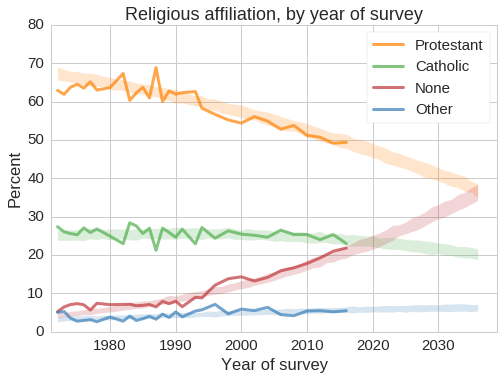
Riffing on an old rock anthem, per Scientific American, by 2020, self-identified "Nones" in the United States of America will equal self-identified Catholics.

This is indeed big news on the American religious landscape.

Don't be so smug, you Baptists and Church of Christers, either.

By 2035, Nones will catch you, too.

And, you should, in fact, be even less smug, per this image:


That comes from the author's own blog, linked at the bottom of the SciAm piece.

In other words, the liberal wing of Lutherans, Methodists, Presbyterians and Episcopalians has already caught you Baptists, etc.

Sure, they may go to church less — setting aside the fact that time and motion studies show that most of you don't go to church as much as you claim — but they don't feel the guilt-tripped NEED to go to church.

This reminds me of other studies that show voters in a Congressional district are not as conservative as their representative assumes, and that the false assumption is done by both Democrats and Republicans.

It's why, here in Tejas, Dems like Wendy Davis chase the mythical moderate.

Update, with some related stats? In 2019, 23 percent of Americans went to church every week. Sounds fairly devoted, right, every week? But 29 percent never went once. Texas, Bible Belt stereotypes aside, is no exception. This site says that it was less than 20 percent, and they're a religious website.

August 15, 2015

Why aren't "we" Mardukites or Baalists instead of Jews or Christians?

I'm none of the four, of course, but, per this post from his new blog by philosopher friend Dan Kaufman, it's a legitimate question.

Here's an edited version of my comment on there to both Dan and Peter Smith, a former secularist now Catholic, who, after his conversion has become quite ardent in his Catholicism. As you can see on this blog post, his ardency is against Protestants, as well as against atheists, all of whom he has repeatedly stereotyped on Massimo Pigliucci's Scientia Salon as New Atheists. (As a sidebar, to be honest, I question Massimo using him as an editor for book reviews, because of this and other things, but, it's Massimo's place, not mine.)

Dan asked, rhetorically, what justification was there for Christianity if one got rid of (western) Christianity's idea of original sin, and the need for a substitutory atonement for that by a "divine man."

First, the Eastern Orthodox tradition disagrees with both Catholicism and Protestantism, and doesn't believe in original sin the way either of them do, because it rejects Augustine on this issue. It does believe, though, in an idea of "ancestral sin."

That said, as I told Dan in a follow-up, one can reject original sin, and even Orthodoxy's idea of ancestral guilt, and still see the need for Jesus, if one believes in the need for sacrificial expiation. One simply believes that Temple sacrifices, or the scapegoat of Leviticus, weren't enough.

That gets to the big issue: Supersessionism. Starting with Paul in the book of Romans, then amplified more after the Bar Kochba revolt in the second century CE, and culminating after the legalization, then establishment of Christianity, the idea is that Christianity essentially replaced Judaism, a new covenant, or new testament. Some evangelicals today try to soft-pedal that, especially many who like waving the "Judeo-Christian" fig leaf in the US that Dan rightly decries, claiming Israel is our best ally, etc., all while looking for that magical red heifer.

I, as part of my journey to secularism, of course rejected original sin, even before completing that journey. I also rejected the idea that a god would be so angry that he'd kill his own son, who later Christian theologians say is part of himself, for a sacrifice for original sin, let alone just for actual original sin.

Of course, many more liberal Christians don't stop to ask Dan's (and my) rhetorical question about "Why Jesus."

That said, this is part of why I didn't stop at liberal versions of Christianity when moving away from the conservative wing of Lutheranism.

As for Peter ... even if he  and other more modern, theoretically more modern Xns, interpret Genesis that way, Paul did not. Aquinas did not. Augustine did not. So, per Dan:
A. Why is your version correct?
B. If it is correct, why is something more "liberal" than it, like Geza Vermes' Jesus as Jewish faith healer (or Crossan's Jesus as Jewish Cynic) not even more correct yet?

That said, as a former Protestant, I can wrong-foot Catholics on issues of narrow selectivity. I won't go into details, speaking of mountains of writing, but I can. (This is a bit off topic, but Peter explicitly used the phrase "narrow selectivity" for Protestants. On things like an unmarried priesthood, an all-male priesthood, and claiming that birth control kills life, no, Peter, your church has plenty of narrow selectivity.)

But, back to my header, and a rhetorical question of my own.

That said, since the B'reshit (Genesis) story itself comes from earlier myth, why Judaism, Dan?

Why aren't we all Mardukites, per Enuma Elish, or whatever term you would use? Per the Elijah cycle of stories in 1 Kings, Ba'alism might be better term yet.

Dan puts it off, saying that he is a non-proselytizer.

The reality, though, is that Judaism, via its pre-Ezra Israelitism roots, was also supersessionist. (It's only proper, academically, to use "Judaism" to talk about the religion after Judahites from the "southern kingdom" returned from their exile in Babylon, and Ezra knocked four strands of writing and tradition, plus editing, into the five books of the Torah.) Israelite religion replaced a polytheism of sorts of the Canaanites with first a henotheism (arguably Ba'alism was the same), then a monotheism, mainly in the southern kingdom of Judah. (I'm not getting into a discussion of some historical details, such as whether David and Solomon existed or not, and how much land any putative united kingdom controlled.)

As many a "good" secularist — especially of New Atheist stripe — knows, with the Amalekites, Israelitism even had its own small-h holocaust. (Should we small-h it?)

It's very arguable that Israelitism is supersessionist, and that it presented itself as such. I mean, that's the whole theme, the whole core theme, of the entire Elijah cycle, at least as edited today. Per my reply to his comment, is this exactly the same as Christian supersessionism? No. Is it entirely different? Also, no.

I'm not here to proselytize Dan out of his modern liberal secular Judaism. However, I do invite him, and others, to look at its own history of supersessionism. That plus a bit of luck against the decaying, semi-collapsing empire of Antiochus IV, i.e., Antiochus Epiphanes, still echo around the Middle East today.

Beyond that, his Judaism is too narrow. Yes, he's a professional philosopher and I'm not, but I once was on track to being a professional theologian and he wasn't.

First, Judaism of the era of Jesus can't be limited to the Tanakh. On the one hand, you have the Sadducees, who accepted only the Torah, not the whole Tanakh. On the other, you have the folks at Qumran, accepting all sorts of extrabiblical literature, a fair chunk of which at least somewhat parallels later Xn beliefs.

As for the idea that Christians "misquote," many people still assume the text of the Tanakh was more static at this time than in actuality. Fair parts of Joshua and Judges, and smaller parts of 1-IV Kingdoms (1-2 Samuel/1-2 Kings) are different in Qumran texts, or other non-Masoretic ones, by a non-insignificant degree, than in the Masoretic version. The Septuagint of Jeremiah is 1/8 shorter than the Masoretic version, and in drastically different order. (It's a different order that reflects the normal order of other prophetic books, though.) And, that too is partially reflected at Qumran. The text of other books, cited in targums at Qumran, also differs from the Masoretic text.


These last two issues get to a bigger point. Judaism of circa 0 BCE/0 CE was far more varied and dynamic than something we might call "proto-rabbinic Judaism."

Meanwhile, back to supersessionism.

Religions have long claimed to be replacing others. Arguably, Protestantism, within Christianity, has a supersessionist angle toward Catholicism. Atheism of the Gnu Atheism stripe has the same toward religion in general.

As for Peter, beyond his thinking that Catholicism's shit doesn't stink, compared to Protestantism, and that all atheists are New Atheists? He seems to think that Christianity has unique moral insights.

Well, no.

The Torah scribe cited Leviticus 19:18, "Love your neighbor as yourself," as one half of the fulfillment of the Torah. Jesus, of course, responded with the story of the Good Samaritan, which seems to have its general ideas translate today, though some details are still problematic and situational.

And?

Yahweh himself showed Jonah that Ninevites, and by extension, Assyrians in general, were his neighbors.

As for the Golden Rule? The so-called Silver Rule, that says, "Do NOT do to your neighbor what you do NOT want done to yourself," is both morally superior in that it doesn't presume to know what's best for our neighbor, and is older.

Within Judaism, Hillel uttered it a century before Jesus. Beyond Judaism, Confucius said it 400 years before Hillel.

This is nothing personal against Peter. It's just that he is a known example of an enthusiastic convert to a non-fundamentalist type of Christianity who thinks he has all the bases covered. (That said, Peter never responded to any of my comments over there. I'm not at all shocked.)

Ditto, my noting that Israelitism is supersessionist is nothing personal against Dan. Jews theologically liberal (or nonobservant), moderate, and conservative alike abound who likely have never even thought about this.

Nor is this personal against New Atheists, who are also, of course, supersessionist and often vocally so.

January 11, 2015

If god delivered you, then why ....

I don't do this often, because I'm not a Gnu Atheist, but I get tired of these "God put me in the right place" types of nuttery. Among the latest is one from Austin, and the nutbar would-be bomber Steve McQuilliams. Officer Johnson, if god were really involved, then why didn't he prevent Steve McQuilliams from getting his guns and bombs in the first place?

And, it's not just Christians, it appears.

Chandra Susanto, if he's from Indonesia, is likely to be thanking Allah for not boarding the recent Air Asia flight that crashed and killed all 162 on board.

The mainstream media don't help on things like this when, even before survivors use the word, they talk about someone "miraculously" surviving a crash of some sort. 

And, "true believers," whether in Jesus, Allah, Metatron (or Megatron?) or any other variety of an omnipotent deity, please do NOT trot out the "inscrutability of god" issue. I've covered the Psychological Problem of Evil here more than once.

October 06, 2014

Don't like gay marriage? Then don't marry a gay person

That's my brief and blunt reaction to the Supreme Court not hearing appellate level challenges about gay marriage in several different states.

Having a number of gay and lesbian friends, several of whom have had long-term partnerships, some of whom have wanted the legal, financial and social protections and assurances of marriage, I am glad to see this.

You know, like your partner being able to see you in the hospital. Or, when your partner dies, his or her homophobic parents being unable to break up a will. Or the right to adopt. Etc., etc.

That said, what if being gay or lesbian isn't 100 percent genetic? Or even 100 percent genetic + an uncontrollable part of "nurture," the womb environment?

What if, on average, it's 10 percent choice?

No matter.

Atheism is 100 percent choice, arguably, yet deserves the full protection of the First Amendment's "freedom of religion" clause as properly understood.

That said, there's another reason I raise the issue of "choice" on gay marriage.

What about certain elements of gay male culture that, stereotypically, at least, have an aversion to long-term partnerships? Bathhouse culture, to use a name?

Well, nobody's forcing them, or randier straight males, to get married. And gay marriage is likely to leave unchanged their non-interest in marriage.

And, let's hope it leaves unchanged our non-interest in their non-interest in gay marriage either.

The great majority of gay males aren't card-carrying members of Queer Nation, anyway. (And, that's despite PR efforts by both Queer Nation and fundamentalist Christians.)

That said, per discussion about the issue, SCOTUS' move still doesn't address the "full faith and credit" clause of the Constitution. If it's sending a signal to red states to stop the nonsense, I still would have preferred an explicit ruling sooner rather than later. Get married in California but move to Kansas? SCOTUS says "sorry, but not yet." Or, if you just live in Kansas, it's definitely "not yet." Residents of 20 states are still out in the cold.

Because, in hardcore red states like Texas, hardcore red-state politicos like Greg Abbott will keep trying to deny the rights of people they don't like. After all, he is our state's money-waster in chief. And, in a place like the south, the Fifth Circuit Court of Appeals WILL give SCOTUS the thumbs-down ruling that it's going to have to face anyway.

I'm also interested in who switched sides since the Court's Prop 8 and DOMA ruling. That was 5-4, after all, and it only takes 4 votes, not 5, to grant cert.

July 13, 2014

Theistic evolutionist Ruse shoots himself in the foot

And I'm not talking about any theistic evolutionist. I'm talking about prominent biologist Michael Ruse, who testified against creationists and Intelligent Designers in the McLean case in Arkansas, etc.

But, in an interview with philosopher Gary Gutting, host of the new York Times philosophy blog/column The Stone, Ruse stumbles over Ye Olde Problem of Evil, just as do those creationists and IDers he shoots down on their own scientific, and philosophical, illiteracy.

Let's start here, with GG being Gutting and MR being Ruse, in this interview format:
G.G.: Do you think that evolution lends support to the atheistic argument from evil: that it makes no sense to think that an all-good, all-powerful God would have used so wasteful and brutal a process as evolution to create living things?

M.R.: Although in some philosophy of religion circles it is now thought that we can counter the argument from evil, I don’t think this is so. More than that, I don’t want it to be so. I don’t want an argument that convinces me that the death under the guillotine of Sophie Scholl (one of the leaders of the White Rose group opposed to the Nazis) or of Anne Frank in Bergen-Belsen ultimately contributes to the greater good. If my eternal salvation depends on the deaths of these two young women, then forget it.
So far, all fair and good, and I totally agree with Ruse that the attempts of the likes of Alvin Plantinga to counter the problem of evil have been massive flops.

But, next, Ruse immediately goes on:
This said, I have never really thought that the pains brought on by the evolutionary process, in particular the struggle for survival and reproduction, much affect the Christian conception of God. For all of Voltaire’s devastating wit in “Candide,” I am a bit of a Leibnizian on these matters. If God is to do everything through unbroken law, and I can think of good theological reasons why this should be so, then pain and suffering are part of it all. 
Sorry, Michael, but that IS a non sequitur from what you said just above, and higher above.

First, unless you ARE rejecting either the "omnipotent" or "omnibenevolent" forks of traditional Western monotheism and the problem of evil, you're simply wrong.

Second, if you do reject one or the other of those forks, then it's incumbent on you to expressly  declare such things.

Third, if you're citing Leibniz, I'm pretty sure you're not rejecting either fork.

That said, Ruse is himself a secularist, even though he thinks it's possible for religious belief and evolution to co-exist. Because of that, and other things, I'll stand behind calling him a theistic evolutionist. He reminds me of the atheists who work with liberal Christians to try to show that the Bible isn't anti-gay even though it clearly is.

Ruse has other interesting things to say in the interview, too. Like this:
I won’t say I accept the ontological argument for the existence of God — the argument that derives God’s existence from his essence — but I do like it (it is so clever).
Well, with that comment, I think I can really say that I think Ruse is overrated as a philosopher. The ontological argument is simplistic semantics and nothing more.

He strikes me as being a bit like Rodney Stark, the sociologist of religion. Despite saying he's some sort of agnostic, Stark went from Eastern Washington University to Baylor, has adopted with both fists Samuel Huntington's Christianist "clash of cultures" idea, and tells all sorts of lies about historical development to try to support himself.

While I agree with P.Z. Myers very little, Michael Ruse just showed why secularists always need to have a bit of care in working with theistic evolutionists. And the likes of Eugenie Scott should take note in the future. I still reject the label of accommodationist, but won't claim that PZ is all wet. And, given that this part of Gnu Atheism isn't all wet, I can see why Ruse doesn't call himself an atheist.

And while I agree with his anti-scientism stance, given all of the above, I think I'll pass on his new book, “Atheism: What Everyone Needs to Know.”

June 26, 2014

#Atheists: Maybe you're using the wrong amendment?

Come again?, you might be saying to yourself, if you are an atheist, especially if atheism and civil liberties are important to you.

I'm thinking of the most recent Supreme Court ruling related to that, Town of Greece v Galloway, of course.

But, I'm also thinking about recent federal district court rulings, and now an appellate one, on gay marriage.

All of these have been decided not on individuals getting married in a state that already had gay marriage, and asking for the "full faith and credit" clause of the Constitution to protect them, but on the 14th Amendment, namely the Equal Protection clause.

It might be hard for an atheist to argue that she or he were "losing anything" from public prayer before city council meetings, but, would it be impossible?

Without abandoning a primary focus on the First Amendment, would it be possible to bring in the Fourteenth as a supplement? 

At the least, atheists could argue that without atheists having the right to publicly lead a "moment of silence," they are being deprived of an equal psychological and sociological atmosphere at public meetings.

Yes, per Kennedy's lead opinion in the case, where he noted:
“To hold that invocations must be non-sectarian would force the legislatures sponsoring prayers and the courts deciding these cases to act as supervisors and censors of religious speech,” Kennedy wrote for himself and the conservative members on the court. Lawmakers and judges would otherwise have to police prayer, he wrote, involving “government in religious matters to a far greater degree than is the case under the town’s current practice of neither editing nor approving prayers in advance nor criticizing their content after the fact.”
Well, not having prayer of any sort would let government avoid that, Justice Kennedy! Besides, what if the original plaintiffs, or similar plaintiffs in other cases, start keeping documented records that show that conservative to fundamentalist Christians are disproportionately getting the podium in Greece?

Beyond that, Kennedy's stance is a clear example of the "tyranny of the majority" that some of our Founding Fathers warned against.

So, atheists? Next time, stay with the 1st Amendment, but add the 14th. Arguably, it's been "federalized" more than any other.

March 01, 2014

Atheism with respect for religion

Excellent interview by Louise Antony with Gary Gutting. (I've read Antony's book, found it very good, and had an email correspondence with one of the contributing authors.)

Antony's first in-depth comment sets the tone:
Because the question has been settled to my satisfaction. I say “there is no God” with the same confidence I say “there are no ghosts” or “there is no magic.” The main issue is supernaturalism — I deny that there are beings or phenomena outside the scope of natural law.

That’s not to say that I think everything is within the scope of human knowledge. Surely there are things not dreamt of in our philosophy, not to mention in our science – but that fact is not a reason to believe in supernatural beings.
That second paragraph is important. Antony is rejecting gods of the gaps, while rejecting scientism at the same time. In short, this is not going to be a defense of atheism like Sam Harris might offer.

Indeed, Antony rejects interviewer Gary Gutting's idea that religious belief might be a hallmark of irrationality (let alone the mental illness canard) with this: "I’m puzzled why you are puzzled how rational people could disagree about the existence of God."

More on that is near the end of the interview:
It is disrespectful, moreover, to insist that someone else’s belief has some hidden psychological cause, rather than a justifying reason, behind it. ...

I believe I have reasons for my position, and I expect that theists believe they have reasons for theirs. Let’s agree to pay each other the courtesy of attending to the particulars.
Well put. And, that holds true even if a certain strand of the religious refuses to engage in such courtesies.

Antony later extends that courtesy to religious beliefs in the public sphere:
No one needs to defend their religious beliefs to me — not unless they think that those beliefs are essential to the defense of the policy they are advocating. If the only argument for a policy is that Catholic doctrine says it’s bad, why should a policy that applies to everyone reflect that particular doctrine? ...

But usually, religious people who become politically active think that there are good moral reasons independent of religious doctrine, reasons that ought to persuade any person of conscience. 
She then cites drone warfare as a particular example

Antony then goes to note, per the old atheist trope that we just believe in one less god than Christians, Muslims or whomever, who are atheists in terms of Zeus, Thor, etc., that rational people within the large set of religious believers disagree among themselves.

She makes this important point, about that diversity:
I’m challenging the idea that there’s one fundamental view here.
From there, Antony rejects the idea of epistemic peers. She doesn't claim that all knowledge is subjective, or that their are individualized facts. She does, though, note that we all bring our individual past perspectives to the table.

Antony then addresses what many people call "spiritual" experiences. I do not, because the term eventually gets twisted. Antony talks about "profound" experiences that, for her, did not become conversion experiences:
I’ll admit that I believe I know what sort of experiences the theists are talking about, that I’ve had such experiences, but that I don’t think they have the content the theists assign to them. I’ve certainly had experiences I would call “profound.” Many were aesthetic in nature — music moves me tremendously, and so does nature. I’ve been tremendously moved by demonstrations of personal courage (not mine!), generosity, sympathy. I’ve had profound experiences of solidarity, when I feel I’m really together with other people working for some common goal. These are very exhilarating and inspiring experiences, but they are very clearly about human beings — human beings at their best.
That's the bottom line, and how Antony is a good humanist as well as good atheist.

February 18, 2014

Are scientists as religious as the general public?

Religious News Service would like you and I to believe that.

One basic, Mack Truck-sized loophole, though?

"Scientist" is nowhere defined, other than, possibly, but probably not, by membership in the American Academy for the Advancement of Science, whose findings are nowhere linked to in the piece. The AAAS did the research, but it's not clear who all was researched.

That only 20 percent of the general public attends worship weekly? Yes, using time logs rather than self-reporting, that's been confirmed. Question: were scientists surveyed the same way? I don't know, because I don't see a link. So, not only do I not know who was researched, I don't know how the research was done, and if we're comparing apples to apples or not.

Second, what counts as religious services? Unitarianism and Reform Judaism are at least somewhat non-metaphysical. Indeed, Judaism is higher among scientists than the general public.

So, claiming 18 percent of scientists attend services weekly? It's almost contentless. It's definitely apples to oranges, per that second link.

Plus, exactly the opposite of the general public (at least the general public in the past), scientific religiosity decreases with age. Religiosity also decreases by specific science field, with the "harder" sciences being less religious. Again, while RNS linked to that second piece, it didn't note that it undercuts almost all of what it is trying to claim.

Third, we have further evidence to the contrary. Some 92 percent of members of the National Academy of Sciences, for which a Ph.D. is a de facto membership requirement, are atheists or agnostics. Of the remaining 8 percent, even if 100 percent attend a religious service weekly (highly doubtful), that's just 8 percent. And, that was back in 1998.

And, the general public, when thinking about "scientists," is likely to be thinking about "hard" scientists doing Ph.D. level research, thus, much closer to the NAS than to whatever undefined standard Religious News Service has.

Given that, outside of behavioral psychology, large tracts of psychology aren't that scientific, even at the Ph.D. level, and that's somewhat true of sociology, I am going to lean toward Gould's 1998 link above. 

In one area that runs more religious than "hard" scientists, mathematics, I don't consider mathematics to be scientific. Rather, it is its own field. It can be put to use for cosmology and astrophysics, yes. It can also, under the old "lies, damned lies and statistics," of Twain, Disraeli or whomever, be put to use for unscientific psychology and sociology, or even more unscientific economics.

And, the fact that Chris Stedman of Faitheist fame retweets the RNS story without comment reinforces that, while he may be an evangelist for his "liberal Protestant" version of atheism, a skeptic he is not. Even if using Gould's NAS "greater scientists" angle is too narrow, whatever unexplained definition AAAS used is surely too wide.

Of course, this is all part of a broad tussle, that, speaking of Gould, goes back to his idea of "non-overlapping magisteria."


In biology, for example, evolution by natural selection is not the same as abiogenesis, though Darwin's "warm little pond" comment could be seen as including abiogenesis. And, in cosmology, no a Big Bang doesn't exclude a deity, especially if one notes that current physics understanding can't get on "the other side" of Planck time. 

On issues of science education, I have no problem, then, in atheists working with folks like the National Center for Science Education, just as I personally have no problem firing off the occasional First Amendment email drafted by Americans United for Separation of Church and State.

I'm an "accommodationist" in many Gnu Atheist eyes. So sue me, P.Z. Myers.

That said, I think Gould's idea, overall, is wrong. It's little more than the old "god of the gaps" in new drag.

And, in a Twitter exchange, RNS author Cathy Lynn Grossmann doubled down on this being a PR piece, claiming the NAS definition of scientist is more subjective than the no-definition "whatever" of her piece.

January 22, 2014

Ta-Nehesi Coates comes out of a closet, no thanks to #GnuAtheists

The outstanding, thought-provoking Atlantic Monthly columnist Ta-Nehesi Coates has "outed" himself as an atheist:
I don't have any gospel of my own. [Tony Judt's history book] Postwar, and the early pages of Bloodlands, have revealed a truth to me: I am an atheist. (I have recently realized this.) I don't believe the arc of the universe bends towards justice. I don't even believe in an arc. I believe in chaos. I believe powerful people who think they can make Utopia out of chaos should be watched closely. I don't know that it all ends badly. But I think it probably does. 
He goes on to say that he's not a cynic. Instead, he presents himself as a skeptical realist who finally realized where his journey had led.

That said, if not for generalized Gnu Atheists, he might have come out earlier. He calls work by Carl Sagan an effective argument for atheism, but then notes:
Perhaps it’s just me, but many of my encounters with atheist [sic] remind me of my encounters with the born-again. Indeed I often suspect that the latter was once the former, and is really angry about it.
I'd agree. So would many other non-Gnu Atheists.

Coates apologized five days later, claiming he had perpetuated a stereotype:
One often doesn't realize he's invoked a stereotype until after the fact. I received quite a bit of pushback in comments, and on twitter, accusing me of doing just that. I actually hadn't realized that there was a stereotype of the overbearing atheist. But I did know that when you generalize about broad groups of people, you often end up in trouble. 

So it was with me.  All I can really say is the following--My bad, ye band of godless heathens. Or more seriously, I was wrong to speak in such a sweeping manner. Weasel phrases like "Perhaps it's just me" don't make it right.
He should have stuck by his guns. When enough empirical observation points about a group, in general, are true, it's called, per my earlier comment, a "generalization," not a stereotype. The borders can be fuzzy, yes.

In the last six months, I've gotten a bit more nuanced my my generalizations. I may soon call some people semi-Gnus as part of that.

But, as long as the likes of P.Z. Myers and David Silverman actively fold, spindle and mutilate facts at times, in the pursuit of atheist evangelism, I'll still talk about others, individually and as members of a group, as Gnu Atheists.

And, per Coates, I too won't use this, not even plain old "atheism," as a primary definer of my philosophical and metaphysical take on the world.

Besides, although the phrase "Gnu Atheist" wasn't around 60 years ago, in "The Rebel," Camus wrote of a species of atheist that needed a god to exist, in order to have something to rebel against.

So, welcome, Ta-Nehisi. There's plenty another metaphysical naturalist who feels, thinks, and acts on these issues pretty much like you.

And, given that "diversity" is an issue, Gnu Atheists might just realize that, with Coates, Neal de Grasse Tyson (see this talk of his on Bill Moyers) and others, you might increase that diversity with honey instead of vinegar.

But, I'm not currently holding my breath.

January 13, 2014

#MalcolmGladwell can gladly rot in a secular hell

If there were a hell, Malcolm Gladwell could gladly rot in it.

I knew, with his appearance on Glen Beck's show, that he had jumped the shark. Other reviews of his new book pretty much indicated that his pseudo-intellectual, pseudo-critical thinking had become even more pseudo recently.

But, this interview with him in an online Christian magazine is a straw too far.

And non-Gnu Atheists who still have a benighted view of him should probably rethink.

Indirectly, by indicating that forgiving comes from "weapons of the spirit," he's peddling some version of the "no morality without god" idea. True that he doesn't say forgiving comes ONLY from that, but, given that the book is in part about his reconversion, and ideas he's gained from that, I am taking that ONLY as a reasonable inference. That's reinforced by a comment like this:
What I understand now is that I was one of those people who did not appreciate the weapons of the spirit.
Because, before what we today call religion was formed, nobody could forgive anybody, right?

But, that's not all.

The interview points out how utterly vapid he has now become in general. Here's a sampling.
Why are so many successful entrepreneurs dyslexic? Why did so many American presidents and British prime ministers lose a parent in childhood?
Gladwell, in the interview, and in general, presents no statistics to back up his blank-check assertions. What's "so many"? Ten percent? Twenty? Thirty? Tell us, Malcolm, then give us some more details.

Back to that second rhetorical question, though.
Why did so many American presidents and British prime ministers lose a parent in childhood?
Uhh, because before 1900, the average life expectancy was below 50 and a lot of women died in childbirth?

Beyond that, being an orphan is no guarantor of spiritual enlightenment in general, nor of general life success.

Hell, Gladwell, let's just go to Rumanian orphanages then, and look for our next popes, our next UN Secretary General, etc., etc. If Rumania doesn't work, Rwanda, Cambodia and other places will be glad to put your insipidness to the test.

What's next? "Brightsided: The Orphan's Manual to a New Life"? 

Or, given his previous shilling for Big Tobacco: "Smoke if You've Got 'Em and Give Your Parentless Children a Whole New Life."

And, speaking of non-Gnu Atheists, to work

That leads me to riff to the battle/schism between Gnu Atheists and  Skeptics™. I know a few of the latter who think that, if Gladwell's not great, he's at least not bad.

Seriously?

I encourage a lot of rethinking. Anybody, whether on general intellectual matters or general moral ones, among broad-minded thinkers, who can give Gladwell even a "not bad" has a variety of critical thinking I don't want. 

Next thing you know, he'll be turning up as a 2016 GOP campaign consultant. 

And no, I'm not joking. Given that his Big Tobacco background reflects larger connections, and work history, in the conservative think tank shark tank, this seriously would not surprise me.

(Note: The cult of Gladwell is another reason I'd gladly help Deadspin with its desire to kill off Bill Simmons.)

Beyond this, per the website? I'm about sick of the "intentionally living" phrase. To some degree, at least from some people, it's become a spirituality superiority bit of word candy.

Assuming he picks it up on Twitter, this ought to give Yasha Levine some fun. 

November 13, 2013

Review: Philosophers without gods

Philosophers Without Gods: Meditations on Atheism and the Secular LifePhilosophers Without Gods: Meditations on Atheism and the Secular Life by Louise M. Antony

My rating: 5 of 5 stars


A great book of essays, each running from around 10 to 20 pages in length, about issues of "deconversion" to non-theism, all by people who are now professional philosophers.

Only one, Dan Dennett, is an outright Gnu Atheist. Only a few others might be called "evangelizing atheists." But none is a shirking violet as to how they address these issues.

Some spend more time on their actual deconversion and how that appears from a philosophic angle. Others, whether evangelizers or not, focus on their current relations with religion in general, or conservative apologists for the religion of their childhood, either Christianity or Judaism. (The one small down point: no ex-Muslim atheist philosopher seems to be in this book.) On this issue, the different philosophers vary within themselves on issues such as "respect" for Christianity in general (I'm taking this as the "default" in America and Britain alike), or how much respect, or whatever, more liberal versions of Christianity deserve.

Others focus more on their post-deconversion lives, including with bits of wistfulness, though not full regret, for some parts of their past.  One, Paul Farrell, whom has promised me some materials via snail mail, talks about second-order values and applying those in a secular way after having learned to in a Catholic way when younger. (I found this triggered thoughts of Catholic, and Lutheran in my case, "vocation," and also got me to thinking about Aristotelian flourishing, among other things.)

Anyway, per that last comment, you'll probably gather, if you're someone who follows my reviews, that this is a book to read. There's no formal logic or anything else even very close to being technical or jargonistic.

Update: She's had an interview with Gary Gutting, who oversees the New York Times' philosophy blog The Stone.


View all my reviews

September 20, 2013

Chimerism causes problems for souls, life forces and other metaphysics

I had originally titled this post, pre-publication, as "How many individuals are inside each of us?" But, as I later expanded it more, I decided I wanted the change, especially when I, like one of the few good things Christopher Hitchens did as a Gnu Atheist, took Eastern as well as Western religion into my gunsights.

That first sentence? That's a rhetorical question, as regular readers of this blog might guess. But, it's one based on hard science, and this time, it's not based on neuroscience or philosophy ideas of Dan Dennett.

Carl Zimmer's latest science piece in the New York Times is simply fascinating. It appears that many more humans than previously recognized are chimeras.

That is, whether you were part of a twin birth or not, you were part of a twin conception, and you either absorbed some cells from your twin or, in many cases, you absorbed the entire twin.

Or, some of us may be a mosaic, just like the mosaic cats you see with two halves of their faces with definitely different colors. In humans, it seems the mosaic patterns don't show up in outward appearance; rather, more insidiously, they may be behind the formation of some cancers.

A mosaic is not a blend of two different persons' DNA, as one twin absorbing another. Per this new piece by Zimmer, rather, a mozaic is when one zygote undergoes mutations early in cell division, before any differentiation, and both (or three or more!) cell versions are preserved. Result? Part of the cells of a heart may be defective, but not all.

As regular readers of this blog know, I'm also an atheist. And, not just an atheist in the way the Dalai Lama is, or some New Agers claim to be. Rather, I'm also an anti-metaphysician.

And, while I'm not a Gnu Atheist, generally poking fun at Christians liberal and fundamentalist alike just because they're Christians, nonetheless, to anybody who believes in an immaterial, metaphysical soul, the fact of chimerism (and other issues of human conception behind it) present stark challenges to your belief. As they do to religious-based prolife stances. (What a Nat Hentoff does with information like this, I have no idea, but he may "elide" it too.)

My answer to the rhetorical question is that there's quite posssibly more than "one" inside of me, if we're talking about DNA. It's also that, Dennett's multiple-drafts theory of consciousness, and ideas of subselves, aside, that there's only one inside of me if we're talking about core personalities. That's because I have only one brain, and only one body to embody the consciousness that's inside me, and zero souls, no matter whether my DNA is from one fertilized zygote or two, representing that consciousness. 

This is why that, though my move from conservative-to-fundamentalist Lutheranism to eventually land in atheism, or secular humanism, began over psychological and philosophical issues related to the problem of evil, as well as doing intellectual judo on my religious upbringing from my own religious graduate school training, eventually, science issues also came into mind.

Now, liberal versions of Christianity can find themselves perfectly compatible with, say, evolution. But, any religion that believes in an individualized, metaphysical soul? I simply don't see how you reconcile these scientific findings with your beliefs. And, under "individualized, metaphysical soul" I include the likes of the Dalai Lama and millions of other Buddhists who believe that some individualized life force is reincarnated. If it's an item tied to an individual person and it's metaphysical, it fits the bill here.

Many people claim that the Dalai Lama has said that he'll accept whatever science says.

However, I have read (sorry, I never did bookmark it) that he has elsewhere said that if it is science vs. one of two core Buddhist principles — karma and reincarnation — then science goes and Buddhism stays. 

And I don't doubt that its true.

In other words, chimerism simply wrecks the idea of a soul being created at conception, unless one is prepared to stand by an even darker god than John Calvin was.  If you're of the ilk of Hobby Lobby,  or Catholics, then, in the case of chimeras, you have to quadruple down on the biblical myth of Jacob and Esau in the womb, and believe that one of two fraternal twins, in many births, is a cannibalistic soul-devourer. Or else, it's a physical cannibal with two souls "attached" to what on the outside seems to be one body, with one brain.

Chimerism also has other connections to the abortion debate, especially within the Western monotheistic/monotritheistic tradition.

It's another variant on the old problem of evil. How can a deity purportedly both all-powerful and all-good let human reproduction be such a minefield of problems? Beyond all the chimeras (which, to be most blunt, from the fundamentalist point of view, must be considered versions of tiny infant cannibalism) to the fact that as many as one in four, maybe even one in three, human conceptions is spontaneously aborted, it is not even close to being anything but an evolutionary minimum of success, it would seem. And, aside from the fundamentalist problems I just lined out already, it's also a vast waste of putative divine economy.

If any fundamentalist tries to do the old hand-waving about how god's ways aren't are ways and vice versa, and god is inscrutable, etc., therefore there's surely an ultimate good behind this, I answer twice.

The first is that a god who is all-powerful and all-good not only can but morally should make his plans scrutable to any sentient beings he creates. Therefore, this is just the problem of evil squred.

Second is that said god is illogical, and unless one wants to be Martin Luther and talk about "that whore, reason," not all-good and therefore self-refuting.

To any fundamentalist who says "original sin," I reply three ways.

First and second, the two answers above.

Third, that you believe in a monster who isn't even close to all-good. (And, yes, like Ken Ham, some Xns actually will attribute the cause of anything wrong in our world to original sin.)

And, speaking of "souls," maybe chimerism explains why identical twins aren't so identical, even in their brains. (Of course, this would require parental cells/DNA, or else a third, fraternal twin.)

Update, May 2, 2021: Fascinating Smithsonian piece here. If you're familiar with what chimeras are, namely a human fetus that has absorbed another in the womb, the discovery that moms can become chimeras from their fetuses is ... fascinating.