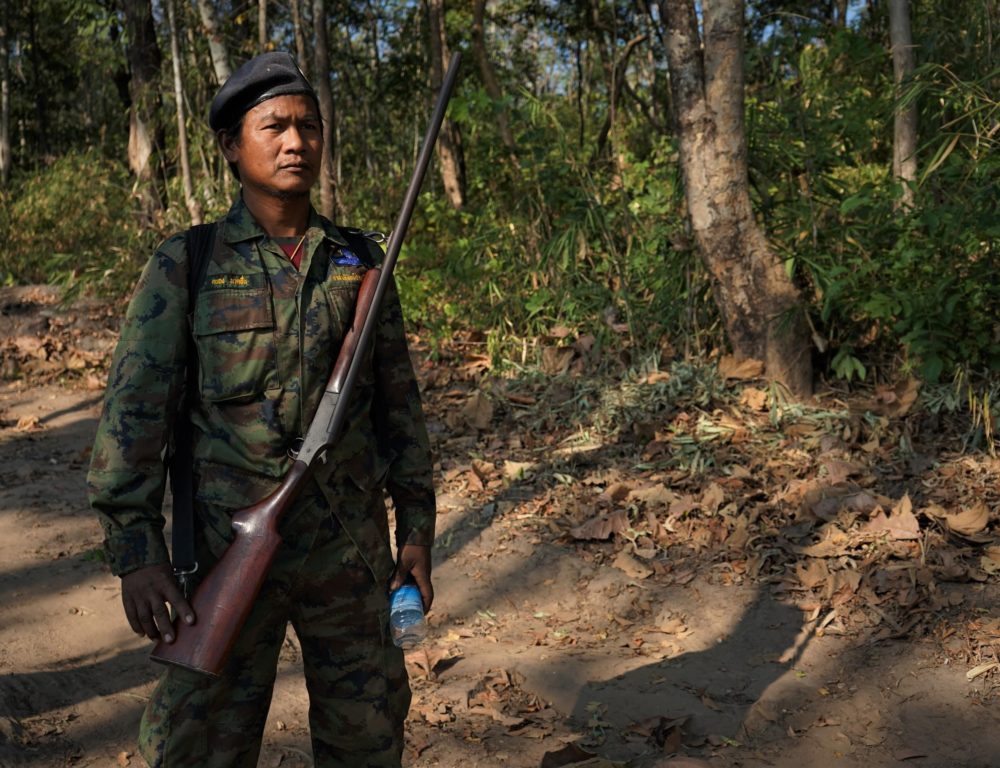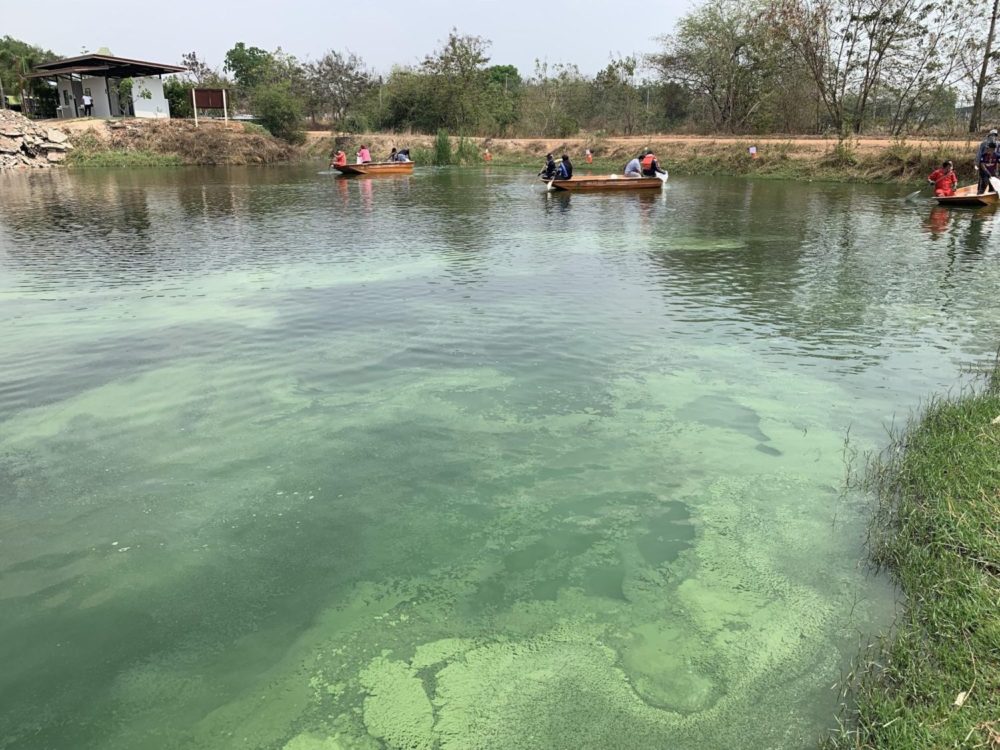


Local farmers often are blamed for the annual haze of particulate matter (PM) from burning that blankets Isaan each year. Research shows a more complex story, with rural burning increases driven by international demand for mass-produced meat, and thus for livestock feed. The situation has helped to entrench agribusiness supply chains and reduced the options available to small-scale farmers. The demand for livestock feed is one of the major driving forces for deforestation. and field burning across the greater Mekong region. Solutions to the region’s PM air pollution problem requires taking a broad view, considering the full range of incentives along supply chains that leads to the burning and other sources of PM.

Each year in Isaan, especially from February through April, the smoke arrives. Quietly at first—a faint haze over rice fields after harvest, while the smell of burning drifts across villages in the early morning. Within weeks, the air thickens, PM2.5 levels climb, schools close, and masks return.
Farmers often take the blame for the annual PM2.5-laden haze over North and Northeastern Thailand, but with scant resources, they are merely responding to the pressures of agribusiness and surging demand—especially for animal feed crops.
The story seems straightforward: farmers burn their land, and everyone else pays the price. Farmers are told to stop burning. Officials issue bans. Social media is filled with images of smoldering fields, often accompanied by anger directed at rural communities.
Although the air pollution problem is less severe than in northern provinces such as Chiang Mai and Chiang Rai, there is no question that agricultural burning contributes to smog in Northeast Thailand. After the rice harvest, fields are often burned to clear stubble quickly and prepare for the next crop. Sugarcane farmers burn leaves before cutting to reduce labor time and costs. In a region where margins are thin and time is short, fire is usually the fastest and cheapest tool available.
Yet focusing only on the act of burning misses the underlying driving forces behind it. For many farmers in Isaan, the choice is not between burning and some clean, affordable alternative; rather, it is between burning and falling further into debt. Mechanized solutions, such as mulching equipment or green harvesting for sugarcane, require investment that smallholders most often can’t afford. Labor and other input costs continue to rise, while crop prices remain volatile. Under these conditions, burning is less a preference than a necessity.
Over the past decades, farming has become increasingly tied to national and global supply chains. Cassava, sugarcane, and maize (corn) are grown not just for local consumption, but for processing, export, and—crucially—for animal feed.
Maize is particularly important. Across northern Thailand and parts of Isaan, corn cultivation has expanded to supply feed mills that supply Thailand’s growing livestock industry. Chickens, pigs, and aquaculture operations all depend on steady inputs of feed crops. Several peer-reviewed studies have shown that as demand for meat grows, so too does demand for maize. According to one such study, “Because of the expansion of the livestock industry, demand for maize in animal feed increased.”
This demand is a major driver of deforestation, which itself causes a one-time surge of air pollution. Greenpeace Thailand identified around 1.88 million hectares of forest loss in the Greater Mekong Subregion—largely linked to expansion of maize for animal feed—based on satellite data covering the late 2010s to early 2020s
These wider issues, however, are rarely part of the public conversation about air pollution. When maize residues are burned, the smoke is not just the byproduct of subsistence farming: it is part of a larger system driven by industrial-scale demand for animal feed.
The haze over Isaan is thus not only a rural problem; it’s also a reflection of consumption patterns, supply chains, and policy choices that extend far beyond the region.
Blaming farmers alone obscures this unpalatable reality. It places responsibility on those with the least power to change the system, while leaving larger actors—agribusiness firms, policymakers, and consumers—largely unexamined.
To be sure, agricultural burning is not the only source of pollution in Isaan. Urban centers like Khon Kaen and Nakhon Ratchasima face growing emissions from traffic, construction and industry. Diesel vehicles, in particular, contribute significantly to PM2.5 levels. Small factories and biomass power plants add further pollutants.

Seasonal weather conditions also make matters worse. During the dry season, stagnant air traps pollutants close to the ground. Instead of dispersing, they become concentrated, turning local emissions into a regional health crisis.
There is also a transboundary dimension since smoke does not respect provincial or national borders. Burning in neighboring countries can contribute to haze in Thailand, just as Thai emissions affect the wider region. Focusing blame narrowly on Isaan farmers ignores this broader context.
Still, the politics of blaming farmers persists, and part of the reason is visibility. Burning fields are easy to see, photograph and regulate. A farmer lighting a fire is a clear and immediate target. By contrast, the role of big businesses, livestock supply chains, corporate buyers and consumption patterns is less visible and more difficult to confront directly as a driving force for seasonal air pollution.
There is also a question of power. Targeting small-scale farmers is politically easier than challenging large agribusiness interests or rethinking national agricultural policy. It allows authorities to appear decisive without addressing deeper structural issues. But year after year, bans on burning are announced, and year after year, the fires return. Enforcement is inconsistent, while alternatives remain out of reach. The underlying systemic forces did not change.
Pressure on farmers can deepen existing inequalities. Those who are caught burning may face fines or sanctions, while still lacking the resources to adopt different methods. Meanwhile, the broader system that drives demand for feed crops—and, by extension, for burning—continues largely unchanged.
Thailand’s livestock sector is a major economic force, supplying both domestic markets and exports. It depends heavily on feed crops grown in both the country’s north and northeast. As long as demand for meat continues to rise, so too will pressure on farmers to supply feed.
This does not mean that farmers have no responsibility: burning has real consequences for local air quality, and reducing it is essential for public health. But responsibility must be measured in proportion to power: farmers make decisions within constraints. Those constraints are shaped by policy, markets, and demand—and without addressing those factors, efforts to reduce burning will remain limited.
A more positive approach would start by supporting farmers, rather than just showering them with blame. This could include subsidies for equipment that allows residue management without burning, support for cooperative ownership of machinery, and incentives for buyers to accept unburned crops.
At the same time, policymakers need to take a broader view. Regulating supply chains, increasing transparency in feed sourcing and—most fundamentally—encouraging shifts in consumption, particularly around livestock products, are all part of the solution.
Urban emissions must also be addressed, from vehicle standards to industrial regulation. Air pollution is a shared problem, and it requires a shared response.
The haze over Isaan is not the result of a single decision or a single group. It is the product of a system—one that connects rural fields to urban markets, and local practices to global demand.
In the end, the fires that blanket Isaan each year are not driven by farmers alone, but by a convergence of rising production costs, limited access to alternatives, expanding livestock feed demand, entrenched agribusiness supply chains, weak policy support and seasonal weather conditions that together make burning the easiest option.
Farmers may light some of the fires, but they do not control the forces that make those fires so difficult to extinguish. Until those forces are confronted, the smoke will continue to rise, the haze will thicken and the blame will continue to fall in the wrong places.