

Aves are warm-blooded vertebrates that lay eggs and have specialised forelimbs to fly. They are bipedal, with an endoskeleton that is fully ossified and long bones that are pneumatic in nature. Aves is an animal class that mostly includes all birds and their extinct ancestors. They are the endothermic vertebrates that fall under the phylum Chordata. The vertebrates that fall under the Aves class have certain features, like toothless jaws, and they lay eggs with hard shells, etc.
Classification of Class Aves
Class Aves can be broadly divided into two major groups. Archaeornithes represent extinct birds that possessed toothed beaks and long, lizard-like tails. In contrast, Neornithes include modern birds that lack teeth in their beaks and have short tails.
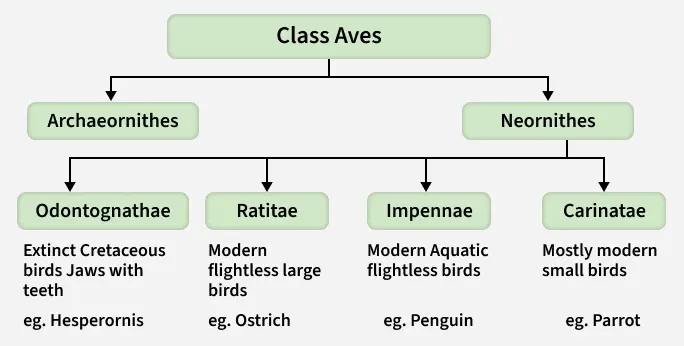
Here we are going to discuss them as mentioned below:
1. The Archaeornithes or Ancient Birds
The Archaeornithes, or the ancient birds, are a set of extinct groups of Aves that had a beak with teeth and a long lizard-like tail. Here are some major facts about them:
- Archaeornithes belong to the creatures of the prehistoric avian group that lived in the Mesozoic Era.
- They had a beak with teeth and a long lizard-like tail, which made them distinct from modern birds.
- Their wing bones, such as the humerus, radius, and ulna, played a major role in making them able to fly.
2. The Neornithes or Modern birds
The Neornithes, or modern birds, do not contain any teeth in their beaks and have a short tail. Here are some major facts:
- Neornithes or modern birds have more lightweight bones which is a unique skeletal structure.
- The Neornithes or the modern birds' skull is lightweight.
- Ribs are connected by the small bones.
- Cervical Vertebrae are present in the neck of the Neornithes Or Modern Birds and provide high flexibility to the bird's neck to regulate the movement of the head.
Biological Classification of Class Aves
The taxonomic classification of Class Aves is outlined below:
Kingdom | Animalia |
|---|---|
Phylum | Chordata |
Subphylum | Vertebrata |
Class | Aves |
Subclasses | Paleognathae, Neognathae |
Infraclasses | Palaeognathae (Ratites, Tinamous), Neognathae (Various orders) |
Superorders | Paleognathae (Palaeognathiformes, Tinamiformes), Neognathae (Various orders) |
Orders | Falconiformes, Passeriformes, Anseriformes, Columbiformes, Struthioniformes, etc. |
Characteristics of Class Aves
They are visually attractive because of their colourful feathers with a unique pattern. The aves class contains around 9000 species that show courtship, parental care, nest building, and, most importantly, territorial behaviour. Aves are the first vertebrates that have warm blood in their body. Here are some key features and characteristics of the Aves class:
Feathers
- Feathers are the most recognisable feature of the Aves class.
- Feathers allow them to fly and keep them warm and insulated.
- There are so many variety of feathers, including down feathers, contour feathers, and flying feathers.
Wings
- Aves have specialised forelimbs to fly.
- Wings help them to lift their whole body and also contribute to maintaining flight.
Flight
- It is one of the most amazing abilities that the Aves class has adopted to fly.
- This ability helps them to create lift and maintain the flight constantly.
- With this adaptation, their skeletal structure changed over time.
Skeletal Adaptations
- Aves have more lightweight bones, which is a unique skeletal structure. This adaptation was necessary to reduce the overall body to fly.
- Aves's skull is lightweight. The beak is prominent and depends on the bird's diet.
- The vertebral part of the Aves backbone is fused, which provides the stability for efficient flight.
- Many of the bones of the Aves are pneumatic. The air sacs are present in these bones and are more efficient in exchanging gases.
Bipedal
- Aves are bipedal. They use both feet when they walk.
- This bipedal nature saves their energy and helps them to perch on branches more easily.
Warm-Blooded
- Aves are the first warm-blooded vertebrates.
- They can survive and keep their body temperature stable in extreme conditions.
- They can take air during respiration in a wide range of habitats.
Beaks and Bills
- Beaks and Bills of the Aves are the result of anatomical adaptation.
- This adaptation helped grasp and swallow food.
- Based on the species, the size and form of the beaks can be changed for Aves.
Alimentary Canal
- The Aves have a modified digestive system.
- It helps them to break and soften the food particles.
- There are so many Aves species that do not have the gallbladder.
Four-chambered Heart
- Aves have a four-chambered heart.
- Their lungs are elastic and spongy.
- Their blood cells are oval-shaped, nucleated, and biconvex.
Endothermy
- Aves can keep their body temperature stable due to a high metabolic rate.
- It helps to allow them to produce heat, and Endothermy is the phenomenon.
Lay Eggs
- Aves are oviparous in nature, as the fertilisation process occurs in their bodies.
- Females produce eggs with four embryonic membranes. The layers are the chorion, the amniotic sac, the allantois, and the yolk sac.
Excretory Organ
- Aves also have the kidneys. It is their urinary organ, and their urine is semisolid in nature.
Highly Developed Sight
- Aves have excellent eyesight with an underdeveloped sense.
- They have one pair of obvious eyes with the ear holes.
Vocalizations
- To establish territory, attract mates, and communicate with one another, birds take the help of vocalisations.
- It is another way to distinguish different species of Aves.
Sexual Dimorphism
- Aves are oviparous in nature.
- Different Aves species show differences in their sexual nature.
- Females produce eggs with four embryonic membranes. The layers are the chorion, the amniotic sac, the allantois, and the yolk sac.
Examples of Class Aves
Here are some examples of Aves class vertebrates with their scientific names as mentioned below:
Name Of The Birds | Scientific Names Of Birds |
|---|---|
Bald Eagle | Haliaeetus leucocephalus |
Common Raven | Corvus corax |
Ruby-throated Hummingbird | Archilochus colubris |
Peregrine Falcon | Falco peregrinus |
Great Horned Owl | Bubo virginianus |
European Robin | Erithacus rubecula |
Emperor Penguin | Aptenodytes forsteri |
Atlantic Puffin | Fratercula arctica |
Southern Cassowary | Casuarius casuarius |
Victoria Crowned Pigeon | Goura victoria |
