

The phylum Chordata is one of the most advanced and diverse groups in the animal kingdom, characterised by the presence of a notochord, a dorsal hollow nerve cord, pharyngeal gill slits, and a post-anal tail at some stage of its life cycle. Chordates exhibit a high level of structural organisation and include animals ranging from simple marine forms to highly evolved vertebrates. This phylum includes fish, amphibians, reptiles, birds, mammals, and humans.
Characteristics of Phylum Chordata
- Chordates are bilaterally symmetrical animals, meaning that the body can be divided into two halves along a single plane.
- They are triploblastic because their bodies develop from three embryonic germ layers, namely ectoderm, mesoderm, and endoderm.
- They possess a true coelom, which is a fluid-filled body cavity lined by mesoderm.
- They exhibit an organ-system level of organisation with specialised organs performing specific functions.
- A notochord is present at least during the embryonic stage.
- A dorsal hollow nerve cord lies above the notochord and develops into the central nervous system.
- Pharyngeal gill slits are present at some stage of development.
- A post-anal tail extends beyond the anus.
- The circulatory system is generally closed.
- The heart is located on the ventral side of the body.
- Respiration occurs through gills, lungs, or skin, depending on the group.
- Excretion is carried out by the kidneys or kidney-like organs.
- Most chordates possess an internal endoskeleton made of cartilage or bone.
Diagnostic Features of Chordates
- Notochord: The notochord is a flexible, rod-like supporting structure situated between the digestive tract and the dorsal nerve cord. It serves as the primary axial skeleton in primitive chordates. In vertebrates, the notochord is present only during embryonic development and is later replaced by the vertebral column.
- Dorsal Hollow Nerve Cord: Chordates possess a hollow tubular nerve cord located dorsally above the notochord. This nerve cord develops into the brain and spinal cord in vertebrates.
- Pharyngeal Gill Slits: The pharynx contains a series of paired openings called pharyngeal gill slits. In aquatic chordates, these structures help in respiration, whereas in terrestrial vertebrates, they are modified into various structures of the head and neck.
- Post-Anal Tail: The tail extends beyond the anus and is supported by muscles and skeletal elements. It aids in locomotion and balance in many chordates.
- Endostyle or Thyroid Gland: Most chordates possess an endostyle or a thyroid gland, which plays an important role in metabolism and growth.
Classification of Phylum Chordata
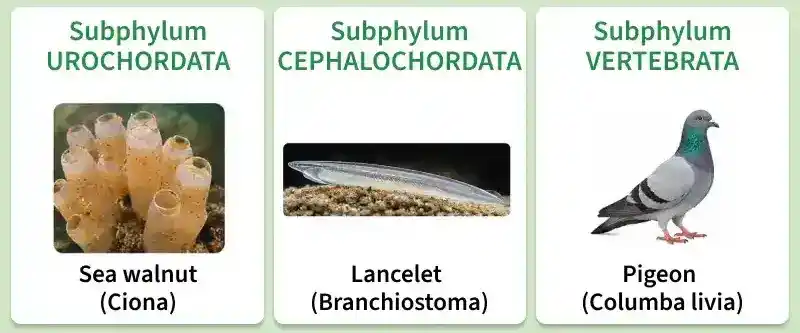
Phylum Chordata is divided into three subphyla:
Subphylum Urochordata
Urochordata includes marine chordates in which the notochord is present only in the tail of the larva and disappears in the adult stage.
- All members are exclusively marine.
- The body is covered by a tunic or test made of tunicin.
- Notochord is present only in the larval tail.
- The dorsal hollow nerve cord is present in the larva but degenerates in the adult.
- Adults are usually sessile.
- Pharyngeal gill slits are present.
- Most members are hermaphroditic.
- They undergo retrogressive metamorphosis.
Examples: Herdmania, Ascidia, Salpa, Doliolum
Subphylum Cephalochordata
Cephalochordata includes small marine chordates in which the notochord extends from the anterior end to the posterior end of the body and persists throughout life.
- Exclusively marine animals.
- Body is elongated and fish-like.
- Notochord extends throughout the length of the body.
- Notochord persists throughout life.
- Dorsal hollow nerve cord is present.
- Numerous pharyngeal gill slits are present.
- Sexes are separate.
- The circulatory system is closed.
Example: Branchiostoma (Amphioxus or Lancelet)
Subphylum Vertebrata
Vertebrata includes chordates in which the notochord is present during embryonic development and is replaced by a cartilaginous or bony vertebral column in the adult.
- Notochord is replaced by a vertebral column.
- Cranium enclosing the brain is present.
- Endoskeleton is made of cartilage or bone.
- Well-developed brain and sense organs are present.
- Ventral muscular heart is present.
- A closed circulatory system is present.
- Kidneys perform excretion and osmoregulation.
- Paired appendages such as fins or limbs are usually present.
Examples: Fishes (Scoliodon, Labeo), Amphibians (Rana, Bufo), Reptiles (Calotes, Naja), Birds (Columba, Pavo), and Mammals (Canis, Homo sapiens)
Classification of Vertebrata
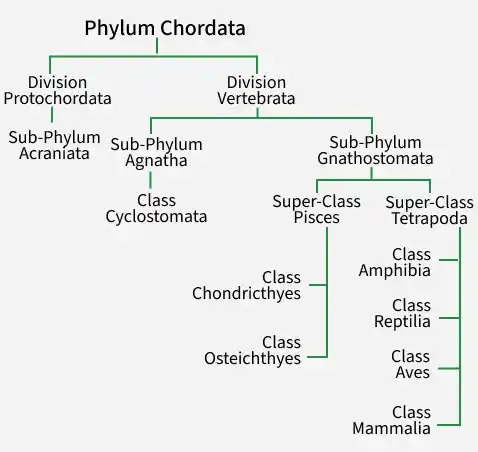
Vertebrates are divided into two divisions:
1. Division Agnatha
Agnathans are the most primitive vertebrates and lack true jaws and paired appendages.
Class Cyclostomata
Cyclostomata comprises primitive jawless vertebrates that possess a circular suctorial mouth and are mostly ectoparasites on fish.
- Body is elongated, cylindrical, and eel-like.
- Jaws are absent.
- Mouth is circular and suctorial.
- Paired fins and scales are absent.
- Cranium and endoskeleton are cartilaginous.
- Six to fifteen pairs of gill slits are present for respiration.
- The circulatory system is closed.
- They are marine animals but migrate to freshwater for spawning.
- Most members are ectoparasitic on fish.
Examples: Petromyzon (Lamprey) and Myxine (Hagfish)
2. Division Gnathostomata
Gnathostomata includes vertebrates possessing true jaws and paired appendages such as fins or limbs.
Class Chondrichthyes
Chondrichthyes includes marine fishes that possess a completely cartilaginous endoskeleton and are commonly known as cartilaginous fishes.
- Endoskeleton is entirely cartilaginous.
- Body is streamlined and spindle-shaped.
- Skin is tough and covered with placoid scales.
- Mouth is ventrally located.
- Five to seven pairs of gill slits are present and are not covered by an operculum.
- Tail fin is heterocercal.
- Swim bladder is absent.
- Fertilisation is internal, and many species are viviparous.
Examples: Scoliodon (Dogfish), Pristis (Sawfish), Trygon (Sting Ray), and Carcharodon (Great White Shark)
Class Osteichthyes
Osteichthyes includes vertebrates possessing a bony endoskeleton and are commonly known as bony fishes.
- Endoskeleton is partly or completely bony.
- Body is generally streamlined.
- Skin is covered with cycloid or ctenoid scales.
- Four pairs of gills are covered by an operculum.
- Swim bladder is usually present.
- Mouth is generally terminal.
- Fertilisation is usually external.
- Found in both marine and freshwater habitats.
Examples: Labeo (Rohu), Catla (Catla), Hippocampus (Seahorse), and Exocoetus (Flying Fish)
Class Amphibia
Amphibia includes vertebrates that live both in aquatic and terrestrial environments during different stages of their life cycle.
- Skin is moist, glandular, and generally without scales.
- Respiration occurs through gills, lungs, and skin.
- Two pairs of limbs are usually present.
- Heart is three-chambered.
- They are ectothermic (cold-blooded) animals.
- Fertilisation is generally external.
- Eggs are laid in water.
- Development includes a larval stage and metamorphosis.
Examples: Rana (Frog), Bufo (Toad), Hyla (Tree Frog), Salamandra (Salamander), and Ichthyophis (Limbless Amphibian)
Class Reptilia
Reptilia includes cold-blooded vertebrates whose bodies are covered with dry, cornified scales and which are primarily adapted for life on land.
- Skin is dry, glandless, and covered with horny scales.
- Respiration occurs only through the lungs.
- Internal fertilisation takes place.
- Most reptiles are oviparous and lay shelled eggs.
- The heart is generally three-chambered, except in crocodiles, where it is four-chambered.
- They are ectothermic animals.
- Development is direct without a larval stage.
Examples: Calotes (Garden Lizard), Chamaeleon (Chameleon), Crocodylus (Crocodile), Naja (Cobra), Bungarus (Krait), Vipera (Viper), and Testudo (Tortoise)
Class Aves
Aves comprises warm-blooded vertebrates commonly known as birds, whose forelimbs are modified into wings for flight.
- Body is covered with feathers.
- Forelimbs are modified into wings.
- Hind limbs are adapted for walking, perching, or swimming.
- Bones are light, pneumatic, and hollow.
- Beak is present, and teeth are absent.
- Heart is four-chambered.
- Respiration occurs through the lungs, aided by air sacs.
- Fertilisation is internal.
- They are oviparous and lay hard-shelled eggs.
Examples: Columba (Pigeon), Corvus (Crow), Psittacula (Parrot), Pavo (Peacock), Struthio (Ostrich), and Aptenodytes (Penguin)
Class Mammalia
Mammalia includes highly evolved warm-blooded vertebrates characterised by the presence of mammary glands that produce milk for nourishing their young.
- Body is covered with hair.
- Mammary glands are present in females.
- External ears or pinnae are present.
- Skin contains sweat glands and sebaceous glands.
- Heart is four-chambered.
- Respiration occurs through the lungs.
- A muscular diaphragm separates the thoracic and abdominal cavities.
- Most mammals are viviparous.
- Young ones are nourished with milk secreted by mammary glands.
Examples: Ornithorhynchus (Platypus), Macropus (Kangaroo), Canis (Dog), Felis (Cat), Elephas (Elephant), Panthera tigris (Tiger), Panthera leo (Lion), Balaenoptera (Blue Whale), and Delphinus (Dolphin)
Importance of Phylum Chordata
- Chordates include economically important animals such as fish, poultry, and livestock.
- They provide food, milk, eggs, wool, leather, and other useful products.
- Many chordates play important ecological roles in maintaining ecosystem balance.
- Vertebrates represent the highest level of evolutionary development among animals.
- Human beings belong to this phylum.
