

Lipids are a diverse group of naturally occurring organic compounds that are essential for the structure, function, and energy storage of living organisms. They are one of the major classes of biomolecules present in all living cells and play important roles in maintaining normal physiological activities. Lipids are mainly composed of carbon, hydrogen, and oxygen, although some lipids may also contain phosphorus, nitrogen, and sulphur.

Characteristics of Lipids
Lipids possess several characteristic properties that distinguish them from other biomolecules. These properties are important for understanding their biological significance.
- Lipids are hydrophobic or nonpolar molecules.
- They are insoluble in water but soluble in organic solvents.
- Lipids contain carbon, hydrogen, and oxygen.
- They provide more energy than carbohydrates and proteins.
- Many lipids are esters of fatty acids and alcohols.
- Lipids may exist in solid or liquid form at room temperature.
- The high energy content of lipids makes them efficient energy reserves in living organisms.
Structure of Lipids
Most lipids are formed from fatty acids and glycerol. Fatty acids are long hydrocarbon chains containing a carboxyl group (-COOH) at one end. Glycerol is a three-carbon alcohol containing hydroxyl groups. Triglycerides are the most common form of stored fats in animals and plants.

When glycerol combines with fatty acids through ester bonds, fats are formed. The formation of triglycerides can be represented as:
Glycerol + 3 Fatty Acids → Triglyceride + 3H2O
Classification of Lipids
Lipid subunits are Glycerol and Fatty acids. Lipids are mainly classified into three types. They are simple, complex, and derived lipids.

Simple Lipids
Simple lipids are triglycerides, esters of fatty acids, and wax esters. The hydrolysis of these lipids gives glycerol and fatty acids. Simple lipids are classified into Triglycerides and Waxes.
1. Triglycerides
Triglycerides are the most common type of simple lipids. They consist of glycerol molecules linked to three fatty acid chains through ester bonds. Triglycerides are found in adipose tissue (body fat) and serve as a long-term energy reserve. They are the constituents of fats and oils. Lipids that are solid at room temperature are fats, and lipids that are liquid at room temperature are oils.
A. Glycerol
It is a colourless, odourless, viscous liquid that is sweet-tasting and non-toxic. The glycerol backbone is found in those lipids known as glycerides. It is a simple polyol compound.
B. Fatty Acids
Fatty acids are carboxylic acids; they are long chains of hydrocarbons with a carboxylic group at the end. Fatty acids are an important component of lipids; they are the building blocks of fat in the body. There are two types of fatty acids, saturated fatty acids and unsaturated fatty acids.
i. Saturated Fatty Acids
It consists of single C-C single bonds. These molecules fit closely together in a regular pattern and have strong attractions between fatty acid chains. These fatty acids have high melting points, which makes them solid at room temperature. Examples of saturated fatty acids are palmitic acid and stearic acid.

ii. Unsaturated Fatty Acids
Unsaturated fatty acids are fatty acids that consist of one or more C=C double bonds. An unsaturated fatty acid is divided into two types.
- Monounsaturated fatty acids: Example: oleic acid.
- Polyunsaturated fatty acids: Example: linoleic acid.
2. Waxes
Waxes are a type of simple lipid formed by the combination of long-chain fatty acids with long-chain alcohols through ester bonds. They are hard, water-resistant substances that remain solid at ordinary temperatures. Unlike fats and oils, waxes do not contain glycerol and are highly resistant to water and chemical breakdown. Because of their waterproof nature, waxes play an important protective role in both plants and animals.
Complex Lipids
Complex lipids are a type of lipid that have more complex structures compared to simple lipids (triglycerides and waxes). They contain additional molecules, such as phosphates, carbohydrates, proteins, fatty acids and glycerol. Complex lipids are involved in various biological functions, including cell structure, energy storage, and cell signalling. Examples of complex lipids are Phospholipids and glycolipids.
1. Phospholipids
Phospholipids are constituents of cellular membranes. An ester is formed when a hydroxyl reacts with a carboxylic acid and loses H2O. Phospholipids, also known as phosphatides, are classes of lipids whose molecule has a hydrophilic head and two hydrophobic tails. A head containing a phosphate group and tails derived from fatty acids joined by a glycerol molecule. They serve as emulsifiers.
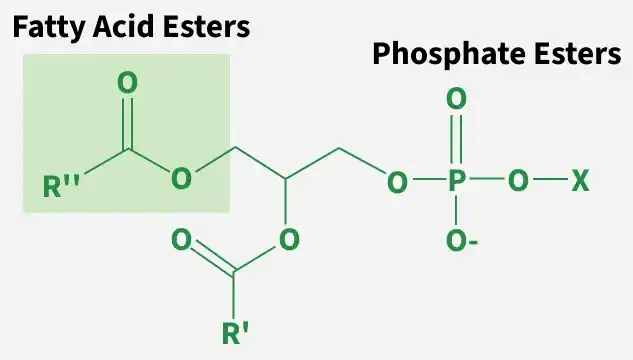
There are two types of phospholipids:
- Glycerophospholipids: Glycerophospholipids are a class of phospholipids containing glycerol as alcohol, two fatty acids, and phosphate. It is the most abundant lipid in the cell membrane.
- Sphingophospholipids: Sphingophospholipids are a class of phospholipids containing sphingosine as alcohol. It produces ceramide by an amide linkage to a fatty acid. Ceramide is an important component of skin. It acts as a second messenger to regulate programmed cell death.
2. Glycolipid
It is a structural lipid, an essential part of the cell membrane. They are lipids with a carbohydrate attached by a glycosidic bond. They act as receptors at the surface of the red blood cell. It helps in the determination of an individual's blood group. It has an important role in maintaining the stability of the cell membrane. Glycolipids participate in cell recognition, cell signalling, and immune responses. Cerebrosides and Gangliosides are the two types of Glycolipids.
Derived Lipids
Derived lipids are the hydrolysed compounds of simple and complex lipids. Examples are fatty acids, steroids, fatty aldehydes, ketone bodies, lipid-soluble vitamins, and hormones.
1. Steroids
Steroids are found in the cell membrane and have fused ring structures. Many steroids have -OH functional groups; they are also hydrophobic and insoluble in water. All the steroids have 4 linked carbon rings, and most of them have a short tail. Steroids also act as hormones in the body.
2. Sterols
Sterols are solid steroid alcohols that are widely present in plants and animals, such as cholesterol and ergosterol. They are a subgroup of steroids that naturally occur in most eukaryotes. They are found in animal products. They are used to make bile for digestion in the body. Sterols can have greater than half of the membrane lipid content in cells, and they are known to alter membrane structure and fluidity.
3. Carotenoids
Carotenoids are lipid-soluble compounds. They are pigments that are mainly responsible for the yellow and red colours of plant and animal products. Carotenoids consist of carotenes and xanthophylls. A class of hydrocarbons is carotenes, and its oxygenated derivatives are xanthophylls. They give colour to many fruits and vegetables. They have antioxidant and anti-inflammatory properties for humans. Carotenoids are important for the health of the human eye.
Functions of the Lipids
- Lipids, like adipose tissue, act as insulators and help to maintain body temperature by reducing heat loss.
- Lipids, especially triglycerides, act as energy storage in organisms, providing a reserve of metabolic fuel.
- Phospholipids form the lipid bilayers of cell membranes and regulate the passage of molecules in and out of cells.
- Protecting the plant leaves from direct heat and drying.
- Steroid hormones, derived from cholesterol, play vital roles in regulating various physiological processes, including metabolism, growth, and reproduction.
- It acts as the structural component of the body and also acts as the hydrophobic barrier.
- In plants, lipids can be stored as oils in seeds, providing a source of energy for germination and early growth.
- Lipids form waterproofing structures, such as the waxy cuticle on plant leaves or the oil on the feathers of water birds.
- It provides colour to many fruits and vegetables with the presence of carotenoid pigment.
