

Photoperiodism is the response of plants to the relative duration of day and night, which helps regulate important developmental processes such as flowering, growth, and dormancy. Through photoperiodism, plants can detect seasonal changes and flower at the most favourable time for successful reproduction.
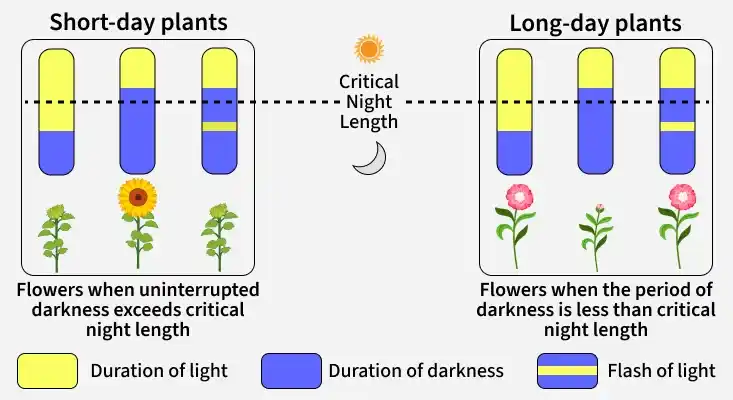
Different plants require varying lengths of light and darkness to initiate flowering, while others remain unaffected by day length. This phenomenon was first studied by W. W. Garner and H. A. Allard, who discovered the role of light duration in controlling flowering in plants.
Critical Photoperiod
- The critical photoperiod is the specific duration of light or darkness required by a plant to initiate flowering. Each plant species has its own critical photoperiod.
- If the required duration of light or darkness is not achieved, flowering may not occur even if all other environmental conditions are favourable.
- In most plants, the duration of uninterrupted darkness is more important than the duration of daylight. Plants measure the length of the night with great precision and use this information to regulate their flowering.
- A brief exposure to light during the dark period can sometimes prevent flowering in certain plants because it interrupts the required continuous dark period.
Role of Phytochromes in Photoperiodism
Phytochromes are specialised light-sensitive pigments present in the leaves of plants that regulate photoperiodic responses. These pigments help plants detect changes in light and darkness and play an important role in controlling flowering and other developmental activities.
Phytochromes exist in two interconvertible forms:
- Pr Form: The Pr form is the inactive form of phytochrome. It absorbs red light with a wavelength of approximately 660 nanometres. When exposed to red light during daytime, the Pr form is converted into the active Pfr form.
- Pfr Form: The Pfr form is the active form of phytochrome. It absorbs far-red light and is responsible for initiating various physiological responses in plants, including flowering. During darkness, the Pfr form gradually converts back into the inactive Pr form.
Types of Plants Based on Photoperiodism
Based on their response to day length and night length, plants are classified into three major categories.
1. Short-Day Plants (SDP)
- Short-day plants are plants that require long and continuous periods of darkness for flowering.
- These plants usually flower when the day length is shorter than the critical photoperiod.
- Because they require longer nights, they are also called long-night plants.
- In short-day plants, flowering occurs only if the dark period remains uninterrupted. Even a brief exposure to light during the dark period may inhibit flowering because it interrupts the required night length.
- Examples of short-day plants include tobacco, soybean, chrysanthemum, rice, and cotton.
- These plants generally flower during late summer, autumn, or winter when nights become longer.
2. Long-Day Plants (LDP)
- Long-day plants require longer durations of daylight and shorter nights for flowering.
- These plants flower when the day length exceeds the critical photoperiod. Since they require shorter nights, they are also called short-night plants.
- In long-day plants, flowering is promoted when the dark period is interrupted by light.
- These plants usually flower during spring or early summer when daylight hours increase.
- Examples of long-day plants include spinach, radish, wheat, lettuce, oats, and barley.
- Long-day plants are commonly found in temperate regions where seasonal changes in day length are more pronounced.
3. Day-Neutral Plants (DNP)
- Day-neutral plants are plants whose flowering does not depend on the duration of day or night.
- These plants flower regardless of photoperiod, provided that other environmental conditions such as temperature, nutrients, and water are favourable.
- Examples of day-neutral plants include tomato, cucumber, sunflower, and rose.
- These plants can flower throughout the year under suitable growth conditions.
Importance of Photoperiodism
- Photoperiodism ensures that flowering occurs during the most favourable season for pollination, seed formation, and fruit development. This increases the chances of reproductive success.
- Plants use photoperiodic responses to adapt to changing environmental conditions such as variations in temperature, rainfall, and seasonal light availability.
- Photoperiodism is very important in agriculture because farmers can manipulate light conditions to control flowering time, crop production, and yield. Greenhouses and artificial lighting are often used to regulate photoperiodic responses in commercial crop cultivation.
- The distribution of plant species across different regions of the world is influenced by photoperiodism. Some plants can survive only in areas with suitable day lengths and seasonal conditions.
- Apart from flowering, photoperiodism also regulates seed germination, dormancy, leaf fall, tuber formation, and vegetative growth in many plant species.
