

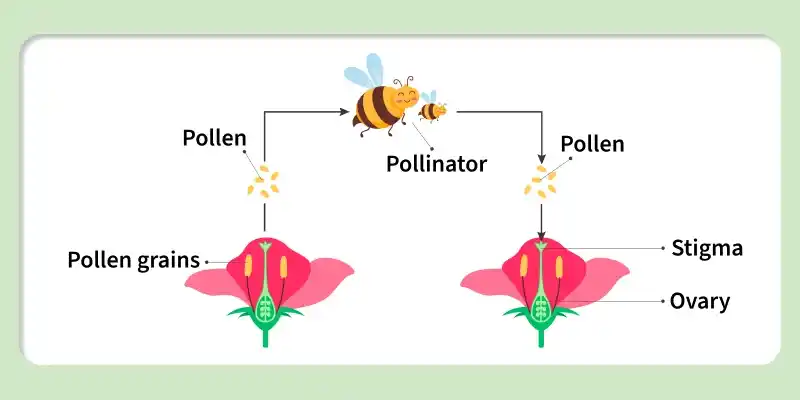
Pollination is the process of the transfer of pollen grains from the anther (male reproductive part) to the stigma (female reproductive part) of a flower.
- It is an essential step in the sexual reproduction of flowering plants because it leads to fertilization and seed formation.
- It may occur through different agents such as wind, water, insects, birds, and other animals.
Process
1. Transfer of Pollen Grains: The first step of pollination is the transfer of pollen grains from the anther to the stigma.
- Pollen grains are produced inside the anther, which is present in the stamen of the flower.
- These pollen grains are transferred to the stigma with the help of different pollinating agents such as wind, insects, birds, water, and animals.
- The stigma is usually sticky so that it can easily receive and hold pollen grains.
2. Germination of Pollen Grain: After reaching a compatible stigma, the pollen grain absorbs moisture and nutrients from the stigma.
- This stimulates the pollen grain to germinate.
- The outer wall of the pollen grain breaks open, and a pollen tube begins to develop from it.
3. Formation of Pollen Tube: A pollen tube grows from the pollen grain and passes through the style towards the ovary.
- The style acts as a connecting tube between the stigma and the ovary.
- The pollen tube provides a pathway through which the male gametes travel to reach the ovule.
4. Movement of Male Gametes: The male gametes present inside the pollen grain move through the pollen tube towards the ovule.
- The pollen tube enters the ovule through a small opening called the micropyle.
5. Fertilisation: Inside the ovule, fertilisation occurs when the male gamete fuses with the egg cell to form a zygote.
- In flowering plants, a special process called double fertilisation occurs one male gamete fuses with the egg cell to form the zygote and the second male gamete fuses with the polar nuclei to form the endosperm.
- The zygote later develops into the embryo.
6. Seed and Fruit Formation: After fertilisation, the ovule develops into a seed, and the ovary develops into a fruit.
- The seed contains the embryo, while the fruit protects the seed and helps in seed dispersal.
Types of Pollination
Pollination is mainly of two types:
1. Self-Pollination
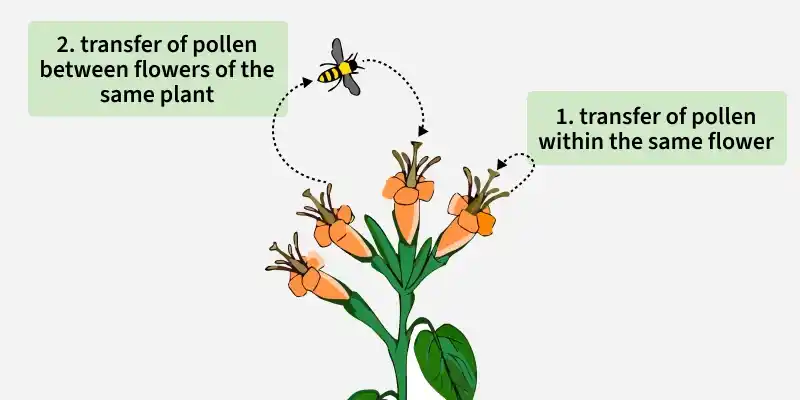
Self-pollination is the process in which pollen grains are transferred from the anther to the stigma of the same flower or another flower on the same plant. Since both male and female gametes belong to the same plant, there is very little genetic variation in the offspring. Self-pollination commonly occurs in bisexual flowers where both stamens and carpels are present in the same flower.
Types of Self-Pollination
- Autogamy: Autogamy is the transfer of pollen grains from the anther to the stigma of the same flower. This type of pollination usually occurs in bisexual flowers. Examples are pea, wheat, and rice.
- Geitonogamy: Geitonogamy is the transfer of pollen grains from one flower to another flower on the same plant. Although it functions like cross-pollination, genetically it is similar to self-pollination because both flowers belong to the same plant. Examples are maize and castor.
Advantages
- Less wastage of pollen grains.
- Maintains pure genetic lines.
- Does not depend on pollinators.
- Assures seed formation even in isolated plants.
- Preserves parental characters.
Disadvantages
- Little or no genetic variation.
- Reduced adaptability.
- Offspring may have lower disease resistance.
- Harmful recessive traits may accumulate.
2. Cross-Pollination
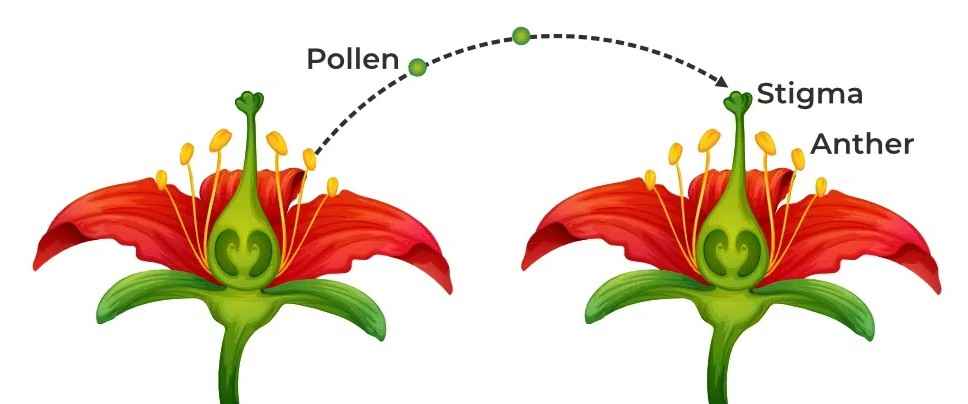
Cross-pollination is the transfer of pollen grains from the anther of one plant to the stigma of a flower on another plant of the same species. In this type of pollination, male and female gametes come from different plants. Therefore, cross-pollination increases genetic variation among offspring. Cross-pollination is common in unisexual flowers and plants that have mechanisms preventing self-pollination.
Advantages
- Produces genetically diverse offspring.
- Offspring are healthier and more vigorous.
- Better adaptability to environmental changes.
- Seeds are more viable.
Disadvantages
- Greater wastage of pollen grains.
- Depends on pollinating agents.
- May introduce undesirable traits.
Agents of Pollination
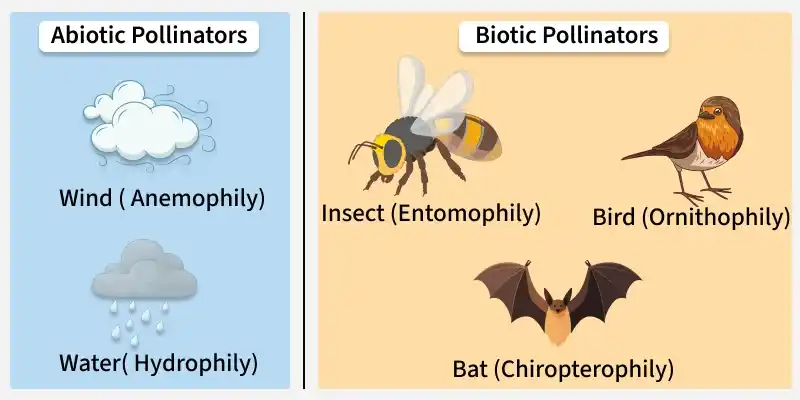
The agents that help in the transfer of pollen grains are called pollinators. These agents are broadly classified into two categories:
- Abiotic Pollinating Agents
- Biotic Pollinating Agents
1. Abiotic Pollination
Abiotic pollination is the type of pollination in which non-living agents help in the transfer of pollen grains from the anther of a flower to the stigma. In this method, pollination takes place without the involvement of living organisms such as insects, birds, or animals. The two main abiotic agents of pollination are wind and water.
Wind Pollination (Anemophily)
- Pollination occurs through wind currents.
- Flowers are small and inconspicuous.
- Pollen grains are light and dry.
- Stigma is feathery.
- Examples are Maize, Wheat, and Grasses.
Water Pollination (Hydrophily)
- Pollination occurs through water currents.
- Mostly seen in aquatic plants
- Pollen grains float on water
- Examples are Vallisneria and Zostera
2. Biotic Pollination
Biotic pollination is the type of pollination in which living organisms help in the transfer of pollen grains from the anther of a flower to the stigma of another flower. These living organisms are known as pollinators. Biotic pollination is very common in flowering plants and plays an important role in plant reproduction, fruit formation, and seed production.
Insect Pollination (Entomophily)
- Pollination occurs through insects such as bees and butterflies.
- Flowers are brightly coloured.
- Produce fragrance and nectar.
- Pollen grains are sticky.
- Examples are Sunflower, Hibiscus, and Mustard.
Bird Pollination (Ornithophily)
- Pollination occurs through birds.
- Flowers are large and brightly coloured.
- Rich in nectar.
- Examples are Bottlebrush and Coral tree
Bat Pollination (Chiropterophily)
- Bat pollination, known as Chiropterophily, is the process of pollination carried out by bats.
- Flowers that are bat-pollinated typically bloom at night, coinciding with the nocturnal activity of bats.
- These flowers are strongly scented to attract bats, as bats rely heavily on their sense of smell to locate food.
- They produce abundant nectar to reward and attract bats, ensuring repeated visits and effective pollination.
- Examples are Banana and Agave.
Importance of Pollination
- Pollination leads to fertilisation, which is essential for the continuation of the plant life cycle.
- It enables seed and fruit formation, ensuring the propagation of plant species.
- It maintains plant reproduction by facilitating the transfer of pollen from the anther to the stigma.
- Cross pollination increases genetic diversity, making plants more adaptable and resistant to diseases.
- It supports agriculture and food production by improving crop yield and quality, making it vital for human sustenance.
