

The Abstract Digital Forensic Model is a systematic framework used in digital forensic investigations to guide the identification, collection, preservation, analysis and presentation of digital evidence. It provides a structured methodology that helps investigators maintain evidence integrity, follow legal procedures and ensure consistent investigation outcomes.
Phases of the Abstract Digital Forensic Model
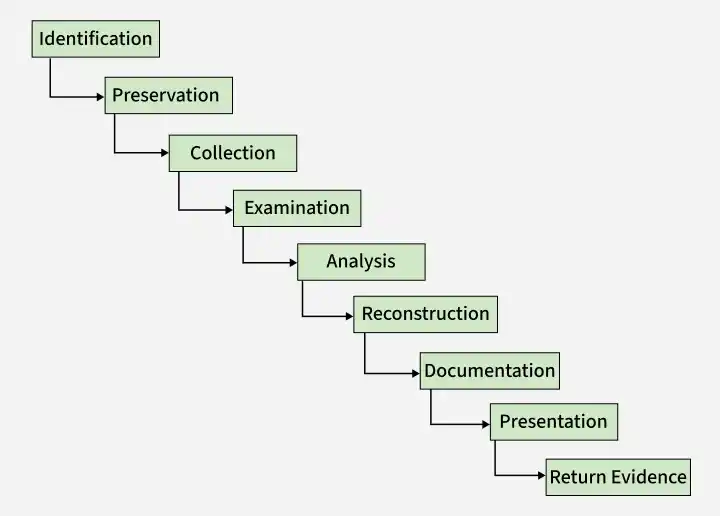
- Identification: Asset inventories, network logs and incident indicators are used to determine potential evidence sources.
- Preservation: Write blockers and cryptographic hash verification are employed to prevent evidence modification.
- Collection: Bit-stream imaging captures all allocated, unallocated and slack space from the storage media.
- Examination: Forensic tools parse file systems, artifacts and metadata to extract actionable information.
- Analysis: Timeline correlation and artifact analysis are performed to identify user actions and attack patterns.
- Reconstruction: Event sequences are recreated using timestamps, log records and system artifacts.
- Documentation: Detailed records of procedures, tool outputs and evidence handling are maintained throughout the investigation.
- Presentation: Findings are communicated using evidence summaries, timelines and forensic visualizations.
- Returning Evidence: Evidence release is conducted according to chain-of-custody requirements and organizational policies.
Real World Examples
Mobile Forensics (Criminal Case)
In a criminal investigation, a suspect’s smartphone is seized to find evidence of communication.
- Identification: The suspect’s mobile phone is identified as key evidence.
- Preservation: The phone is placed in a Faraday bag to block signals.
- Collection: A forensic image of the phone data is created.
- Examination: Messages, call logs and media files are extracted.
- Analysis: Deleted messages and hidden chats are recovered.
- Reconstruction: Investigators recreate conversations and event timelines.
- Documentation: Findings are documented for legal use.
- Presentation: Chat records and timelines are presented in court.
- Returning Evidence: The phone is returned after the case is closed.
Limitations
- Lack of flexibility: Difficult to adapt to dynamic or complex scenarios.
- Complex results: Findings may be hard to interpret for non-experts.
- Limited scope: Not suitable for all types of digital investigations .
- Technology dependency: Failure of tools or systems can disrupt the process.
- Lack of standardization: Maintaining consistency across investigations can be challenging.
