

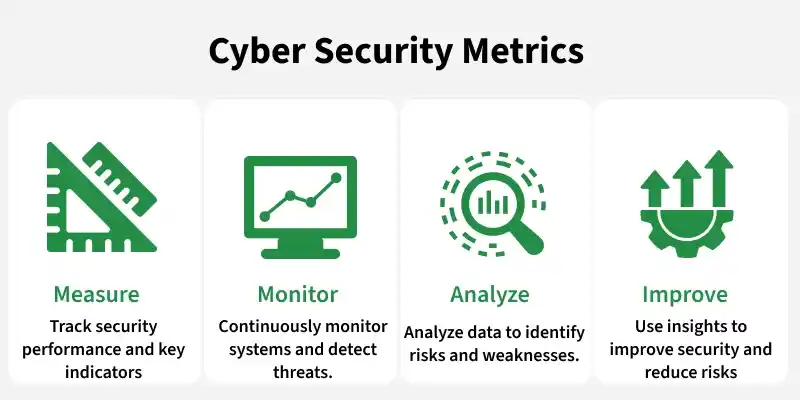
Cybersecurity metrics are quantifiable measurements used to assess the effectiveness of an organization's cybersecurity controls, processes and risk management practices. They enable organizations to measure security performance, monitor cyber risks, evaluate the efficiency of security operations and support data-driven decision-making for continuous security improvement.
Types of Cyber Security Metrics
1. Operational Metrics
Operational metrics measure daily security activities and system performance. These metrics help security teams monitor routine operations effectively.
- Monitors the status of patch management, malware detection and firewall performance to ensure systems remain protected against known vulnerabilities and cyber threats.
- Evaluates the effectiveness of preventive security controls by tracking timely patch deployment, malware detection accuracy and firewall efficiency.
2. Incident Response Metrics
Incident response metrics evaluate how quickly and effectively organizations respond to cyber incidents. Organizations use these metrics to improve response efficiency and minimize damage during attacks.
- Measures the efficiency of incident management using key metrics such as Mean Time to Detect (MTTD), Mean Time to Respond (MTTR) and Mean Time to Contain (MTTC).
- Tracks the number of resolved security incidents to evaluate the effectiveness of cybersecurity operations and continuous security improvement.
3. Risk Metrics
Risk metrics measure the level of cyber risk facing an organization. Risk metrics help organizations prioritize security improvements and allocate resources effectively.
- Assesses organizational risk by tracking vulnerability severity scores, the number of critical vulnerabilities and the status of unpatched systems.
- Evaluates third-party security risks to identify potential threats arising from vendors, suppliers and external service providers.
4. Compliance Metrics
Compliance metrics evaluate whether an organization follows security standards, regulations and policies. These metrics are important for industries that must follow framework such as GDPR, HIPAA or ISO 27001.
- Measures compliance through audit results, policy adherence rates and the identification of regulatory violations to ensure alignment with security standards.
- Tracks the security awareness training completion rate to evaluate employee compliance and strengthen the organization's overall security posture.
Key Cyber Security KPIs
Key Performance Indicators (KPIs) are measurable values used to evaluate how successfully security objectives are achieved. Security experts in 2026 consider MTTD and MTTR among the most valuable security metrics because they directly show how fast organizations can detect and stop attacks.
- Mean Time to Detect (MTTD): Measures how long it takes to identify a cyber threat after it occurs.
- Mean Time to Respond (MTTR): Measures the time required to respond to and resolve security incidents.
- Patch Management Rate: Tracks how quickly software vulnerabilities are patched.
- Phishing Detection Rate: Measures how effectively employees identify phishing attacks.
- Security Awareness Training Completion: Tracks employee participation in cyber security training programs.
- Vulnerability Remediation Time: Measures how quickly critical vulnerabilities are fixed.
Challenges in Measuring Cyber Security
Many organizations now avoid "vanity metrics" and focus on metrics that demonstrate actual risk reduction and resilience improvement. Organizations face several challenges when implementing cyber security metrics:
- Large amounts of security data.
- Difficulty selecting meaningful metrics.
- Lack of standard measurement frameworks.
- Constantly evolving cyber threats.
- Managing false positive alerts.
Best Practices for Effective Cyber Security Metrics
Security teams should also ensure that metrics are simple, understandable and actionable. To build an effective metric system, organizations should:
- Continuously monitor and update metrics.
- Automate data collection when possible.
- Present metrics through dashboards and reports.
- Align metrics with organizational objectives.
- Prioritize outcome-based measurements.
