
The binary number system, also known as the base-2 system, uses only two digits, '0' and '1', to represent numbers. Forms the fundamental basis for how computers process and store data.
- This number system is used to process and store information, representing everything from text to images as sequences of 0s and 1s.
- The word "binary" is derived from the word "bi," which is Latin for "two."
- The binary number (11001)₂ corresponds to the decimal number 25.
Binary Number Table
Given below is the decimal number and its binary equivalent.

Conversion from Binary to Other Number Systems
Binary numbers use digits 0 and 1 and have a base of 2. Converting a binary number to another number system involves changing its base. The following outlines the conversion of binary numbers to other number systems:
Binary to Decimal Conversion
A binary number is converted into a decimal number by multiplying each digit of the binary numbers 1 or 0 to the corresponding to the power of 2 according to the place value.
Let us consider that a binary number has n digits, B = an-1...a3a2a1a0. Now, the corresponding decimal number is given as:
D = (an-1 × 2n-1) +...+(a3 × 23) + (a2 × 22) + (a1 × 21) + (a0 × 20)
Example: To convert (11101011)2 into a decimal number.
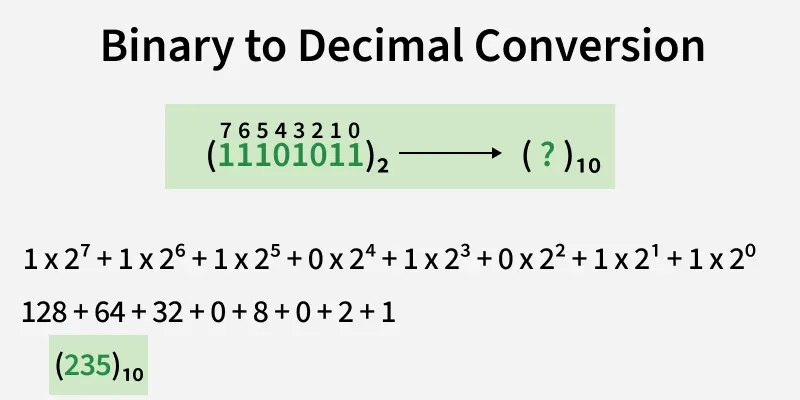
Steps:
- Step 1: Multiply each digit of the Binary number with the place value of that digit, starting from right to left i.e. from LSB to MSB.
- Step 2: Add the result of this multiplication and the decimal number will be formed.
Binary to Octal Conversion
Binary numbers have a base of 2, while octal numbers have a base of 8. To convert a binary number to an octal number, the base is changed from 2 to 8.
Example: To convert (11101011)2 into an octal number.
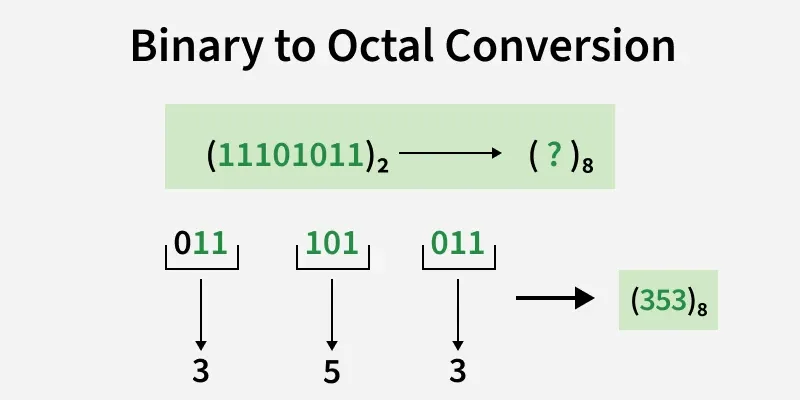
Steps:
- Step 1: Divide the binary number into groups of three digits starting from right to left i.e. from LSB to MSB.
- Step 2: Convert these groups into equivalent octal digits.
Binary to Hexadecimal Conversion
Binary numbers have a base of 2, while hexadecimal numbers have a base of 16. To convert a binary number to a hexadecimal number, group the digits appropriately and convert to the corresponding hexadecimal value.
Example: To convert (1110101101101)2 into a hex number.
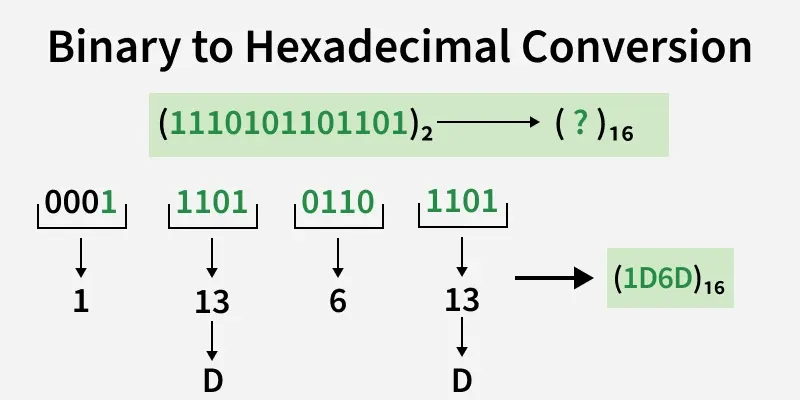
Steps:
- Step 1: Divide the binary number into groups of four digits starting from right to left i.e. from LSB to MSB.
- Step 2: Convert these groups into equivalent hex digits.
Arithmetic Operations on Binary Numbers
We can easily perform various operations on Binary Numbers. Various arithmetic operations on the Binary number include,
- Binary Addition
- Binary Subtraction
- Binary Multiplication
- Binary Division
Binary Addition
The result of the addition of two binary numbers is also a binary number. To obtain the result of the addition of two binary numbers, we have to add the digits of the binary numbers digit by digit. The table below shows the rules of binary addition.
Binary Number (1) | Binary Number (2) | Addition | Carry |
|---|---|---|---|
0 | 0 | 0 | 0 |
0 | 1 | 1 | 0 |
1 | 0 | 1 | 0 |
1 | 1 | 0 | 1 |
Example: Find (1101)2 + (1011)2 = ?
\begin{array}{cccccc} & & 1 & 1 & 0 & 1 \quad (\text{13 in decimal}) \\+ & & 1 & 0 & 1 & 1 \quad (\text{11 in decimal}) \\\hline & 1 & 1 & 0 & 0 & 0 \quad (\text{24 in decimal})\end{array}
Binary Subtraction
The result of the subtraction of two binary numbers is also a binary number. To obtain the result of the subtraction of two binary numbers, we have to subtract the digits of the binary numbers digit by digit. The table below shows the rule of binary subtraction.
Binary Number (1) | Binary Number (2) | Subtraction | Borrow |
|---|---|---|---|
0 | 0 | 0 | 0 |
0 | 1 | 1 | 1 |
1 | 0 | 1 | 0 |
1 | 1 | 0 | 0 |
Example: Find (1011)2 - (1110)2 = ?
\begin{array}{cccccc} & 1 & 1 & 1 & 0 \quad (\text{14 in decimal}) \\- & 1 & 0 & 1 & 1 \quad (\text{11 in decimal}) \\\hline & 0 & 0 & 1 & 1 \quad (\text{3 in decimal})\end{array}
Binary Multiplication
The multiplication process of binary numbers is similar to the multiplication of decimal numbers. The rules for multiplying any two binary numbers are given in the table.
Binary Number (1) | Binary Number (2) | Multiplication |
|---|---|---|
0 | 0 | 0 |
0 | 1 | 0 |
1 | 0 | 0 |
1 | 1 | 1 |
Example: Find (101)2 ⨉ (11)2 = ?
Solution:
\begin{array}{cccccc} & & 1 & 0 & 1 \\ \times & & & 1 & 1 \\\hline & & 1 & 0 & 1 \\+ & 1 & 0 & 1 & \times \\\hline & 1 & 1 & 1 & 1 \end{array}
Binary Division
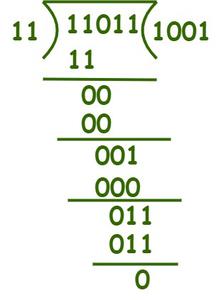
The division method for binary numbers is similar to that of the decimal number division method. Let us go through an example to understand the concept better.
Example: Find (11011)2 ÷ (11)2 = ?
1's and 2's Complement of a Binary Number
- 1's Complement of a Binary Number is obtained by inverting the digits of the binary number.
Example: Find the 1's complement of (10011)2.
Solution:
Given Binary Number is (10011)2
Now, to find its 1's complement, we have to invert the digits of the given number.
To find the 1's complement of a binary number, you simply flip all the bits:
Thus, 1's complement of (10011)2 is (01100)2
- 2's Complement of a Binary Number is obtained by inverting the digits of the binary number and then adding 1 to the least significant bit.
Example: Find the 2's complement of (1011)2.
Solution:
Given Binary Number is (1011)2
To find the 2's complement, first find its 1's complement, i.e., (0100)2
Now, by adding 1 to the least significant bit, we get (0101)2
Hence, the 2's complement of (1011)2 is (0101)2
Uses of the Binary Number System
Binary Number Systems are used for various purposes, and the most important use of the binary number system is,
- Binary Number System is used in all Digital Electronics for performing various operations.
- Programming Languages use the Binary Number System for encoding and decoding data.
- Binary Number System is used in Data Sciences for various purposes, etc.
➢Practice: Solved Examples
