
The Quotient Rule is a differentiation rule used to determine the derivative of a function that is expressed as the quotient (division) of two differentiable functions.
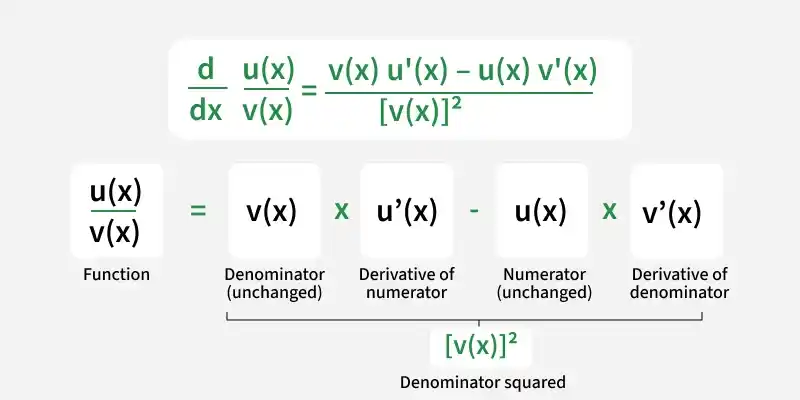
If a function is written as :
\frac{d}{dx}\left(\frac{u(x)}{v(x)}\right) = \frac{v(x)u'(x)-u(x)v'(x)}{[v(x)]^2}\\[3pts]\text{or}\\[3pts]\left(\frac{u}{v}\right)' = \frac{vu'-uv'}{v^2}
where,
- u(x) is the first function that is differentiable,
- u'(x) is the derivative of function u(x),
- v(x) is the second function, which is a differentiable function, and
- v'(x) is the derivative of the function v(x).
Steps to Apply
Step 1: Write the individual functions as u(x) and v(x).
Step 2: Find the derivative of the individual function u(x) and v(x), i.e. find u'(x) and v'(x).
Step 3: Now apply the quotient rule formula:
\frac{d}{dx}\left(\frac{u(x)}{v(x)}\right) = \frac{v(x)u'(x)-u(x)v'(x)}{[v(x)]^2} Step 4: Simplify the expression.
Proof
We can derive the quotient rule using the following methods:
1. Using Chain Rule
Given,
y=\frac{u(x)}{v(x)} Using the quotient as a product,
y=u(x)[v(x)]^{-1} Applying the Product Rule,
y' = u'(x)[v(x)]^{-1} + u(x)\frac{d}{dx}[v(x)]^{-1} Using the Power Rule,
\frac{d}{dx}[v(x)]^{-1} = -\frac{v'(x)}{[v(x)]^2} Substituting,
y' = \frac{u'(x)}{v(x)} - \frac{u(x)v'(x)}{[v(x)]^2} Taking the common denominator v2(x)
y' = \frac{u'(x)v(x)-u(x)v'(x)} {[v(x)]^2} Therefore,
\frac{d}{dx} \left( \frac{u(x)}{v(x)} \right) = \frac{v(x)u'(x)-u(x)v'(x)} {[v(x)]^2} Hence, the Quotient Rule is proved.
2. Using Derivative and Limit Properties
Let ,
f(x)=\frac{u(x)}{v(x)} , where u(x) and v(x) are differentiable functions and v(x) ≠ 0.Using the definition of a derivative,
f'(x)=\lim\limits_{h\to 0}\frac{f(x+h)-f(x)}{h} Substituting
f(x)=\dfrac{u(x)}{v(x)} ,
f'(x) = \lim\limits_{h\to 0} \frac{\frac{u(x+h)}{v(x+h)}-\frac{u(x)}{v(x)}}{h}\\[3pts]f'(x) = \lim\limits_{h\to 0} \frac{u(x+h)v(x)-u(x)v(x+h)} {h\,v(x+h)v(x)} Add and subtract u(x)v(x) in the numerator:
\lim_{h\to 0} \frac{ u(x+h)v(x)-u(x)v(x) + u(x)v(x)-u(x)v(x+h) } {h\,v(x+h)v(x)} Factor the common terms:
\lim\limits_{h\to 0} \frac{ v(x)\big[u(x+h)-u(x)\big] - u(x)\big[v(x+h)-v(x)\big] } {h\,v(x+h)v(x)} Separate the expression into two terms:
\lim\limits_{h\to 0} \left[ \frac{v(x)\big(u(x+h)-u(x)\big)} {h\,v(x+h)v(x)} - \frac{u(x)\big(v(x+h)-v(x)\big)} {h\,v(x+h)v(x)} \right] Simplifying and applying the limit,
= \lim\limits_{h\to 0} \left[ \frac{u(x+h)-u(x)} {h\,v(x+h)} - \frac{u(x)\big(v(x+h)-v(x)\big)} {h\,v(x+h)v(x)} \right]= \frac{u'(x)}{v(x)} - \frac{u(x)v'(x)}{v^2(x)} Taking the common denominator v2(x),
f'(x) = \frac{u'(x)v(x)-u(x)v'(x)} {v^2(x)} Therefore,
\frac{d}{dx} \left( \frac{u(x)}{v(x)} \right) = \frac{v(x)u'(x)-u(x)v'(x)} {[v(x)]^2} Hence, the Quotient Rule is proved.
Solved Examples
Example 1: Differentiate
Both Numerator and Denominator functions are differentiable.
Applying Quotient Rule,
y'=\dfrac {d}{dx}[\dfrac{x^3-5+2}{x^2+5}]
y'= \dfrac{[d/dx(x^3-x+2)(x^2+5)-(x^3-x+2)d/dx(x^2+5)]}{[x^2+5]^2}
y'= \dfrac{[(3x^2-1)(x^2+5)-(x^3-x+2)(2x)]}{[x^2+5]^2}\\=\dfrac{(3x^4+15x^2-x^2-5)-(2x^4-2x^2+4x)}{[x^2+5]^2}
y'= \dfrac{x^4+16x^2-4x-5}{[x^2+5]^2}
Example 2: Differentiate, f(x) = tan x.
tan x is written as sinx/cosx, i.e.
tan x = (sin x) / (cos x)
Both Numerator and Denominator functions are differentiable.
Applying Quotient Rule,
f'(x)=\dfrac{(d/dx(sinx))(cosx)-(d/dx(cosx))(sinx)}{cos^2x} ⇒
f'(x)= \dfrac{cosx.cosx-(-sinx)(sinx)}{cos^x} ⇒
f'(x)=\dfrac{cos^2x+sin^2x}{cos^2x} ⇒
f'(x)=\dfrac{1}{cos^2x}=sec^2x.
Example 3: Differentiate, f(x)= ex/x2
Both Numerator and Denominator functions are differentiable.
Applying Quotient Rule,
f'(x)=\dfrac{[(x^2)\frac{d}{dx} (e^x)-(e^x)\frac{d}{dx}(x^2)]}{x^4} Differentiate:
\frac{d}{dx}(e^x) = e^x,\ \frac{d}{dx}(x^2) = 2x Substitute and simplify:
f'(x)=\frac{x^2e^x-2xe^x}{x^4} \\f'(x)=\frac{e^x(x^2-2x)}{x^4} \\f'(x)=\frac{e^x(x-2)}{x^3} ⇒
f'(x)=\frac{e^x(x-2)}{x^3} a
Example 4: Differentiate,
Both Numerator and Denominator functions are differentiable.
Applying Quotient Rule,
y'=\dfrac{d/dx(cosx)(x^2)-d/dx(x^2)(cosx)}{x^4} ⇒
y'=\dfrac{-sinx(x^2)-(2x)(cosx)}{x^4} ⇒
y'=\dfrac{-(x^2)sinx-(2xcosx)}{x^4}
Example 5: Differentiate, f(p) = p+5/p+7
Both Numerator and Denominator functions are differentiable.
Applying Quotient Rule,
f'(p)=d/dx[\dfrac{p+5}{p+7}] ⇒
f'(p)=[\dfrac{d/dx(p+5)(p+7)-d/dx(p+7)(p+5)}{(p+7)^2}] ⇒
f'(p)=[\dfrac{p+7-p-5}{(p+7)^2}] ⇒
f'(p)=[\dfrac{2}{(p+7)^2}]
Practice Problems
Question 1: Find the derivative of f(x) = (x2 + 3)/(sin x)
Question 2: Find the derivative of f(x) = (2x2 + 3x + 5)/(x + 3)
Question 3: Find the derivative of f(x) = (x + 3)/(ln x)
Question 4: Find the derivative of f(x) = (x.sin x)/(x2)
Question 5: Differentiate
