
SAP (Systems, Applications, and Products in Data Processing) is one of the world's leading Enterprise Resource Planning (ERP) software providers. It helps organizations integrate and manage business processes such as finance, human resources, sales, procurement, manufacturing, and supply chain management through a centralized system.
- Integrates multiple business functions into a single platform.
- Provides real-time access to business data and insights.
- Automates business processes to improve efficiency and productivity.
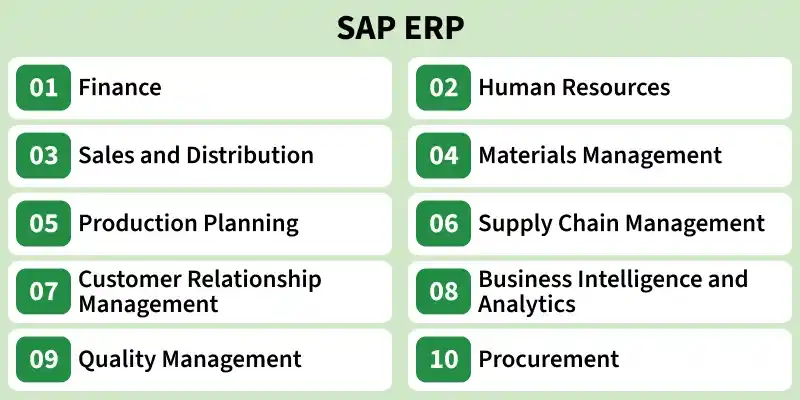
SAP Functionality
SAP offers a wide range of functionalities that help organizations manage different business operations efficiently. These functionalities streamline workflows, improve collaboration across departments, and support effective resource planning and management.
- Enterprise Resource Planning (ERP): Integrates finance, procurement, manufacturing, sales, human resources, and other business processes into a single system.
- Financial Management: Manages accounting, budgeting, financial reporting, asset management, and tax compliance.
- Human Capital Management (HCM): Handles employee records, payroll, recruitment, attendance, performance, and training.
- Sales and Distribution (SD): Supports order processing, pricing, shipping, billing, and customer-related sales activities.
- Materials Management (MM): Manages procurement, inventory, vendor information, purchase orders, and stock levels.
- Production Planning (PP): Helps plan manufacturing activities, production scheduling, material requirements, and capacity planning.
- Supply Chain Management (SCM): Optimizes procurement, logistics, warehouse management, transportation, and supply chain operations.
- Customer Relationship Management (CRM): Improves customer interactions by managing sales, marketing, and customer service activities.
- Business Intelligence and Analytics: Generates reports, dashboards, and real-time insights to support data-driven decision-making.
- Quality Management (QM): Ensures products meet quality standards through inspections, audits, and quality control processes.
Features of SAP
SAP includes several features that improve business efficiency, data management, and collaboration across the organization.
- Integrated System: Connects multiple business functions within a single platform.
- Centralized Database: Stores business data in one location, ensuring consistency and reducing duplication.
- Real-Time Data Processing: Updates information instantly across all modules.
- Modular Architecture: Allows organizations to implement only the modules they require.
- Scalability: Supports businesses of all sizes, from small enterprises to multinational organizations.
- Automation: Automates repetitive business processes, reducing manual effort and errors.
- Data Security: Provides role-based access control, user authentication, and data protection.
- Customization: Supports business-specific configurations and workflows without changing the core system.
Benefits of SAP
SAP provides several benefits that help organizations improve performance and efficiency.
- Improves operational efficiency by integrating business processes.
- Reduces data duplication through centralized data management.
- Provides real-time business insights for faster decision-making.
- Automates routine tasks to increase productivity and reduce errors.
- Enhances collaboration and coordination across departments.
- Supports business growth with scalable and flexible solutions.
- Strengthens data security and regulatory compliance.
- Improves customer satisfaction through streamlined business operations.
