

The Rapid Application Development (RAD) model is an iterative and incremental software development model that prioritises rapid prototyping, iterative development, and continuous user feedback over extensive upfront planning.
- Develops software quickly using short development cycles (60–90 days) and parallel module development.
- Uses prototypes with continuous user feedback to improve the system throughout development.
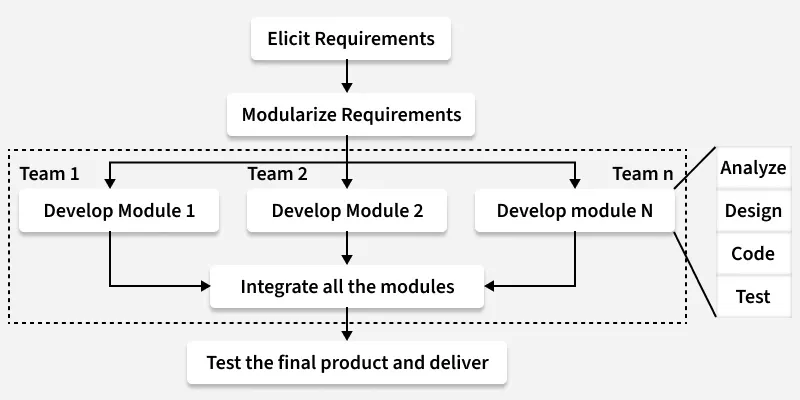
Modern RAD projects commonly use visual development tools, low-code platforms, frameworks, and IDEs to accelerate development.
- Requirements Planning: In this phase, developers and users meet to discuss what the software should do. All requirements are gathered, analyzed, and a basic plan for the project is created.
- User Design: Developers create simple prototypes or models of the software. Users try them, give feedback, and suggest changes. This helps ensure the software meets user needs.
- Construction: The actual software is developed in this phase. Coding, improving features, and fixing issues are done using fast development tools.
- Cutover: The completed software is tested, different modules are integrated, and the final system is deployed for user use. User acceptance testing is also done here.
The process involves building a rapid prototype, delivering it to the customer, and taking feedback. Customer feedback from prototypes is incorporated into the evolving requirements and final system design.
Objectives
- Fast Development: The main objective of RAD is to develop software quickly. By using rapid prototyping and short development cycles, a working system can be delivered in less time.
- Flexibility and Adaptability: RAD easily supports changes in requirements. If users suggest modifications, they can be included without affecting the entire system.
- Active User Involvement: Users participate throughout the development process. Their continuous feedback helps in building a system that meets real user needs.
- Improved Communication: Regular interaction between developers and users ensures clarity, reduces misunderstandings, and keeps everyone aligned with project goals.
- Better Quality through Prototyping: Prototypes allow early testing and validation. Errors and design issues are identified early, improving overall software quality.
- Higher Customer Satisfaction: Since users are involved and working versions are delivered quickly, the final product closely matches expectations, leading to better customer satisfaction.
When to use the RAD Model?
- Well-understood Requirements: RAD is best used when the project requirements are clear and unlikely to change much.
- Time-sensitive Projects: It is suitable when the software must be delivered quickly within a short time.
- Small to Medium-Sized Projects: RAD works well for projects that are not too large and can be handled by small teams.
- High User Involvement: It is ideal when users can give regular feedback during development.
- Innovation and Creativity: RAD is useful for projects that need experimentation, new ideas, and flexible design.
- Prototyping: It is best when building and improving prototypes is an important part of development.
- Low Technological Complexity: RAD suits projects that use simple and familiar technologies.
Advantages
- Fast development: Reusable components reduce development time.
- Early customer feedback: Users see prototypes early and give feedback.
- Lower development effort: Fewer developers are needed due to automation.
- Better quality: Powerful tools help build quality software quickly.
- Easy progress tracking: Development progress is visible in each phase.
- Flexible to changes: Changing requirements are easy to handle due to short cycles.
- High productivity: Small teams can deliver results faster.
Disadvantages
- Needs skilled professionals: Developers must be experienced with advanced tools.
- Depends on reusable components: Lack of reusable parts can cause failure.
- High coordination needed: Team leader must closely manage developers and customers.
- Not suitable for all systems: Systems that cannot be modularized cannot use RAD.
- Continuous customer involvement required: Lack of user commitment can fail the project.
- Costly for small projects: Tool and automation costs may exceed the budget.
- Not suitable for every application: Some projects do not fit RAD structure.
