
Software Evolution is the process of continuously modifying and updating software after its release to fix bugs, add new features, improve performance, adapt to changing environments, and meet evolving user requirements.
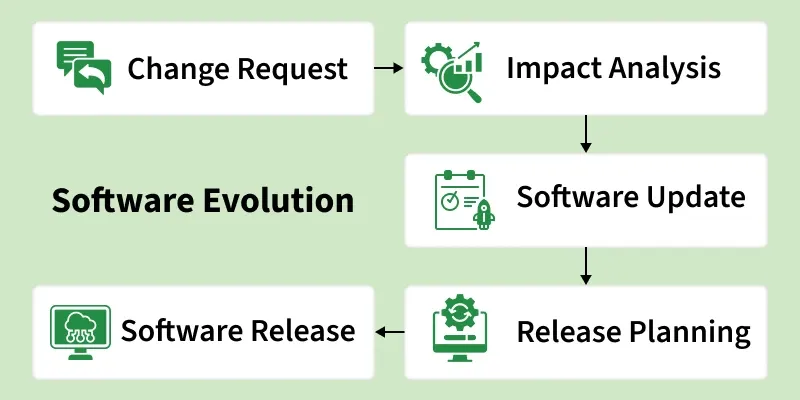
- Change Analysis: Evaluate the impact and cost of the proposed changes.
- Release Planning: Approve and plan changes such as bug fixes, adaptations, and new features.
- Design: Create the design for the approved changes.
- Implementation: Develop, test, and update the software iteratively before releasing the new version.
Necessity of Software Evolution
- Changing requirements: As an organization’s needs change over time, the software must be updated to support new ways of working and improve performance.
- Environmental changes: When the working environment or technology changes, software must evolve with updated features to stay compatible and useful.
- Errors and bugs: Software defects discovered after deployment must be fixed to improve reliability, stability, and user experience.
- Security risks: Outdated software is vulnerable to cyberattacks, making regular updates and security patches essential.
- New features and performance: Software must continuously evolve to add new features, improve speed and meet user expectations.
Laws Used for Software Evolution
- Law of Continuing Change: Any software system used in a real-world environment must continuously evolve, or it becomes progressively less useful.
- Law of Increasing Complexity: As an evolving program changes, its structure becomes more complex unless effective efforts are made to avoid this phenomenon.
- Law of Conservation of Organization Stability: The average rate of development of an evolving software system remains relatively constant throughout its lifetime, regardless of the resources allocated.
- Law of Conservation of Familiarity: To maintain familiarity with the software, the amount of change introduced in each release should remain relatively constant. Excessive changes make the software difficult for developers and users to understand.
- Law of Self Regulation: The evolution of software system is self-regulating, meaning its development process follows predictable patterns, and measures such as productivity, growth, and change tend to remain stable over time.
- Law of Continuing Growth: The functionality of software system must continue to grow over time to satisfy users' changing needs and maintain user satisfaction.
- Law of Declining Quality: The quality of software system gradually declines unless it is continuously maintained and updated to adapt to changing user needs and operating environments.
- Law of Feedback System: It depends on continuous feedback from users, developers, and the operating environment. Effective evolution requires using this feedback to guide future changes and improvements.
Advantages
- Keeps software updated to meet changing user and business needs.
- Protects software against new security threats through regular updates.
- Keeps software compatible with new technologies and operating systems.
- Improves usability by adding new features and refining existing ones.
- Keeps software useful and relevant for a longer time.
Challenges
- Requires significant time, effort, and resources.
- Risk of introducing new defects during updates.
- May introduce new vulnerabilities during updates.
- Can cause conflicts with existing systems or software.
- Insufficient testing during evolution may reduce software quality.
- Increasing software complexity makes future maintenance more difficult.
