
Software testing is an essential activity in software development that helps verify the quality, reliability, and performance of an application. Proper planning and management of testing activities ensure that defects are identified early and the software meets user requirements.
- Improves software quality and reliability
- Helps identify defects before software release
- Ensures the software meets user requirements
Test Policy
A Test Policy is a high-level document prepared at the organizational level that defines the overall rules, objectives, and direction for software testing. It provides a common framework for testing activities across all projects.
- Defines the organization’s testing goals and standards
- Provides guidelines for all testing projects
- Helps measure test success and quality
- Ensures consistency in testing practices across the organization
Example: A test policy may state that all critical defects must be fixed before release and that testing effectiveness will be measured using defect detection percentage.
Test Strategy
A Test Strategy is a document that describes the overall approach, methods, and techniques to be followed for testing a project. It explains how testing will be carried out to ensure that the software meets quality requirements.
- Defines the scope, objectives, and approach of testing
- Specifies the test levels, test types, and techniques to be used
- Identifies the resources, tools, and test environment required
- Supports the systematic execution of testing activities
Example: A test strategy may specify that the project will include functional testing, performance testing, and security testing, and that automation tools will be used for regression testing.
Test Estimates
Test Estimates refer to the process of predicting the time, effort, cost, and resources required to complete testing activities in a project. It helps in planning the testing work effectively and ensures that testing is completed within the required schedule.
- Estimates the time and effort needed for testing tasks
- Helps allocate resources and budget properly
- Supports planning and scheduling of testing activities
- Reduces the risk of delays and incomplete testing
Example: A test estimate may predict that test case design will take 3 days, execution will take 5 days, and regression testing will require 2 testers for 4 days.
Common Test Estimation Techniques
Several techniques are used to estimate testing effort, time, and cost in a project.
- Expert Judgment: Estimates are based on the experience of test managers or senior testers.
- Work Breakdown Structure (WBS): Testing tasks are divided into smaller activities and estimated individually.
- Percentage of Development Effort: Testing effort is estimated as a percentage of development effort.
- Historical Data: Estimates are prepared using data from similar past projects.
- Three-Point Estimation: Uses optimistic, most likely, and pessimistic estimates to calculate expected effort.
Relationship Between Test Policy, Test Strategy, and Test Estimates
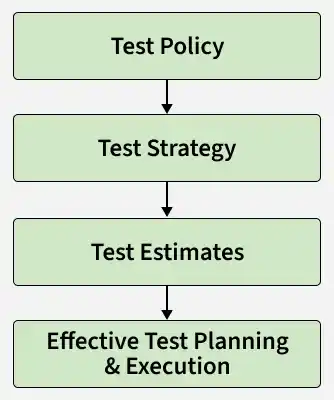
Test Policy, Test Strategy, and Test Estimates are closely related in software testing. They work together to ensure proper planning and execution of testing activities.
- Test Policy provides the overall testing guidelines
- Test Strategy is developed based on the test policy
- Test Estimates are prepared according to the test strategy
- Together, they help in effective planning and execution of testing
Advantages of Test Policy, Test Strategy, and Test Estimates
Using test policy, test strategy, and test estimates helps organizations manage software testing in a structured and efficient manner.
- Provides a clear direction for testing activities
- Helps in better planning and management of testing work
- Ensures consistency and standardization in testing practices
- Improves time, cost, and resource utilization
- Supports early risk identification and control
- Increases the chances of delivering quality software on time
