

Gaius Julius Caesar
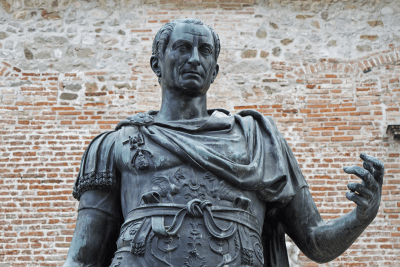
Julius Caesar was a Roman general, statesman, and writer who played a central role in the fall of the Roman Republic and the rise of the Roman Empire. Celebrated for his victories in Gaul, his crossing of the Rubicon, and his rise to dictatorship, Caesar remains one of the most influential and controversial figures in ancient history.
Born in 100 BC into the ancient but financially weakened Julii family, Gaius Julius Caesar rose through a mixture of political ambition, military brilliance, personal daring, and relentless self-promotion. His career took him from a difficult youth in Rome to fame in the Gallic Wars, civil war against Pompey after crossing the Rubicon, and finally supreme power as dictator, before his assassination on the Ides of March.
Caesar's legacy extends far beyond his own lifetime. His victories, reforms, and concentration of power reshaped Roman politics, while his death triggered the final struggles that ended the Roman Republic and opened the way for Augustus. The 21-part series below follows the full arc of Caesar's life, from his early years to his political rise, military triumphs, dictatorship, and death.
Julius Caesar at a glance:
- Born: 100 BC
- Died: 15 March 44 BC
- Known for: Conquest of Gaul, crossing the Rubicon, civil war, dictatorship of Rome
- Historical significance: Helped end the Roman Republic and pave the way for the Roman Empire
Why Julius Caesar Still Matters
Julius Caesar's significance lies not only in his own achievements, but in the profound transformation of Roman politics that followed his rise. By concentrating power in his own hands, challenging the authority of the Senate, and ultimately declaring himself dictator for life, Caesar exposed the weaknesses of the Republican system. His career demonstrated that Rome's traditional institutions could no longer contain the ambitions of powerful individuals, setting the stage for the end of the Republic.
The consequences of his assassination were just as important as his life. Rather than restoring the Republic, the death of Caesar triggered a new series of civil wars that reshaped the Roman world. Figures such as Mark Antony and Octavian (later Augustus) emerged from the chaos, ultimately leading to the establishment of the Roman Empire. In this sense, Caesar's death did not halt the shift toward one-man rule - it accelerated it.
Beyond politics, Caesar's legacy endures through his writings, his reforms, and his lasting influence on Western history. His accounts of the Gallic Wars remain among the most important primary sources from antiquity, while his name itself became synonymous with imperial power, giving rise to titles such as “Caesar,” “Kaiser,” and “Tsar.” More than two thousand years later, Julius Caesar remains a defining figure in the story of Rome, embodying both the ambitions that built the empire and the tensions that brought the Republic to an end.
Explore the complete life of Julius Caesar below, from his early years and political rise to his military campaigns, dictatorship, and assassination.
















The Rise and Fall of Rome's Greatest Conqueror: The History of Julius Caesar
by Jacob Abbott
Ideal for history fans, students, and anyone interested in the drama of Ancient Rome, The Rise and Fall of Rome's Greatest Conqueror not only captures the grandeur and achievements of Julius Caesar's life but also offers insight into the personal traits, ambitions, and flaws of the man who changed the course of history.