|
|
Jallian Wala Memorial
|
|
| April 13,the
day of Baisakhi festival, the day of celebrations marking the beginning
of harvest, the birthday of Khalsa in 1699 founded by Guru Gobind
Singh, was destined to be another historic day in 1919. The memorial
at this site commemorates the 2000 Indians who were killed or wounded,
shot indiscriminately by the British under the |
| command
of Gen Michael O"Dyer on April13, 1919 while participatingin a peaceful
public meeting. This was one of the major incidents of India's freedom
struggle. |
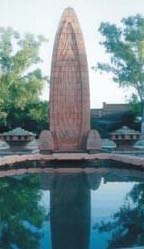 |
| The story
of this appaling massacre is told in the Martyr's Gallery at the site.
A section of wall with bullet marks still visible is preserved along
with the memorial well, in which some people jumped to escape. |
| "The impossible
men of India shall rise and liberate their mother land", declared
Mahatma Gandhi, after the Jallian Wala massacre. |
| "This disproportionate
severity of punishment inflicted upon the unfortunate people and method
of carrying it out is without parallel in the history of civilized
govt." wrote Rabindra Nath Tagore the noble laureate while returning
knighthood. |
|
|
Ram Bagh Garden
|
|
|
 |
Ram
Bagh a beautiful garden ,an accustomed listener to the Neighs
of thousand horses, announcing the arrival of the statesman
of the century Maharaja Ranjit Singh(1780-1839) the Lion of
Punjab, has in its heart the summer Palace of this great ruler. |
| Maintenance
free inbuilt cooling system designed in the Palace exhibits
the architectural excellence and invokes a keen interest.The
king of his time brought local chieftains under his control
and virtually finished any eventuality of possible attacks on
the kingdom raised by him. |
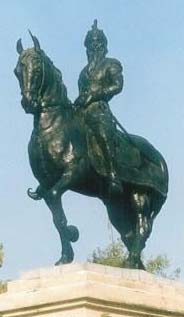
| To
commemorate the memory of his valour Ram Bagh on its one end
has a lively statue of Maharaja Ranjit Singh saddled on a horse
in a winsome posture. The garden was named by the ruler himself
as a tribute to Guru Ram Das, the founder of the city. |
| Now
the summer palace of the Maharaja Ranjit Singh has been converted
into a museum which speaks volumes on his times.On display are
weapons dating back to Mughal times, portraits of ruling houses
of Punjab and a replica of diamond "Kohinoor". |
In
those days the garden was approached by a huge fortified gate
which still exists in its original form and is just on the periphery
of the garden.
|
|
|
|
Bhai Vir Singh Heritage Museum & Library
|
|
|
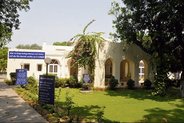 |
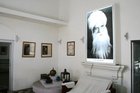
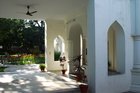
Bhai Vir Singh, popularly remembered as the Father of Modern
Punjabi Literature, was born in Amritsar in 1872. Bhai Sahib
spent the creative years of his life in Bhai Vir Singh Niwas
Asthan, 60 Lawrence Road, Amritsar. In view of Bhai Vir Singh's
literary contribution and the respect he commanded, Niwas
Asthan, more than 100-years old Victorian-style kothi with
vast gardens, was converted into Bhai Vir Singh Heritage
Museum and Library, and the road was renamed Bhai Vir Singh
Marg.
Bhai Sahib used to start his day by paying obeisance at
the Golden Temple by offering the first bouquet from the
garden of Niwas Asthan, and the tradition continues to this
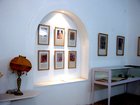
day. Apart from personal art and artefacts of the celebrated
poet, the museum houses original handwritten manuscripts of
Bhai Vir Singh, a collection of rare Guru Granth Sahib birs,
rare texts on Sikhism and Punjabi life, letters, antique
furniture, old coins, rare photographs, etc. |
How to Reach
By Air
Sri Guru Ramdass Ji International Airport is the nearest
airport to BVSHML, and the distance to the airport is 12
kilometres.
By Train
Amritsar Junction is the nearest railway station to BVSHML,
and the distance from the station is 1 kilometre.
By Road
Shaheed Madan Lal Dhingra Inter-State Bus Terminal is the
nearest bus stop to BVSHML, and the distance from the bus
stop is 1.7 kilometres.
|
|
|
|
|