Log In


Dalgaranga meteorite (Dalgaranga Crater), Dalgaranga Station, Yalgoo Shire, Western Australia, Australiai
| Regional Level Types | |
|---|---|
| Dalgaranga meteorite (Dalgaranga Crater) | - not defined - |
| Dalgaranga Station | Station (farming) |
| Yalgoo Shire | Shire |
| Western Australia | State |
| Australia | Country |
This page is currently not sponsored. Click here to sponsor this page.
Latitude & Longitude (WGS84):
27° 38' 4'' South , 117° 17' 20'' East
Latitude & Longitude (decimal):
Köppen climate type:
Mesosiderite-A
Find, 1921; 12.2 kg
The formation of this meteorite has been argued over a lot in the literature by experts in the field. This article will not enter the debate as the writer is not trained in meteorite identification.
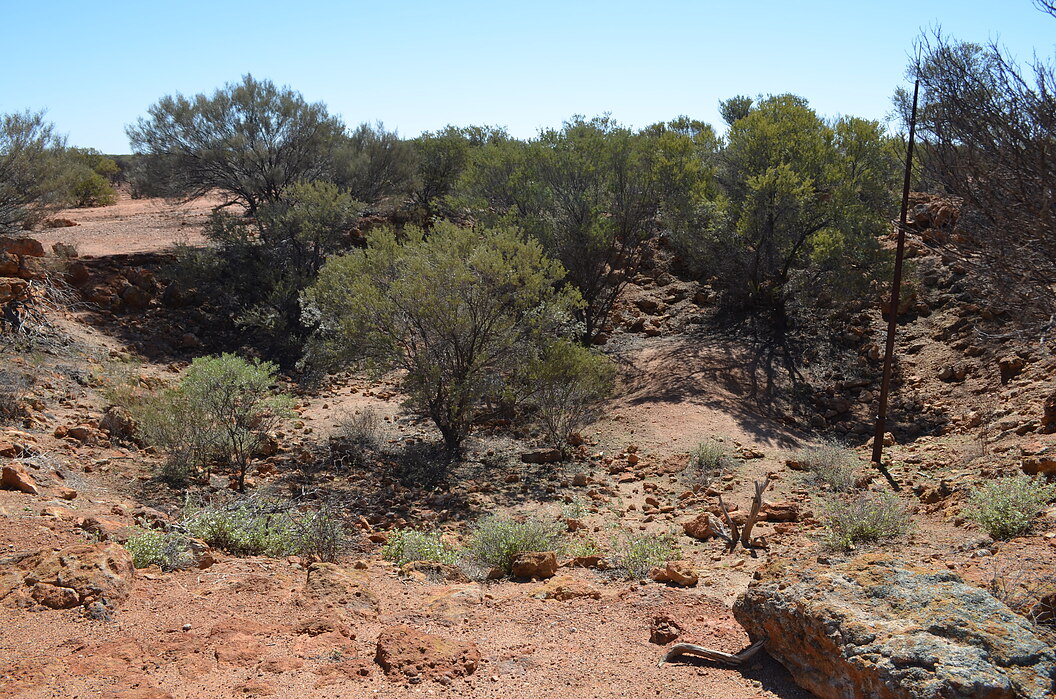
The Dalgaranga Meteorite Crater is 75 kilometres north-west of Mount Magnet. At 24 metres in diameter and 3 metres deep it is the smallest impact crater in Australia, with the exception of the smallest craters at Henbury. Over nearly one hundred years several hundred small fragments have been found in the crater and close by, and some have been seen for sale as specimens. Early literature reports the crater to be one of the youngest in the world at 3000 years, then 25 000 years, and finally it is stated it is one of the oldest preserved impact craters in the world outside Antarctica, as up to 270 000 years.
The crater was discovered by aboriginal stockman, Billy Seward, in 1921, and the first meteorite fragments collected by Dalgaranga station manager, Gerard Wellard shortly after. These were sent to the Western Australian Museum in 1923.
E.S. Simpson reported on the meteorite briefly in 1938, stating he studied a 40gr piece, showing 8.67% nickel, with bent kamacite plates 0.1-0.7mm.
Nininger and Huss studied the impact crater and meteorites in 1959 (published 1960) detailing the often funny difficulties they had operating in a remote environment, as well as their findings on the meteorite itself. G McCall published a detailed study in 1965. All tend to refute each other.
McCall states: 'Dalgaranga is a stony iron meteorite characterised by an uneven distribution of nickel iron, solid lumps within the meteorite showing widmanstatten patterns, and complete 'field' structure. Silicate is howardite and olivine xenocrysts being left as patchy iron free residual cavities, and represented by fragmented enclosures on a nickel iron network.'
He estimates the size of the original meteorite as 1-2 tonnes, although early writers give a higher weight. They agree it fell at low velocity, one stating from the south-east and the other from the west (this is why my hair is falling out!).
McCall states it is an achondrite with mesosiderite tendencies, but then states it cannot be classed as an achondrite because of the prominent olivine phenocrysts, and bears no resemblance at all to chondrite meteorites. He then states it is an atypical medium octahedrite but there is no joy here either as it is divided into fields, often round in shape and swathed in hematite bands about as wide as the lamellae within the widmanstatten figures. As such, it does not resemble any common octahedrite structure.
Iron oxides cover the surface, with internal stringers giving the meteorite a brecciated pattern. The grey howardite host contains bronzite grains and troilite grains up to 0.5mm. There are irregular cavities, either empty or infilled with iron oxide. The phenocrysts are vitreous, pale brown, in grey howardite, traversed by white olivine veinlets, which in turn are veined by chrysotile from terrestrial decomposition.
Found in the metal rich areas, is a non pleochroic variety of eutectic plagioclase, forming laths at the base of irregular pyroxene granules. Hypersthene is also present. The feldspars show clear cut twin lamellae of a labradoritic bytownite. There is a little pigeonite showing augite exsolution lamellae.
Select Mineral List Type
Standard Detailed Gallery Strunz Chemical ElementsDetailed Mineral List:
| ⓘ Anorthite Formula: Ca(Al2Si2O8) |
| ⓘ Anorthite var. Bytownite Formula: (Ca,Na)[Al(Al,Si)Si2O8] |
| ⓘ Augite Formula: (CaxMgyFez)(Mgy1Fez1)Si2O6 |
| ⓘ Chromite Formula: Fe2+Cr3+2O4 |
| ⓘ Chrysotile Formula: Mg3(Si2O5)(OH)4 |
| ⓘ 'Clinopyroxene Subgroup' Description: At least two clinopyroxenes are present — augite (ca-rich) and pigeonite (Ca-poor) |
| ⓘ Enstatite Formula: Mg2Si2O6 |
| ⓘ Enstatite var. Bronzite Formula: (Mg,Fe2+)2[SiO3]2 |
| ⓘ 'Fayalite-Forsterite Series' Description: Quite variable - Fo62-87 reported by Delaney et al. (1980) |
| ⓘ Graphite Formula: C |
| ⓘ 'Hypersthene' Formula: (Mg,Fe)SiO3 |
| ⓘ Ilmenite Formula: Fe2+TiO3 References: |
| ⓘ Merrillite Formula: Ca9NaMg(PO4)7 |
| ⓘ Native Iron Formula: Fe |
| ⓘ Native Iron var. Kamacite Formula: (Fe,Ni) |
| ⓘ 'Orthopyroxene Subgroup' Description: At least 2 varieties present - bytownite (suggestive of a possible eucritic admixture) and hypersthene (suggestive of a possible diogenitic admixture) |
| ⓘ Pigeonite Formula: (CaxMgyFez)(Mgy1Fez1)Si2O6 |
| ⓘ 'Plagioclase' Formula: (Na,Ca)[(Si,Al)AlSi2]O8 |
| ⓘ 'Pyroxene Group' Formula: ADSi2O6 |
| ⓘ Rutile Formula: TiO2 References: |
| ⓘ Schreibersite Formula: (Fe,Ni)3P |
| ⓘ Taenite Formula: (Ni,Fe) |
| ⓘ Tetrataenite Formula: FeNi |
| ⓘ Tridymite Formula: SiO2 |
| ⓘ Troilite Formula: FeS References: McCall, G. J. H. (1965) New material from, and a reconsideration of, the Dalgaranga meteorite and crater, Western Australia. Mineralogical Magazine and Journal of the Mineralogical Society, 35 (271) 476-487 doi:10.1180/minmag.1965.035.271.03 Goresy, Ahmed El (1965) Mineralbestand und Strukturen der Graphit- und Sulfideinschlüsse in Eisenmeteoriten. Geochimica et Cosmochimica Acta, 29 (10) 1131-1151 doi:10.1016/0016-7037(65)90116-x |
Gallery:
List of minerals arranged by Strunz 10th Edition classification
| Group 1 - Elements | |||
|---|---|---|---|
| ⓘ | Native Iron | 1.AE.05 | Fe |
| ⓘ | var. Kamacite | 1.AE.05 | (Fe,Ni) |
| ⓘ | Taenite | 1.AE.10 | (Ni,Fe) |
| ⓘ | Tetrataenite | 1.AE.10 | FeNi |
| ⓘ | Schreibersite | 1.BD.05 | (Fe,Ni)3P |
| ⓘ | Graphite | 1.CB.05a | C |
| Group 2 - Sulphides and Sulfosalts | |||
| ⓘ | Troilite | 2.CC.10 | FeS |
| Group 4 - Oxides and Hydroxides | |||
| ⓘ | Chromite | 4.BB.05 | Fe2+Cr3+2O4 |
| ⓘ | Ilmenite | 4.CB.05 | Fe2+TiO3 |
| ⓘ | Tridymite | 4.DA.10 | SiO2 |
| ⓘ | Rutile | 4.DB.05 | TiO2 |
| Group 8 - Phosphates, Arsenates and Vanadates | |||
| ⓘ | Merrillite | 8.AC.45 | Ca9NaMg(PO4)7 |
| Group 9 - Silicates | |||
| ⓘ | Chrysotile | 9.00. | Mg3(Si2O5)(OH)4 |
| ⓘ | Enstatite | 9.DA.05 | Mg2Si2O6 |
| ⓘ | var. Bronzite | 9.DA.05 | (Mg,Fe2+)2[SiO3]2 |
| ⓘ | Pigeonite | 9.DA.10 | (CaxMgyFez)(Mgy1Fez1)Si2O6 |
| ⓘ | Augite | 9.DA.15 | (CaxMgyFez)(Mgy1Fez1)Si2O6 |
| ⓘ | Anorthite | 9.FA.35 | Ca(Al2Si2O8) |
| ⓘ | var. Bytownite | 9.FA.35 | (Ca,Na)[Al(Al,Si)Si2O8] |
| Unclassified | |||
| ⓘ | 'Hypersthene' | - | (Mg,Fe)SiO3 |
| ⓘ | 'Clinopyroxene Subgroup' | - | |
| ⓘ | 'Fayalite-Forsterite Series' | - | |
| ⓘ | 'Plagioclase' | - | (Na,Ca)[(Si,Al)AlSi2]O8 |
| ⓘ | 'Pyroxene Group' | - | ADSi2O6 |
| ⓘ | 'Orthopyroxene Subgroup' | - | |
List of minerals for each chemical element
| H | Hydrogen | |
|---|---|---|
| H | ⓘ Chrysotile | Mg3(Si2O5)(OH)4 |
| C | Carbon | |
| C | ⓘ Graphite | C |
| O | Oxygen | |
| O | ⓘ Anorthite | Ca(Al2Si2O8) |
| O | ⓘ Augite | (CaxMgyFez)(Mgy1Fez1)Si2O6 |
| O | ⓘ Anorthite var. Bytownite | (Ca,Na)[Al(Al,Si)Si2O8] |
| O | ⓘ Chrysotile | Mg3(Si2O5)(OH)4 |
| O | ⓘ Chromite | Fe2+Cr23+O4 |
| O | ⓘ Enstatite | Mg2Si2O6 |
| O | ⓘ Hypersthene | (Mg,Fe)SiO3 |
| O | ⓘ Ilmenite | Fe2+TiO3 |
| O | ⓘ Pigeonite | (CaxMgyFez)(Mgy1Fez1)Si2O6 |
| O | ⓘ Rutile | TiO2 |
| O | ⓘ Tridymite | SiO2 |
| O | ⓘ Enstatite var. Bronzite | (Mg,Fe2+)2[SiO3]2 |
| O | ⓘ Merrillite | Ca9NaMg(PO4)7 |
| O | ⓘ Fayalite-Forsterite Series | |
| O | ⓘ Plagioclase | (Na,Ca)[(Si,Al)AlSi2]O8 |
| O | ⓘ Pyroxene Group | ADSi2O6 |
| Na | Sodium | |
| Na | ⓘ Anorthite var. Bytownite | (Ca,Na)[Al(Al,Si)Si2O8] |
| Na | ⓘ Merrillite | Ca9NaMg(PO4)7 |
| Na | ⓘ Plagioclase | (Na,Ca)[(Si,Al)AlSi2]O8 |
| Mg | Magnesium | |
| Mg | ⓘ Augite | (CaxMgyFez)(Mgy1Fez1)Si2O6 |
| Mg | ⓘ Chrysotile | Mg3(Si2O5)(OH)4 |
| Mg | ⓘ Enstatite | Mg2Si2O6 |
| Mg | ⓘ Hypersthene | (Mg,Fe)SiO3 |
| Mg | ⓘ Pigeonite | (CaxMgyFez)(Mgy1Fez1)Si2O6 |
| Mg | ⓘ Enstatite var. Bronzite | (Mg,Fe2+)2[SiO3]2 |
| Mg | ⓘ Merrillite | Ca9NaMg(PO4)7 |
| Mg | ⓘ Fayalite-Forsterite Series | |
| Al | Aluminium | |
| Al | ⓘ Anorthite | Ca(Al2Si2O8) |
| Al | ⓘ Anorthite var. Bytownite | (Ca,Na)[Al(Al,Si)Si2O8] |
| Al | ⓘ Plagioclase | (Na,Ca)[(Si,Al)AlSi2]O8 |
| Si | Silicon | |
| Si | ⓘ Anorthite | Ca(Al2Si2O8) |
| Si | ⓘ Augite | (CaxMgyFez)(Mgy1Fez1)Si2O6 |
| Si | ⓘ Anorthite var. Bytownite | (Ca,Na)[Al(Al,Si)Si2O8] |
| Si | ⓘ Chrysotile | Mg3(Si2O5)(OH)4 |
| Si | ⓘ Enstatite | Mg2Si2O6 |
| Si | ⓘ Hypersthene | (Mg,Fe)SiO3 |
| Si | ⓘ Pigeonite | (CaxMgyFez)(Mgy1Fez1)Si2O6 |
| Si | ⓘ Tridymite | SiO2 |
| Si | ⓘ Enstatite var. Bronzite | (Mg,Fe2+)2[SiO3]2 |
| Si | ⓘ Fayalite-Forsterite Series | |
| Si | ⓘ Plagioclase | (Na,Ca)[(Si,Al)AlSi2]O8 |
| Si | ⓘ Pyroxene Group | ADSi2O6 |
| P | Phosphorus | |
| P | ⓘ Schreibersite | (Fe,Ni)3P |
| P | ⓘ Merrillite | Ca9NaMg(PO4)7 |
| S | Sulfur | |
| S | ⓘ Troilite | FeS |
| Ca | Calcium | |
| Ca | ⓘ Anorthite | Ca(Al2Si2O8) |
| Ca | ⓘ Augite | (CaxMgyFez)(Mgy1Fez1)Si2O6 |
| Ca | ⓘ Anorthite var. Bytownite | (Ca,Na)[Al(Al,Si)Si2O8] |
| Ca | ⓘ Pigeonite | (CaxMgyFez)(Mgy1Fez1)Si2O6 |
| Ca | ⓘ Merrillite | Ca9NaMg(PO4)7 |
| Ca | ⓘ Plagioclase | (Na,Ca)[(Si,Al)AlSi2]O8 |
| Ti | Titanium | |
| Ti | ⓘ Ilmenite | Fe2+TiO3 |
| Ti | ⓘ Rutile | TiO2 |
| Cr | Chromium | |
| Cr | ⓘ Chromite | Fe2+Cr23+O4 |
| Fe | Iron | |
| Fe | ⓘ Augite | (CaxMgyFez)(Mgy1Fez1)Si2O6 |
| Fe | ⓘ Chromite | Fe2+Cr23+O4 |
| Fe | ⓘ Hypersthene | (Mg,Fe)SiO3 |
| Fe | ⓘ Ilmenite | Fe2+TiO3 |
| Fe | ⓘ Native Iron | Fe |
| Fe | ⓘ Native Iron var. Kamacite | (Fe,Ni) |
| Fe | ⓘ Pigeonite | (CaxMgyFez)(Mgy1Fez1)Si2O6 |
| Fe | ⓘ Schreibersite | (Fe,Ni)3P |
| Fe | ⓘ Taenite | (Ni,Fe) |
| Fe | ⓘ Tetrataenite | FeNi |
| Fe | ⓘ Troilite | FeS |
| Fe | ⓘ Enstatite var. Bronzite | (Mg,Fe2+)2[SiO3]2 |
| Fe | ⓘ Fayalite-Forsterite Series | |
| Ni | Nickel | |
| Ni | ⓘ Native Iron var. Kamacite | (Fe,Ni) |
| Ni | ⓘ Schreibersite | (Fe,Ni)3P |
| Ni | ⓘ Taenite | (Ni,Fe) |
| Ni | ⓘ Tetrataenite | FeNi |
Other Regions, Features and Areas containing this locality
Australia
- Western Australia
- West Australian ElementCraton
- Yilgarn CratonCraton
Australian PlateTectonic Plate
- West Australian Craton
- Western Yilgarn CratonCraton
This page contains all mineral locality references listed on mindat.org. This does not claim to be a complete list. If you know of more minerals from this site, please register so you can add to our database. This locality information is for reference purposes only. You should never attempt to
visit any sites listed in mindat.org without first ensuring that you have the permission of the land and/or mineral rights holders
for access and that you are aware of all safety precautions necessary.
References
Simpson, Edward S. (1938) Some new and little-known meteorites found in Western Australia. Mineralogical Magazine and Journal of the Mineralogical Society, 25 (163) 157-171 doi:10.1180/minmag.1938.025.163.01
Nininger, H. H., Huss, Glenn I. (1960) The unique meteorite crater at Dalgaranga, Western Australia. Mineralogical Magazine and Journal of the Mineralogical Society, 32 (251) 619-639 doi:10.1180/minmag.1960.032.251.03
Goresy, Ahmed El (1965) Mineralbestand und Strukturen der Graphit- und Sulfideinschlüsse in Eisenmeteoriten. Geochimica et Cosmochimica Acta, 29 (10) 1131-1151 doi:10.1016/0016-7037(65)90116-x
McCall, G. J. H. (1965) New material from, and a reconsideration of, the Dalgaranga meteorite and crater, Western Australia. Mineralogical Magazine and Journal of the Mineralogical Society, 35 (271) 476-487 doi:10.1180/minmag.1965.035.271.03

Dalgaranga meteorite, Dalgaranga Station, Yalgoo Shire, Western Australia, Australia