Log In


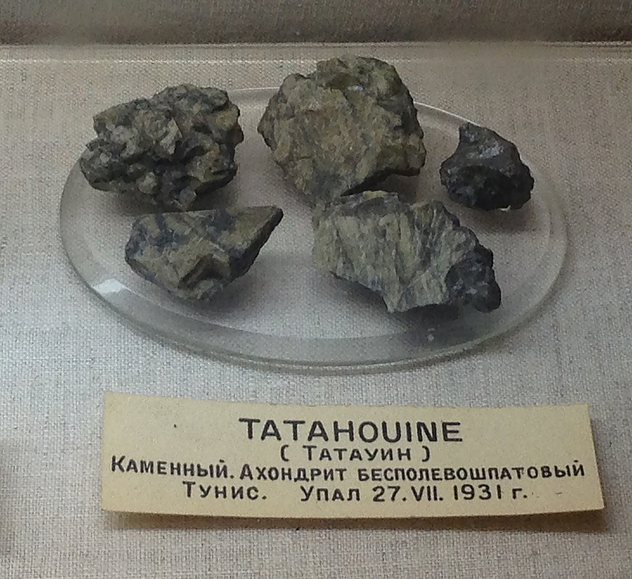
Tatahouine meteorite, Tataouine (Foum Tatahouine), Tataouine, Tunisiai
| Regional Level Types | |
|---|---|
| Tatahouine meteorite | Meteorite Fall Location |
| Tataouine (Foum Tatahouine) | City |
| Tataouine | Governorate |
| Tunisia | Country |
This page is currently not sponsored. Click here to sponsor this page.


Latitude & Longitude (WGS84):
32° 57' North , 10° 25' East
Latitude & Longitude (decimal):
Meteorite Class:
Meteoritical Society Class:
Köppen climate type:
Nearest Settlements:
| Place | Population | Distance |
|---|---|---|
| Tataouine | 62,577 (2018) | 4.0km |
| Beni Kheddache | 3,588 (2018) | 39.3km |
| Medenine | 61,705 (2018) | 45.8km |
Achondrite Diogenite
Fell at 1:30 am ,June 27,1931,near village of Foum-Tataouine,south-Tunisian.
The explosion and the intense flash woke up the entire population and also the French military garrison.
The next day, French legionnaires and local Bedouins recovered at 4 km north-east of the village nearly 12 kg of fragments,numerous very small fragments fell over a radius of 500 m ,which were collected and sent to the Natural History Museum of Paris.The largest fragments did not exceed 2 kg.
Alfred Lacroix, a famous French mineralogist, petrographer, and geologist,professor & curator of the mineralogy collection of the French museum, studied this meteorite, and published a study on it and a comparison of the Tataouine meteorite with previously known diogenites.
(cf Bulletin de Minéralogie Année 1932 55-3-6 pp. 101-122)
In 1992, Dr. Alain Carion, accompanied by his son Louis, undertook to find the places where the French military had found the meteorite in the desert, and found many pieces of the meteorite, which brought the total of samples found for this meteorite to 13.5 kg.
Most Diogenites and all 11 Diogenite falls are pyroxenites compositionally dominated by orthopyroxene (~90 vol%), usually accompanied by plus minor amounts of various silicates and opaques. Unlike most other diogenites, however, Tatahouine's dominant pyroxene is composed mostly of numerous large single, usually seemingly unfragmented crystals of orthopyroxene. Closer inspection reveals, however, that many crystals have been partially deformed by shock and then subsequently reequilibrated and annealed. The Tatathouine's mineral assemblage is composed of very ancient material (~4.5 billion years). However, a moderately 'young' ~4.4 billion years Rb-Sr age suggests that the formation epoch itself was accompanied by almost simultaneous intense shock event(s) which would have interrupted any well-defined simple formational epoch.
Tatahouine has also attracted some attention due to the detection of calcite and carbonate weathering products in samples recovered six decades after the fall. Some of the minerals may be biogenic. All this suggests that a 'well-preserved' meteorite in a hot, dry desert is not as impervious to alteration as first impressions might suggest.
Select Mineral List Type
Standard Detailed Gallery Strunz Chemical ElementsMineral List
7 valid minerals.
Meteorite/Rock Types Recorded
Select Rock List Type
Alphabetical List Tree DiagramDetailed Mineral List:
| ⓘ Ahrensite ? Formula: SiFe2O4 |
| ⓘ Calcite Formula: CaCO3 |
| ⓘ Chromite Formula: Fe2+Cr3+2O4 |
| ⓘ Cristobalite Formula: SiO2 References: |
| ⓘ 'Hypersthene' Formula: (Mg,Fe)SiO3 References: |
| ⓘ Native Iron Formula: Fe Description: Ni-free Iron (Mason, 1963); Ni-poor iron [Ni <1.5 wt%](Gooley & Moore, 1976); Iron with ~2% Ni+Co (Barrat et al.,1999) |
| ⓘ Native Iron var. Kamacite Formula: (Fe,Ni) |
| ⓘ 'Orthopyroxene Subgroup' Description: Orthopyroxene composition relatively homogeneous(En 75), but host regions are often disordered. (Nord & Hewins,1983) References: |
| ⓘ Pentlandite Formula: (NixFey)Σ9S8 |
| ⓘ Troilite Formula: FeS |
Gallery:
List of minerals arranged by Strunz 10th Edition classification
| Group 1 - Elements | |||
|---|---|---|---|
| ⓘ | Native Iron | 1.AE.05 | Fe |
| ⓘ | var. Kamacite | 1.AE.05 | (Fe,Ni) |
| Group 2 - Sulphides and Sulfosalts | |||
| ⓘ | Pentlandite | 2.BB.15 | (NixFey)Σ9S8 |
| ⓘ | Troilite | 2.CC.10 | FeS |
| Group 4 - Oxides and Hydroxides | |||
| ⓘ | Chromite | 4.BB.05 | Fe2+Cr3+2O4 |
| ⓘ | Cristobalite | 4.DA.15 | SiO2 |
| Group 5 - Nitrates and Carbonates | |||
| ⓘ | Calcite | 5.AB.05 | CaCO3 |
| Group 9 - Silicates | |||
| ⓘ | Ahrensite ? | 9.AC. | SiFe2O4 |
| Unclassified | |||
| ⓘ | 'Hypersthene' | - | (Mg,Fe)SiO3 |
| ⓘ | 'Orthopyroxene Subgroup' | - | |
List of minerals for each chemical element
| C | Carbon | |
|---|---|---|
| C | ⓘ Calcite | CaCO3 |
| O | Oxygen | |
| O | ⓘ Calcite | CaCO3 |
| O | ⓘ Chromite | Fe2+Cr23+O4 |
| O | ⓘ Cristobalite | SiO2 |
| O | ⓘ Hypersthene | (Mg,Fe)SiO3 |
| O | ⓘ Ahrensite | SiFe2O4 |
| Mg | Magnesium | |
| Mg | ⓘ Hypersthene | (Mg,Fe)SiO3 |
| Si | Silicon | |
| Si | ⓘ Cristobalite | SiO2 |
| Si | ⓘ Hypersthene | (Mg,Fe)SiO3 |
| Si | ⓘ Ahrensite | SiFe2O4 |
| S | Sulfur | |
| S | ⓘ Pentlandite | (NixFey)Σ9S8 |
| S | ⓘ Troilite | FeS |
| Ca | Calcium | |
| Ca | ⓘ Calcite | CaCO3 |
| Cr | Chromium | |
| Cr | ⓘ Chromite | Fe2+Cr23+O4 |
| Fe | Iron | |
| Fe | ⓘ Chromite | Fe2+Cr23+O4 |
| Fe | ⓘ Hypersthene | (Mg,Fe)SiO3 |
| Fe | ⓘ Native Iron | Fe |
| Fe | ⓘ Native Iron var. Kamacite | (Fe,Ni) |
| Fe | ⓘ Pentlandite | (NixFey)Σ9S8 |
| Fe | ⓘ Troilite | FeS |
| Fe | ⓘ Ahrensite | SiFe2O4 |
| Ni | Nickel | |
| Ni | ⓘ Native Iron var. Kamacite | (Fe,Ni) |
| Ni | ⓘ Pentlandite | (NixFey)Σ9S8 |
Other Regions, Features and Areas containing this locality
This page contains all mineral locality references listed on mindat.org. This does not claim to be a complete list. If you know of more minerals from this site, please register so you can add to our database. This locality information is for reference purposes only. You should never attempt to
visit any sites listed in mindat.org without first ensuring that you have the permission of the land and/or mineral rights holders
for access and that you are aware of all safety precautions necessary.

Tatahouine meteorite, Tataouine, Tataouine, Tunisia