Log In


Corbyn's Head, Torquay, Torbay, Devon, England, UKi
| Regional Level Types | |
|---|---|
| Corbyn's Head | Cliff |
| Torquay | Town |
| Torbay | Unitary Authority |
| Devon | County |
| England | Constituent Country |
| UK | Country |
This page is currently not sponsored. Click here to sponsor this page.


Latitude & Longitude (WGS84):
50° 27' 30'' North , 3° 32' 28'' West
Latitude & Longitude (decimal):
UK National Grid Reference:
SX908632
Type:
Köppen climate type:
Nearest Settlements:
| Place | Population | Distance |
|---|---|---|
| Torquay | 65,388 (2017) | 1.2km |
| Cockington | 10,000 (2016) | 1.2km |
| Paignton | 49,886 (2011) | 3.2km |
| Marldon | 1,838 (2018) | 4.0km |
| Kingskerswell | 4,703 (2018) | 5.4km |
Other/historical names associated with this locality:
"Corbons Head"
Excerpts from West, Ian M. & Csorvasi, Nikolett (2014) Geology of Torquay, Devon (see link below):
"Corbyn's Head (map ref. SX 908632) is at Torbay, south of the main part of the town of Torquay, not far from Torquay Railway Station (it is shown as "Corbons Head" on old geological and topographic maps and in Plate 6 of the old memoir — Lloyd, 1933). It is the southern end of the Torquay Esplanade and sea wall. The headland is a small, flat-topped, promontory near the coast road; it has a cliff of medium height which is accessible at low tide. Occasional rockfalls have been recorded here."
"The cliff is of multi-coloured breccia and sandstone, nearly horizontal and just with a very low dip. It is regarded as of Permian age, although a late Carboniferous age has also been considered. For an introduction to Permian geology in this region see the classic work of Durrance and Laming, 1982."
"The cliff section at Corbyn's Head is about 15m thick. The lower part consists of sandstone and the upper part of conglomerate (Leveridge et al. 2003). The sandstone varies from purplish and reddish brown to buff, pale grey and greenish grey […]. Particle size is medium to coarse. Individual sandstone beds are locally pebbly and show remarkably poor sorting. Pebbles and cobbles form thin breccia or conglomerate beds in places. Clast includes sandstone, vein quartz, limestone chert and porphyritic rhyolite [or quartz porphyry] (Leveridge et al. 2003). […] There are some desiccation-cracked sheets of red mudstone. Some mudstone layers seem to have been eroded and reworked. Some red clasts are present in dipping foresets of sandstone. Red mud in modern deserts is sometimes referred to as being as hard as adobe, and this may have been true for these rip-up clasts. The thin mud-sheets do not seem thick or extensive and may have been very local rather than deposits of a major lake. Perhaps the mud settled from the final stages of flash floods in local depressions."
"The oxidation state here at Corbyn's Head is interesting. It is peculiar that in some cases there are green (i.e. reduced) surrounding halos. Why should there have been reduction around clasts of oxidised material? Although unusual, it is, of course, possible that the Fe oxidation within the mud was actually late. The red colour, rather than brown colour, is probably the result of dehydration of Fe-minerals with burial, temperature and time. Hematite here is probably post-depositional and the result of early burial diagenesis, as shown occurring in Quaternary times in the Sonoran Desert of Baja California, Mexico (Walker, 1967). Brown goethite-rich sediments can change to a red hematite-rich condition, with burial, fairly high temperature and with time."
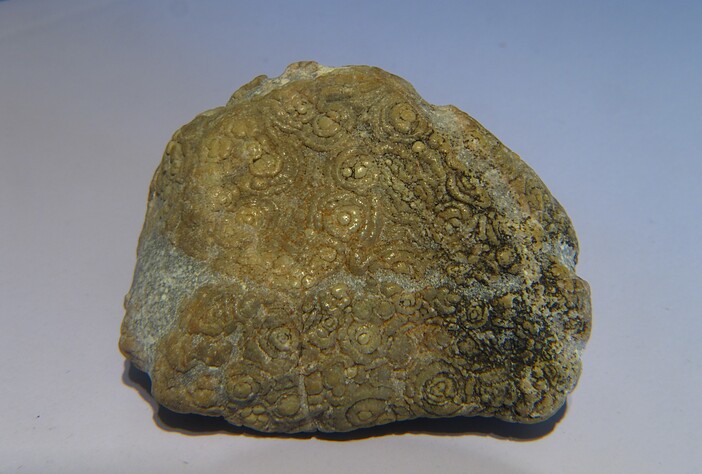
"At Corbyn's Head the Corbyn's Head Member, the basal part of the Torbay Breccia Formation has some other interesting features. This is an area where limestone clasts are often coated with the orbicular coating of chalcedony known as beekite […]. With regard to beekite see Ussher (1903, p. 110)."
"Imbrication directions shown by clasts here and at Livermead Head show transport from a westerly direction between a quartzite ridge and a limestone ridge, present at the time. An interesting feature of the cliff section is the presence of some dish structures."
"[See also: Elaine Burt, Richard Scrivener and Sarita McVicar Wright (2012) Volcaniclastic red beds from the Corbyn's Head Member, Torquay, South Devon. Talk at the Meeting of the Ussher Society, Wednesday 4th January 2012. Probably a paper will be available later.]"
Select Mineral List Type
Standard Detailed Gallery Strunz Chemical ElementsMineral List
2 valid minerals.
Rock Types Recorded
Note: data is currently VERY limited. Please bear with us while we work towards adding this information!
Select Rock List Type
Alphabetical List Tree DiagramDetailed Mineral List:
| ⓘ Hematite Formula: Fe2O3 |
| ⓘ Quartz Formula: SiO2 |
| ⓘ Quartz var. Beekite Formula: SiO2 |
Gallery:

List of minerals arranged by Strunz 10th Edition classification
| Group 4 - Oxides and Hydroxides | |||
|---|---|---|---|
| ⓘ | Hematite | 4.CB.05 | Fe2O3 |
| ⓘ | Quartz var. Beekite | 4.DA.05 | SiO2 |
| ⓘ | 4.DA.05 | SiO2 | |
List of minerals for each chemical element
| O | Oxygen | |
|---|---|---|
| O | ⓘ Quartz var. Beekite | SiO2 |
| O | ⓘ Hematite | Fe2O3 |
| O | ⓘ Quartz | SiO2 |
| Si | Silicon | |
| Si | ⓘ Quartz var. Beekite | SiO2 |
| Si | ⓘ Quartz | SiO2 |
| Fe | Iron | |
| Fe | ⓘ Hematite | Fe2O3 |
Other Regions, Features and Areas containing this locality
British and Irish IslesGroup of Islands
Eurasian PlateTectonic Plate
- Rheno-Hercynian BeltOrogenic Belt
EuropeContinent
UK
- England
- Devon and Cornwall metalliferous mining districtMining District
This page contains all mineral locality references listed on mindat.org. This does not claim to be a complete list. If you know of more minerals from this site, please register so you can add to our database. This locality information is for reference purposes only. You should never attempt to
visit any sites listed in mindat.org without first ensuring that you have the permission of the land and/or mineral rights holders
for access and that you are aware of all safety precautions necessary.
References
southampton.ac.uk (n.d.) http://southampton.ac.uk/~imw/Torquay.htm?fbclid=IwAR09kGlfwrCDT855y-DRd36uHahVEe9LW2f2RHySR4C5wCyaj2Via4XqQf4

Corbyn's Head, Torquay, Torbay, Devon, England, UK